Portrait of Júlio Resende

The 17 Most Famous Júlio Resende Paintings, a Gallery Selection

Updated November 2026 · ranked by our popularity score (searches, visits and orders for each work) · 17 works by Júlio Resende in our catalogue

In short

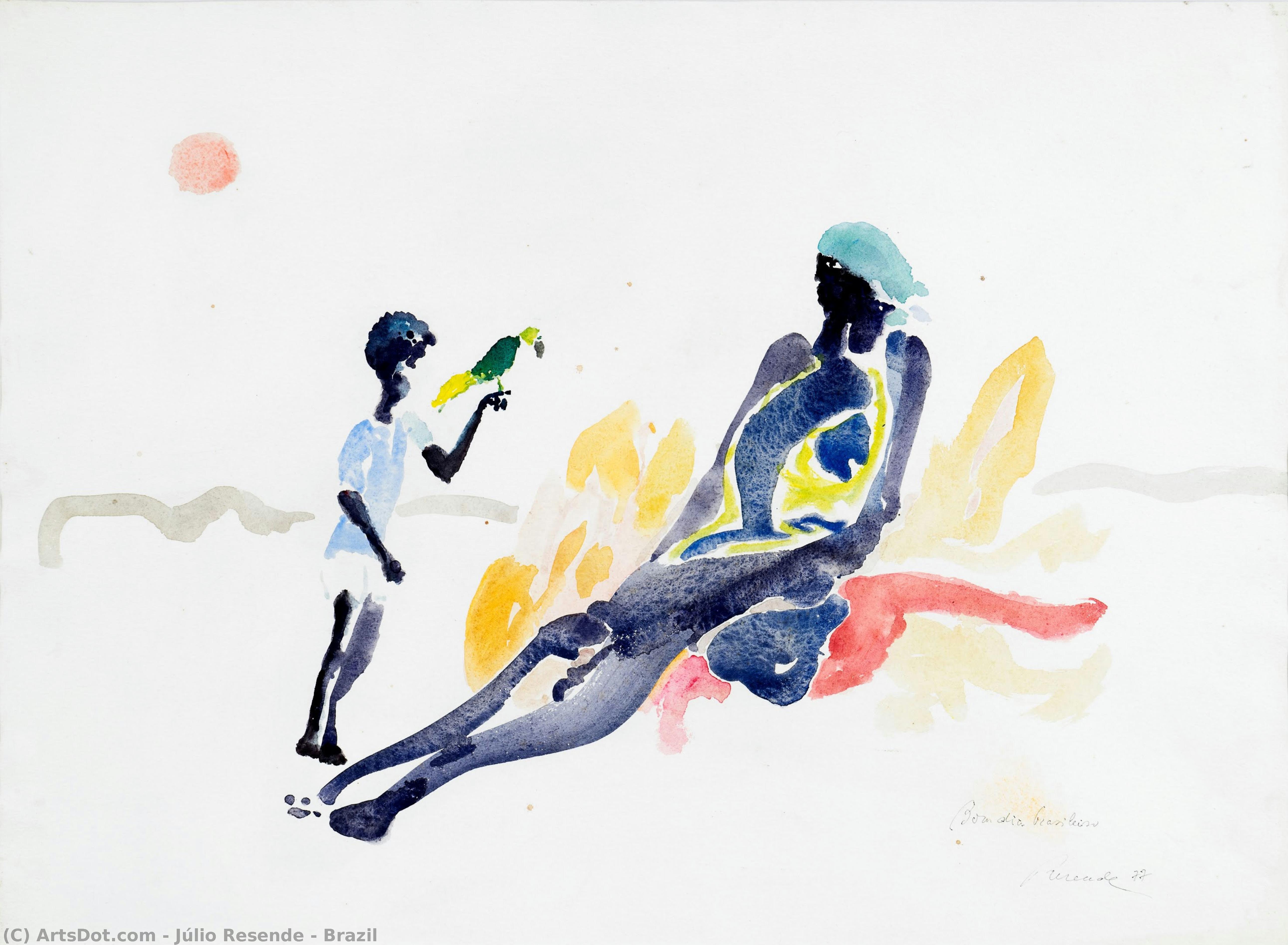
Of all the originals Júlio Resende left, the most famous is Brazil (1977), in the collection of the Rede Portuguesa de Arte Contemporânea a Norte, Porto. Close behind it come Untitled (1954) and Self-portrait (1947). Our catalog holds 17 works by Júlio Resende; the gallery has kept the 17 the world admires most, each shown with its date, its museum and its story.

1917 – 2011, Porto Modernism Most works: Rede Portuguesa de Arte Contemporânea a Norte

Júlio Resende's top 10 paintings: the gallery's choice

2
Untitled (1954) by Júlio Resende

Untitled

In this 1954 painting, a group of five figures is positioned in front of a solid red wall. The composition centers on these human forms, which are arranged in various states of repose and posture. One figure is seated, while the remaining four stand in a loose grouping. The figures possess distinct facial expressions and physical stances, creating a sense of collective presence. To the far left, a chair sits…

The Júlio Resende selection continues, 11 to 17

The subjects that held Júlio Resende's eye

The four subjects that come back most often in these originals, each with its finest example.

The museums that keep Júlio Resende's originals

The museum that holds the most of the paintings on this page.

Museum City Works by Júlio Resende Paintings from this list
Rede Portuguesa de Arte Contemporânea a Norte, PortoRede Portuguesa de Arte Contemporânea a Norte Porto 15 Brazil, Untitled, Self-portrait

Júlio Resende decade by decade: the original that defines each

Works per decade

Pick a decade to see the original that defines it.

Collectors' questions about Júlio Resende's paintings

Which work is Júlio Resende most famous for?Reveal the answer

Brazil (1977), Rede Portuguesa de Arte Contemporânea a Norte, Porto. Untitled (1954) and Self-portrait (1947) come next.

What age was Júlio Resende when Brazil was made?Reveal the answer

60 years old: Brazil dates from 1977, and Júlio Resende was born in 1917.

What are the ten most famous Júlio Resende paintings?Reveal the answer

Brazil, Untitled, Self-portrait, Paris, Man with a jug, Looking at the Sea, Ribeira, Brazil, Ribeira Negra and Ribeira. The ranking above gives each one's year and museum.

How many paintings did Júlio Resende leave?Reveal the answer

Our catalog holds 17 works by Júlio Resende, dated from 1947 to 1997.

In which museums do Júlio Resende's masterpieces hang?Reveal the answer

Mostly in Rede Portuguesa de Arte Contemporânea a Norte (Porto). The museum table above lists them all.

In which years did Júlio Resende paint the most famous works?Reveal the answer

In 1940s: 5 of the 17 works on this page were made then, Self-portrait among them.

What are the first and the last famous originals of Júlio Resende?Reveal the answer

On this page, the earliest is Self-portrait (1947) and the latest Solemnity (1997).

Which subjects did Júlio Resende choose most often?Reveal the answer

Figures (3), People (2) and Group portrait (2), across the 17 works on this page.

Which technique did Júlio Resende use most?Reveal the answer

Watercolor, for 4 of the 17 works on this page.

To which art movement does Júlio Resende belong?Reveal the answer

Modernism, judging by the originals on this page.

Which Júlio Resende works hang at the Rede Portuguesa de Arte Contemporânea a Norte?Reveal the answer

Brazil, Untitled and Self-portrait: the Rede Portuguesa de Arte Contemporânea a Norte, Porto holds 15 of the works on this page.

Júlio Resende: life and work

A Life Immersed in Art: The Journey of Júlio Resende

Júlio Martins da Silva Dias, known to the art world as Júlio Resende, emerged from the vibrant cultural landscape of Porto, Portugal, in 1917. Born into a family that nurtured creativity – his mother a music teacher and his father a trader with an appreciation for aesthetics – Resende’s artistic inclinations were evident from a young age. This early immersion in both disciplined study and expressive freedom would profoundly shape his trajectory as one of Portugal's most significant modern painters. Though initially drawn to commercial pursuits, the pull of art proved irresistible, leading him to the Silva Porto Academy under the tutelage of Alberto Silva, where he honed his foundational skills in drawing and painting. Even during these formative years, a pragmatic side persisted; Resende supported his artistic ambitions through illustration work for periodicals like *Jornal de Notícias* and *O Primeiro de Janeiro*, crafting comic strips such as *Matulinho e Matulão* that showcased his versatility and narrative flair. This early experience instilled in him not only technical proficiency but also a deep understanding of visual communication, qualities that would resonate throughout his career.

Forging a Unique Style: Influences and Artistic Development

Resende’s artistic evolution was marked by a relentless exploration of form and expression. A pivotal moment arrived with a scholarship to the Institute for Advanced Culture in 1947, enabling him to study in Paris – a crucible of modern art. There, at the Académie de Grande Chaumière and the Paris Academy of Fine Arts, he delved into fresco and engraving techniques, expanding his technical repertoire. The Parisian experience exposed him to the avant-garde movements reshaping the artistic landscape, particularly the powerful works of Picasso and Goya. These encounters ignited a fascination with abstractionism, yet Resende never fully abandoned figuration. Instead, he embarked on a path toward a distinctive style that gracefully navigated the space between representation and non-representation. His work became characterized by a lyrical quality, incorporating elements of Expressionism, Neo-Realism, Gesturalism, and Non-figuration – a syncretic approach reflecting his diverse influences and personal vision. Recurring themes emerged: the evocative power of the sea, the sun-drenched landscapes of Alentejo, and the lives of its people, all rendered with an emotional depth that resonated deeply with viewers.

Landmarks in a Celebrated Career: Major Works and Achievements

Throughout his career, Júlio Resende left an indelible mark on both the Portuguese artistic scene and beyond. Perhaps his most recognizable work is *Ribeira Negra*, a monumental tile panel adorning the area near the D. Luís I Bridge in Porto. This striking piece exemplifies his ability to integrate art into public spaces, transforming urban environments with its evocative imagery. Beyond this iconic creation, Resende’s ceramic panels grace significant architectural landmarks such as the Palace of Justice in Lisbon and Hospital de São João in Porto, demonstrating his mastery of diverse media. His talent garnered widespread recognition through numerous individual exhibitions held across Portugal, Spain, Belgium, Norway, and Brazil. The accolades followed: a Special Prize at the 1951 São Paulo Art Biennial, an Honorable Mention in 1959, and the prestigious Graphic Arts Prize in 1969 for his illustrations accompanying Vergílio Ferreira’s novel *Aparição*. Further honors included membership in the Belgian Royal Academy of Sciences, Letters and Fine Arts (1972) and the Comendador de Mérito Civil de España (1982), solidifying his international reputation.

A Lasting Legacy: Historical Significance and Enduring Influence

Júlio Resende occupies a crucial position in Portuguese art history, representing a pivotal transition from traditional styles to the burgeoning possibilities of modern abstraction. His work wasn’t merely an adoption of foreign trends; it was a thoughtful synthesis of diverse influences filtered through his own unique sensibility and deeply rooted connection to Portugal's cultural identity. He masterfully captured the social realities and landscapes of his time, offering poignant reflections on the human condition. Resende’s ability to seamlessly blend disparate artistic elements into a cohesive personal style inspired subsequent generations of artists, encouraging them to explore new avenues of expression. The Júlio Resende Foundation stands as a testament to his enduring legacy, preserving over two thousand drawings that offer invaluable insights into his creative process and the evolution of his vision. His work continues to be celebrated and exhibited, ensuring that his place as an important figure in Portuguese art remains secure for years to come. He was truly a painter who bridged worlds – between figuration and abstraction, tradition and modernity, Portugal and the international stage.