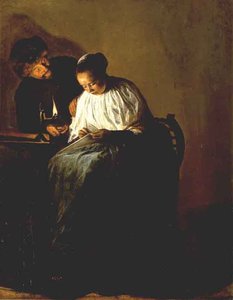
Portrait of Judith Leyster

Judith Leyster Paintings: The 61 Most Famous, Through a Gallery's Eye

Updated November 2026 · ranked by our popularity score (searches, visits and orders for each work) · 65 works by Judith Leyster in our catalogue

In short

To the gallery's eye, Judith Leyster's most famous painting is Young Flute Player (1635), whose original hangs in the Nationalmuseum, Stockholm. Boy Playing A Violin (1635) and Smiling boy holding grapes in his hat (1629) complete the trio every eye recognises. Of the 65 works by Judith Leyster in our catalog, the gallery presents the 61 most famous below, each original with its year, its museum and what makes it unique.

1609 – 1660, Haarlem Baroque Most works: Frans Hals Museum

The gallery's top 10 Judith Leyster paintings

1
Young Flute Player (1635) by Judith Leyster

Young Flute Player

1635 · Oil On Canvas · Nationalmuseum, Stockholm

Within the vibrant tapestry of the Dutch Golden Age, few paintings capture the delicate balance between observation and imagination quite like Judith Leyster's "Young Flute Player," completed around 1635. This captivating oil on canvas isn’t merely a portrait; it’s a fleeting glimpse into a world of youthful pleasure, artistic expression, and the subtle complexities of early modern life. The painting immediately draws the eye to its central figure – a…

2
Boy Playing A Violin (1635) by Judith Leyster

Boy Playing A Violin

1635 · Oil On Canvas · Virginia Museum of Fine Arts, Richmond

A young boy is positioned in a medium shot, oriented slightly off-center within the frame. He is depicted from the upper body upward, his head tilted with an upward gaze and his lips slightly parted. He wears a dark beret and a brown jacket characterized by a stark white collar. His hands are positioned upon a violin, which he holds against his body. The lighting originates from the upper left,…

3
Smiling boy holding grapes in his hat (1629) by Judith Leyster

Smiling boy holding grapes in his hat

1629 · Oil On Panel · Los Angeles County Museum of Art, Los Angeles

In this charming and lively Dutch Golden Age portrait, we encounter Smiling boy holding grapes in his hat, a work painted by Judith Leyster. Created in 1629, the piece captures a young boy in a moment of simple joy. The subject's expression and the presence of the fruit suggest a sense of abundance and youth, rendered with the characteristic warmth of the era.

4
A Card Player (1630) by Judith Leyster

A Card Player

1630 · Oil On Panel

is a Northern Renaissance oil on panel painting by Judith Leyster. Created about 1630, the work belongs to the genre of Tronie and is categorized under the theme of Games.

5
Young Man with a Cat (1635) by Judith Leyster

Young Man with a Cat

1635 · Oil On Panel

A young man sits in a soft, amber-lit space, his presence defined by the gentle weight of a small cat in his hands. The light enters from the upper left, brushing against the pale feathers of his hat and tracing the curve of his cheek. He is positioned slightly off-center, a choice that lends a sense of movement to his stillness. His expression is playful, caught in a fleeting second…

7
An Artist in Her Studio (1632) by Judith Leyster

An Artist in Her Studio

1632 · Oil On Canvas

An Artist in Her Studio is an oil painting by Judith Leyster, executed in 1632. This work belongs to the Dutch Golden Age, a period defined by a high degree of realism and technical precision in genre painting. The piece captures a lively scene within an artist's studio, presenting a moment of social and creative interaction.

8
The Lute Player (facing left) (1630) by Judith Leyster

The Lute Player (facing left)

1630 · Oil On Canvas · National Gallery of Ireland, Dublin City

The Lute Player (facing left) emerges from the shadows of the Dutch Golden Age, a moment frozen in time by the hand of Judith Leyster. Painted about 1630, this work captures a musician in a quiet, singular pause. The subject sits with a lute held across his chest, his presence defined by the stark contrast of a bright white ruff collar against a dark, somber background. He looks toward the…

9
Violinist with a skull and a music book (1633) by Judith Leyster

Violinist with a skull and a music book

1633 · Oil

In this oil on canvas, titled Violinist with a skull and a music book, we encounter a work from 1633 by the Dutch Golden Age painter Judith Leyster. The painting presents a young man immersed in his music, his figure captured in a moment of intense concentration. This specific piece reflects the artist's ability to handle complex subject matter with a direct, observational approach.

10
Round portrait of a boy with beret (1632) by Judith Leyster

Round portrait of a boy with beret

1632 · Oil On Panel · Nationalmuseum, Stockholm

Round portrait of a boy with beret by Judith Leyster utilizes a circular tondo composition to create an intimate, focused study of the subject. The young male figure is presented from the chest up, positioned slightly off-center to break the symmetry of the frame. He gazes toward the viewer with a direct, somewhat somber expression that establishes an immediate connection. A dark beret sits tilted upon his head, adding a…

Judith Leyster paintings, ranked 11 to 61

11Portrait of a boy with a cat (1630) by Judith LeysterPortrait of a boy with a cat1630 12A boy blowing bubbles (1630) by Judith LeysterA boy blowing bubbles1630 13Portrait of a Lutenist (1635) by Judith LeysterPortrait of a Lutenist1635 14Young flute player by lamplight (with two recorders on the wall) (1635) by Judith LeysterYoung flute player by lamplight (with two recorders on the wall)1635 15Lute player by lamplight (at full length) (1633) by Judith LeysterLute player by lamplight (at full length)1633 16Card players by lamplight (1633) by Judith LeysterCard players by lamplight1633 17Woman sewing by lamplight (1633) by Judith LeysterWoman sewing by lamplight1633 18Lute player (1629) by Judith LeysterLute player1629 19Merry Company (1630) by Judith LeysterMerry Company1630 20Cello player (1636) by Judith LeysterCello player1636 21Portrait of a girl seated (1650) by Judith LeysterPortrait of a girl seated1650 22Self portrait (1653) by Judith LeysterSelf portrait1653 23Portrait of painter (1680) by Judith LeysterPortrait of painter1680 24Flowers in a vase (1654) by Judith LeysterFlowers in a vase1654 25The proposition by Judith LeysterThe proposition 26Girl with a Lute (1631) by Judith LeysterGirl with a Lute1631 27The Jester (1625) by Judith LeysterThe Jester1625 28A man offers a young girl money (1631) by Judith LeysterA man offers a young girl money1631 29Jolly Toper (1629) by Judith LeysterJolly Toper1629 · Frans Halsmuseum 30Early Brabantson Tulip (folio 30) (1643) by Judith LeysterEarly Brabantson Tulip (folio 30)1643 · Frans Hals Museum 31Tulip (1643) by Judith LeysterTulip1643 32Serenade (1629) by Judith LeysterSerenade1629 · Rijksmuseum 33Young man encouraging a girl to smoke and drink by Judith LeysterYoung man encouraging a girl to smoke and drink 34man with guitar by Judith Leysterman with guitar 35Portrait of a woman half figure left by Judith LeysterPortrait of a woman half figure left 36A Youth with a Jug by Judith LeysterA Youth with a Jug 37A Boy and a Girl with a Cat and an Eel by Judith LeysterA Boy and a Girl with a Cat and an EelNational Gallery 38The Proposition (1631) by Judith LeysterThe Proposition1631 · Mauritshuis 39The Last Drop (1629) by Judith LeysterThe Last Drop1629 · Philadelphia Museum of Art 40A Game of Tric Trac (1630) by Judith LeysterA Game of Tric Trac1630 · Worcester Art Museum 41Self-Portrait (1635) by Judith LeysterSelf-Portrait1635 · National Gallery of Art 42The Serenade (1629) by Judith LeysterThe Serenade1629 · Rijksmuseum 43The Jolly Drinker (1629) by Judith LeysterThe Jolly Drinker1629 · Rijksmuseum 44Three Boys Merry-making (1629) by Judith LeysterThree Boys Merry-making1629 · Kunsthandel P. de Boer 45Unequal Love (1631) by Judith LeysterUnequal Love1631 · Galleria Nazionale d'Arte Antica 46Carousing Couple (1630) by Judith LeysterCarousing Couple1630 · The Louvre 47A Boy and a Girl with a Cat and an Eel by Judith LeysterA Boy and a Girl with a Cat and an EelNational Gallery 48Standing Cavalier (1630) by Judith LeysterStanding Cavalier1630 · Royal Collection 49Laughing Children with a Cat (1629) by Judith LeysterLaughing Children with a Cat1629 50David with the head of Goliath (1633) by Judith LeysterDavid with the head of Goliath1633 51interior with drinking people (1635) by Judith Leysterinterior with drinking people1635 52Early Brabantsson (folio 29) (1643) by Judith LeysterEarly Brabantsson (folio 29)1643 · Frans Hals Museum 53The Concert (1633) by Judith LeysterThe Concert1633 · National Museum of Women in the Arts 54Portrait of a Woman by Judith LeysterPortrait of a WomanFrans Hals Museum 55Jolly Toper by Judith LeysterJolly ToperGemäldegalerie 56Kannekijker a youth with a jug by Judith LeysterKannekijker a youth with a jug 57Still life by Judith LeysterStill life 58Two musicians (1629) by Judith LeysterTwo musicians1629 59A Game of Cards by Judith LeysterA Game of CardsMusée des Beaux-Arts de Rouen 60Girl with a Straw Hat (1635) by Judith LeysterGirl with a Straw Hat1635 61Young Boy in Profile (1630) by Judith LeysterYoung Boy in Profile1630 · National Gallery of Art

Judith Leyster's famous paintings, period by period

The subjects that held Judith Leyster's eye

The four subjects that come back most often in these originals, each with its finest example.

The museums that keep Judith Leyster's originals

The 8 museums that hold the most of the paintings on this page.

Museum City Works by Judith Leyster Paintings from this list
Frans Hals Museum, HarenFrans Hals Museum Haren 3 Early Brabantson Tulip (folio 30), Early Brabantsson (folio 29), Portrait of a Woman
Rijksmuseum, AmsterdamRijksmuseum Amsterdam 3 Serenade, The Serenade, The Jolly Drinker
Nationalmuseum, StockholmNationalmuseum Stockholm 2 Young Flute Player, Round portrait of a boy with beret
National Gallery, LondonNational Gallery London 2 A Boy and a Girl with a Cat and an Eel, A Boy and a Girl with a Cat and an Eel
National Gallery of Art, WashingtonNational Gallery of Art Washington 2 Self-Portrait, Young Boy in Profile
Virginia Museum of Fine Arts, RichmondVirginia Museum of Fine Arts Richmond 1 Boy Playing A Violin
Los Angeles County Museum of Art, Los AngelesLos Angeles County Museum of Art Los Angeles 1 Smiling boy holding grapes in his hat
Staatliche Kunsthalle Karlsruhe, CarlsruheStaatliche Kunsthalle Karlsruhe Carlsruhe 1 Laughing boy with wineglass

Judith Leyster, one signature painting per decade

Works per decade

Pick a decade to see the original that defines it.

Judith Leyster's paintings: the gallery answers

Which Judith Leyster painting is the most famous of all?Reveal the answer

Young Flute Player (1635), Nationalmuseum, Stockholm. Boy Playing A Violin (1635) and Smiling boy holding grapes in his hat (1629) come next.

How old was Judith Leyster on completing Young Flute Player?Reveal the answer

26 years old: Young Flute Player dates from 1635, and Judith Leyster was born in 1609.

Which are Judith Leyster's top 10 paintings?Reveal the answer

Young Flute Player, Boy Playing A Violin, Smiling boy holding grapes in his hat, A Card Player, Young Man with a Cat, Laughing boy with wineglass, An Artist in Her Studio, The Lute Player (facing left), Violinist with a skull and a music book and Round portrait of a boy with beret. The ranking above gives each one's year and museum.

How many works did Judith Leyster create?Reveal the answer

Our catalog holds 65 works by Judith Leyster, dated from 1625 to 1654.

Where do Judith Leyster's most famous originals hang?Reveal the answer

Mostly in Frans Hals Museum (Haren), Rijksmuseum (Amsterdam) and Nationalmuseum (Stockholm). The museum table above lists them all.

When did Judith Leyster create the most famous paintings?Reveal the answer

In 1630s: 30 of the 61 works on this page were made then, Young Flute Player among them.

Which are Judith Leyster's earliest and latest famous works?Reveal the answer

On this page, the earliest is The Jester (1625) and the latest Flowers in a vase (1654).

Which subjects did Judith Leyster return to most?Reveal the answer

Man (13), Boy (9) and Lute (7), across the 61 works on this page.

Which medium did Judith Leyster work in most?Reveal the answer

Oil On Canvas, for 19 of the 61 works on this page.

Which movement is Judith Leyster associated with?Reveal the answer

Baroque and Dutch golden age, judging by the originals on this page.

Which Judith Leyster originals does the Frans Hals Museum hold?Reveal the answer

Early Brabantson Tulip (folio 30), Early Brabantsson (folio 29) and Portrait of a Woman: the Frans Hals Museum, Haren holds 3 of the works on this page.

Judith Leyster: the artist

early life and training

judith jans leyster, a pioneering female painter, was born in july 1609 in haarlem, netherlands. she was the eighth child of jan willemsz leyster, a cloth maker who later became a brewer. while her training is not well-documented, it's believed that she learned painting from frans pietersz de grebber, a respected artist with a workshop in haarlem.

artistic career

leyster's first known signed works, serenade and jolly topper, date back to 1629 when she was just twenty years old. by 1633, she became a member of the haarlem guild of st. luke, making her one of the first female artists to be part of this prestigious organization.

notable works and collaborations

some of leyster's notable works include:
  • self-portrait (c. 1633), now at the national gallery of art, washington, d.c., which may have been her presentation piece to the guild.
  • two illustrations in a book about tulips from 1643, showcasing her versatility.
  • a portrait from 1652 and a still life from 1654, discovered in a private collection in the 21st century, demonstrate her enduring skill.
collaborations with jan miense molenaer: leyster married jan miense molenaer, a more prolific artist, in 1636. they worked together, sharing a studio in haarlem, and had five children.

legacy and rediscovery

despite being highly regarded by her contemporaries, leyster's work was largely forgotten after her death in 1660. it wasn't until 1893 that she was rediscovered, and scholars began to correctly attribute her works. today, her paintings are recognized as significant contributions to the dutch golden age.

conclusion

judith jans leyster's trailblazing career as a female painter in the 17th century netherlands has left an indelible mark on art history. her rediscovery and recognition serve as a testament to her enduring talent and the evolving perception of women in the art world. museum name: national gallery of art, washington, d.c.