Portrait of John Lavery

The 100 Most Famous John Lavery Paintings, Each One of a Kind

Updated October 2026 · ranked by our popularity score (searches, visits and orders for each work) · 610 works by John Lavery in our catalogue

In short

High Treason Trial of Roger Casement (1916) is the John Lavery painting that draws the most eyes; the original belongs to the Government Art Collection, London. After it, the eye goes to Anna Pavlova and The Right Honourable J. Ramsay Macdonald Addressing the House of Commons (1923). Among the 610 works of John Lavery in our catalog, these 100 are the most famous, each a unique original presented with its year, its museum and the reason it endures.

1856 – 1941, Belfast Impressionism Most works: Imperial War Museum

Top 10 paintings by John Lavery, through the gallery's eye

1
High Treason Trial of Roger Casement (1916) by John Lavery

High Treason Trial of Roger Casement

1916 · Acrylic On Canvas · Government Art Collection, London

A Dramatic Confrontation: Lavery’s ‘High Treason’ – Capturing the Tension of Justice Sir John Lavery's monumental painting, *High Treason: The Appeal of Roger Casement,* stands as a powerful testament to both artistic skill and historical significance. Completed in 1916 amidst the fervor of the First World War and the burgeoning Irish nationalist movement, it’s more than just a depiction of a courtroom scene; it's an encapsulation of the moral dilemmas…

2
Anna Pavlova by John Lavery

Anna Pavlova

Oil On Canvas · Kelvingrove Art Gallery and Museum, Glasgow

About the Artist Sir John Lavery was a renowned Irish painter, born in 1856 and passed away in 1941. He was known for his portraits, landscapes, and war paintings. Lavery studied at the Haldane Academy in Glasgow before moving to Paris where he became associated with the Impressionist movement. In 1888, he married Kathleen MacDermott, who later died of tuberculosis, leaving him devastated. He then married Hazel Martyn, an American…

3
The Right Honourable J. Ramsay Macdonald Addressing the House of Commons (1923) by John Lavery

The Right Honourable J. Ramsay Macdonald Addressing the House of Commons

1923 · Oil On Canvas · Glasgow Art Gallery and Museum, Glasgow

This captivating oil on canvas painting, "The Right Honourable J. Ramsay Macdonald Addressing the House of Commons," created by Sir John Lavery in 1923, offers a compelling glimpse into a pivotal moment in British political history. Currently residing at the Glasgow Art Gallery and Museum, this artwork transcends mere representation; it embodies the spirit of change and the dawn of a new era for the Labour Party.

4
Stephen Alley (1890) by John Lavery

Stephen Alley

1890 · Oil On Canvas · Glasgow Art Gallery and Museum, Glasgow

This striking black and white portrait captures the essence of late Victorian Britain through the masterful brushstrokes of Sir John Lavery. Executed around 1890, “Stephen Alley” exemplifies Lavery’s signature style – a blend of academic precision with subtle Impressionistic nuances that imbue the image with an atmosphere of quiet contemplation.

5
The Entrance, Dover Harbour, 1918 (1918) by John Lavery

The Entrance, Dover Harbour, 1918

1918 · Acrylic On Canvas · Imperial War Museum, London

The painting’s composition guides the viewer’s eye across a carefully orchestrated panorama. The prominent cliff face anchors the scene, providing a sense of stability against which the dynamic movement of the harbor is contrasted. Boats of varying sizes populate the middle ground, creating depth and suggesting the bustling activity of Dover Harbour—a hub for maritime trade and defense.

6
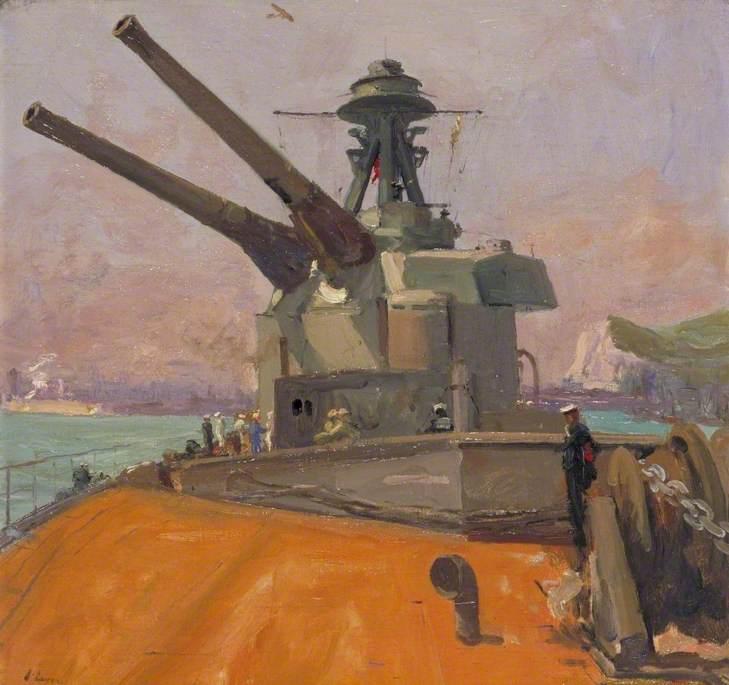
The Guns, HMS 'Terror' (1918) by John Lavery

The Guns, HMS 'Terror'

1918 · Acrylic On Canvas · Imperial War Museum, London

In the vast, churning expanse of the North Sea, Sir John Lavery’s 1918 masterpiece, “The Guns, HMS 'Terror'”, emerges as a profound testament to human fortitude. This monumental oil on canvas does far more than document a vessel of war; it captures the very soul of British naval endurance during the harrowing years of World War I. As the eye meets the canvas, one is immediately struck by the sheer…

7
A Quiet Day in the Studio (1883) by John Lavery

A Quiet Day in the Studio

1883 · Oil On Canvas · Kelvingrove Art Gallery and Museum, Glasgow

Sir John Lavery's "A Quiet Day in the Studio," painted in 1883, isn’t merely a depiction of a woman reading; it’s a meticulously crafted tableau of domesticity and artistic contemplation, imbued with the subtle social currents of Edwardian Britain. The painting immediately draws the viewer into a space of profound tranquility – a cozy sanctuary centered around a crackling fireplace and bathed in the warm glow of afternoon light. Lavery…

8
Mrs Francis Powell (sketch) (1889) by John Lavery

Mrs Francis Powell (sketch)

1889 · Pastel

Mrs Francis Powell (sketch) is a portrait study by Sir John Lavery, executed in 1889. The work captures a woman presented in formal Victorian attire, including a long dress with decorative details and an elaborate hat. The subject is positioned in a full-length pose, looking directly toward the viewer.

9
Eileen, Her First Communion (1901) by John Lavery

Eileen, Her First Communion

1901 · Oil On Panel

Sir John Lavery’s “Eileen, Her First Communion,” painted in 1901, is more than just a portrait; it's a delicately preserved moment of childhood grace and religious significance. Housed within the walls of the Ulster Museum in Ireland, this oil on panel work offers a profound glimpse into Edwardian society and the artist’s remarkable ability to capture the very essence of his subjects – particularly their vulnerability and quiet dignity.

10
A Moorish Dance (1892) by John Lavery

A Moorish Dance

1892 · Oil On Canvas

A Moorish Dance is an artwork by John Lavery. Created about 1892, this piece captures a specific moment of movement and atmosphere. The subject matter focuses on a Moorish dance, likely depicting a performance or a celebration occurring within an interior space.

John Lavery's famous paintings, numbers 11 to 100

11Leith (1917) by John LaveryLeith1917 · Imperial War Museum 12Idonia in Morocco The Equestrian Lady (1890) by John LaveryIdonia in Morocco The Equestrian Lady1890 13James Nicol, City Chamberlain, Glasgow (sketch) (1889) by John LaveryJames Nicol, City Chamberlain, Glasgow (sketch)1889 14The End (also known as Admiral Beatty Reading the Terms of the Surrender of the German Navy) (1918) by John LaveryThe End (also known as Admiral Beatty Reading the Terms of the Surrender of the German Navy)1918 · Imperial War Museum 15Maidenhead Regatta (1932) by John LaveryMaidenhead Regatta1932 16David Richard Beatty, 1st Earl Beatty (1917) by John LaveryDavid Richard Beatty, 1st Earl Beatty1917 · National Portrait Gallery 17The Twelfth of July in Portadown (1928) by John LaveryThe Twelfth of July in Portadown1928 18Eileen in Green (Portrait of Eileen Lavery, later Lady Sempill) by John LaveryEileen in Green (Portrait of Eileen Lavery, later Lady Sempill) 19Portrait of a Young Woman by John LaveryPortrait of a Young Woman 20King George V, Accompanied by Queen Mary, at the Opening of the Modern Foreign and Sargent Galleries (1926) by John LaveryKing George V, Accompanied by Queen Mary, at the Opening of the Modern Foreign and Sargent Galleries1926 21In Morocco (1910) by John LaveryIn Morocco1910 · National Gallery of Victoria 22David Lloyd George (1863–1945) (1934) by John LaveryDavid Lloyd George (1863–1945)1934 · National Library of Wales 23Return from the Market (1884) by John LaveryReturn from the Market1884 · National Gallery of Ireland 24The Dutch Coffee House, Glasgow International Exhibition (1888) by John LaveryThe Dutch Coffee House, Glasgow International Exhibition1888 · Scottish National Gallery 25Lady in black (1894) by John LaveryLady in black1894 · Alte Nationalgalerie 26Dr Max Porges (1932) by John LaveryDr Max Porges1932 27The Golf Course, North Berwick by John LaveryThe Golf Course, North Berwick 28Spring in a Riviera Garden (1921) by John LaverySpring in a Riviera Garden1921 29Opening of the Lord Duveen Annexe to the National Portrait Gallery (1933) by John LaveryOpening of the Lord Duveen Annexe to the National Portrait Gallery1933 · National Portrait Gallery 30Sir Charles Stewart Henry Vane-Tempest-Stewart (1924) by John LaverySir Charles Stewart Henry Vane-Tempest-Stewart1924 · Mount Stewart 31Norwegian Cargo Boats by John LaveryNorwegian Cargo Boats 32State Visit of Her Majesty, Queen Victoria, to the Glasgow International Exhibition, 1888 (1890) by John LaveryState Visit of Her Majesty, Queen Victoria, to the Glasgow International Exhibition, 18881890 33Hazel in black and gold (1911) by John LaveryHazel in black and gold1911 · Laing Art Gallery 34Sir Charles Stewart Henry Vane-Tempest-Stewart (1878–1949), 7th Marquess of Londonderry, KG, MP (1924) by John LaverySir Charles Stewart Henry Vane-Tempest-Stewart (1878–1949), 7th Marquess of Londonderry, KG, MP1924 · Mount Stewart 35Miss Rosemary Hope by John LaveryMiss Rosemary Hope 36'Played!' by John Lavery'Played!' 37A Family Group by John LaveryA Family Group 38Edward Knoblock (1930) by John LaveryEdward Knoblock1930 39Alfred Harmsworth, 1st Viscount Northcliffe (1921) by John LaveryAlfred Harmsworth, 1st Viscount Northcliffe1921 · National Portrait Gallery 40Loch Katrine (1913) by John LaveryLoch Katrine1913 · Scottish National Gallery 41Sir Lionel Henry Cust (1912) by John LaverySir Lionel Henry Cust1912 · National Portrait Gallery 42Cap d'Ail by John LaveryCap d'Ail 43Gaines Ruger Donoho (1883) by John LaveryGaines Ruger Donoho1883 44Fishing by the Grez at Loing (1884) by John LaveryFishing by the Grez at Loing1884 45The Tennis Party (1885) by John LaveryThe Tennis Party1885 46A Grey Summer's Day (1883) by John LaveryA Grey Summer's Day1883 47La Laveuse (1883) by John LaveryLa Laveuse1883 48The Hammock (1884) by John LaveryThe Hammock1884 49George U. Baird (1885) by John LaveryGeorge U. Baird1885 50The Hammock (1884) by John LaveryThe Hammock1884 51Queen Mary's Army Auxiliary Corps Cookhouse, Rouxmesnil (1919) by John LaveryQueen Mary's Army Auxiliary Corps Cookhouse, Rouxmesnil1919 52Edward Arthur Walton, 1860 - 1922. Artist (With his fiancee Helen Law or Henderson, 1859 - 1945, later Mrs Edward Arthur Walton, as Hokusai and the Butterfly) (1889) by John LaveryEdward Arthur Walton, 1860 - 1922. Artist (With his fiancee Helen Law or Henderson, 1859 - 1945, later Mrs Edward Arthur Walton, as Hokusai and the Butterfly)1889 · Scottish National Gallery 53A French Girl (1887) by John LaveryA French Girl1887 54John S. Templeton (sketch) (1889) by John LaveryJohn S. Templeton (sketch)1889 55James Muir (sketch) (1889) by John LaveryJames Muir (sketch)1889 56The Earl of Haddington (sketch) (1889) by John LaveryThe Earl of Haddington (sketch)1889 57Harry Cheyne (sketch) (1890) by John LaveryHarry Cheyne (sketch)1890 58James Clark (sketch) (1890) by John LaveryJames Clark (sketch)1890 59Mrs Macleod (sketch) (1889) by John LaveryMrs Macleod (sketch)1889 60Miss Bain (sketch) (1890) by John LaveryMiss Bain (sketch)1890 61James B. Russell (sketch) (1889) by John LaveryJames B. Russell (sketch)1889 62Harry Younger (sketch) (1889) by John LaveryHarry Younger (sketch)1889 63John A. Campbell (sketch) (1890) by John LaveryJohn A. Campbell (sketch)1890 64Hugh Brechin (sketch) (1889) by John LaveryHugh Brechin (sketch)1889 65Major General Kirkland (sketch) (1890) by John LaveryMajor General Kirkland (sketch)1890 66Mrs Stewart Clark (sketch) (1889) by John LaveryMrs Stewart Clark (sketch)1889 67Miss Shaw Stewart (sketch) (1890) by John LaveryMiss Shaw Stewart (sketch)1890 68Lady's Head (1890) by John LaveryLady's Head1890 69The Earl of Lindsay (sketch) (1889) by John LaveryThe Earl of Lindsay (sketch)1889 70Lady King (sketch) (1890) by John LaveryLady King (sketch)1890 71J. L. Mitchell (sketch) (1889) by John LaveryJ. L. Mitchell (sketch)1889 72James Nicol, City Chamberlain, Glasgow (sketch) (1889) by John LaveryJames Nicol, City Chamberlain, Glasgow (sketch)1889 73From the Verandah (1888) by John LaveryFrom the Verandah1888 74John Carrick, City Architect (sketch) (1890) by John LaveryJohn Carrick, City Architect (sketch)1890 75Henry Cook (sketch) (1889) by John LaveryHenry Cook (sketch)1889 76Duncan McPherson (sketch) (1889) by John LaveryDuncan McPherson (sketch)1889 77John Neil (sketch) (1889) by John LaveryJohn Neil (sketch)1889 78Mrs Cunningham and Mrs Wedderspoon (sketch) (1890) by John LaveryMrs Cunningham and Mrs Wedderspoon (sketch)1890 79J. F. X. King (sketch) (1889) by John LaveryJ. F. X. King (sketch)1889 80HRH the Grand Duke of Hesse (sketch) (1889) by John LaveryHRH the Grand Duke of Hesse (sketch)1889 81The Duke of Montrose (sketch) (1890) by John LaveryThe Duke of Montrose (sketch)1890 82Lady Octavia Shaw Stewart (sketch) (1889) by John LaveryLady Octavia Shaw Stewart (sketch)1889 83The Honourable Mrs Maxwell Scott (sketch) (1889) by John LaveryThe Honourable Mrs Maxwell Scott (sketch)1889 84John Burns, Provost of Forres (sketch) (1890) by John LaveryJohn Burns, Provost of Forres (sketch)1890 85Mrs John Shearer (sketch) (1889) by John LaveryMrs John Shearer (sketch)1889 86J. Wyllie Guild (sketch) (1889) by John LaveryJ. Wyllie Guild (sketch)1889 87G. Millar Cunningham, CE (sketch) (1890) by John LaveryG. Millar Cunningham, CE (sketch)1890 88The Honourable J. C. Maxwell Scott (1889) by John LaveryThe Honourable J. C. Maxwell Scott1889 89James Murray (sketch) (1889) by John LaveryJames Murray (sketch)1889 90James Paton (sketch) (1890) by John LaveryJames Paton (sketch)1890 91Mrs Sargeant (sketch) (1890) by John LaveryMrs Sargeant (sketch)1890 92In the Studio (1890) by John LaveryIn the Studio1890 93El Espada (1892) by John LaveryEl Espada1892 94The White City (1893) by John LaveryThe White City1893 95Father and Daughter (1898) by John LaveryFather and Daughter1898 · Musée d'Orsay 96Harmony in Brown, Portrait of R B Cunninghame Graham (1893) by John LaveryHarmony in Brown, Portrait of R B Cunninghame Graham1893 97Mrs. Fitzroy Bell (1894) by John LaveryMrs. Fitzroy Bell1894 98Edward Aubrey Hunt (1894) by John LaveryEdward Aubrey Hunt1894 · The Burton Art Gallery And Museum 99Miss Mary Burrell (1894) by John LaveryMiss Mary Burrell1894 100A Garden in France (1898) by John LaveryA Garden in France1898

John Lavery's famous paintings, period by period

The subjects that held John Lavery's eye

The four subjects that come back most often in these originals, each with its finest example.

The museums that keep John Lavery's originals

The 8 museums that hold the most of the paintings on this page.

Museum City Works by John Lavery Paintings from this list
Imperial War Museum, LondonImperial War Museum London 22 The Entrance, Dover Harbour, 1918, The Guns, HMS 'Terror', Leith
National Portrait Gallery, LondonNational Portrait Gallery London 12 David Richard Beatty, 1st Earl Beatty, Opening of the Lord Duveen Annexe to the National Portrait Gallery, Alfred Harmsworth, 1st Viscount Northcliffe
Scottish National Gallery, EdinburghScottish National Gallery Edinburgh 5 The Dutch Coffee House, Glasgow International Exhibition, Loch Katrine, Edward Arthur Walton, 1860 - 1922. Artist (With his fiancee Helen Law or Henderson, 1859 - 1945, later Mrs Edward Arthur Walton, as Hokusai and the Butterfly)
Glasgow Art Gallery and Museum, GlasgowGlasgow Art Gallery and Museum Glasgow 10 The Right Honourable J. Ramsay Macdonald Addressing the House of Commons, Stephen Alley
Kelvingrove Art Gallery and Museum, GlasgowKelvingrove Art Gallery and Museum Glasgow 4 Anna Pavlova, A Quiet Day in the Studio
Mount Stewart, NewtownardsMount Stewart Newtownards 4 Sir Charles Stewart Henry Vane-Tempest-Stewart, Sir Charles Stewart Henry Vane-Tempest-Stewart (1878–1949), 7th Marquess of Londonderry, KG, MP
National Gallery of Ireland, Dublin CityNational Gallery of Ireland Dublin City 15 Return from the Market
Government Art Collection, LondonGovernment Art Collection London 1 High Treason Trial of Roger Casement

John Lavery across the decades: one unique original for each

Works per decade

Pick a decade to see the original that defines it.

John Lavery's paintings: questions for the gallery

What is the single most famous work of John Lavery?Reveal the answer

High Treason Trial of Roger Casement (1916), Government Art Collection, London. Anna Pavlova and The Right Honourable J. Ramsay Macdonald Addressing the House of Commons (1923) come next.

At what age did John Lavery create High Treason Trial of Roger Casement?Reveal the answer

60 years old: High Treason Trial of Roger Casement dates from 1916, and John Lavery was born in 1856.

Which ten paintings by John Lavery are the most famous?Reveal the answer

High Treason Trial of Roger Casement, Anna Pavlova, The Right Honourable J. Ramsay Macdonald Addressing the House of Commons, Stephen Alley, The Entrance, Dover Harbour, 1918, The Guns, HMS 'Terror', A Quiet Day in the Studio, Mrs Francis Powell (sketch), Eileen, Her First Communion and A Moorish Dance. The ranking above gives each one's year and museum.

How many works by John Lavery are known?Reveal the answer

Our catalog holds 610 works by John Lavery, dated from 1883 to 1934.

Where can the most famous John Lavery originals be seen?Reveal the answer

Mostly in Imperial War Museum (London), National Portrait Gallery (London) and Scottish National Gallery (Edinburgh). The museum table above lists them all.

During which period did John Lavery create the best-known paintings?Reveal the answer

In 1880s: 38 of the 100 works on this page were made then, A Quiet Day in the Studio among them.

Which famous John Lavery painting is the earliest, and which the latest?Reveal the answer

On this page, the earliest is A Quiet Day in the Studio (1883) and the latest David Lloyd George (1863–1945) (1934).

What subjects did John Lavery favour?Reveal the answer

Portrait (10), Portraiture (7) and Victorian era (7), across the 100 works on this page.

What materials did John Lavery paint with most?Reveal the answer

Oil On Canvas, for 22 of the 100 works on this page.

Which movement does the work of John Lavery belong to?Reveal the answer

Impressionism, judging by the originals on this page.

What John Lavery originals can I see at the Imperial War Museum?Reveal the answer

The Entrance, Dover Harbour, 1918, The Guns, HMS 'Terror' and Leith: the Imperial War Museum, London holds 4 of the works on this page.

Where can I order a hand-painted John Lavery reproduction?Reveal the answer

Yes, as a reproduction: the original stays in its museum, but any painting on this page can be painted by hand for you, made to order one at a time, from the painting's own page.

John Lavery: a portrait of the artist

Early Life, Family and Training

Sir John Lavery was born in inner North Belfast on 20 March 1856. He was the son of Henry Lavery and Margaret Lavery, née Donnelly. His childhood was marked by a sudden and heavy loss when his father, Henry, drowned in April 1859. The accident occurred during the sinking of the packet ship Pomona off the coast of Co. Wexford, Ireland, while the vessel was en route to New York. This tragedy left the young boy to be raised in the wake of such a sudden departure.

His path toward art began in Scotland. During the 1870s, he attended the Haldane Academy in Glasgow, where he first began to develop his technical skills. This training provided the foundation for a life spent observing the world through a lens of light and form. After his time in Glasgow, he moved to London to study at Heatherley's School. This period of study was followed by a move to the heart of European art, where he spent time at the Académie Julian in Paris during the early 1880s. These years of formal instruction in different cities helped shape the way he would eventually approach his subjects.

A Career in Glasgow and London

After his early training, Lavery found himself deeply connected to the artistic energy of Scotland. He became associated with the Glasgow School and the Glasgow Boys, groups that were shaping the direction of art in the region. During this time, he worked as a photographer's assistant, a job that helped him develop a practical understanding of how light interacts with a subject. This period of his life was defined by a growing reputation and a steady connection to the creative circles of Glasgow.

A significant shift occurred in 1888 when he received a major commission to paint Queen Victoria's state visit to the Glasgow International Exhibition. This task changed the course of his professional life. The success of the commission made him a sought-after painter for high society, and he moved to London shortly after. In the capital, his ability to capture the people of the upper classes helped him secure a place among the most prominent artists of the era.

Patrons, Commissions and Notable Subjects

Success in the art world often depends on the people who believe in a painter's vision. For Lavery, this support came from influential figures like William Burrell, a wealthy shipowner who became a faithful patron of Scottish artists. This connection helped sustain his career as he moved through the social circles of London. His ability to capture the likeness of the era's most powerful figures led him to paint men who shaped history, including Winston Churchill, H. H. Asquith, and Lord Derby. He also painted political leaders such as John Redmond and Edward Carson, documenting the faces of a changing political landscape.

His relationship with the Asquith family allowed him to move within their private, privileged world, providing a glimpse into the lives of the political elite. Beyond these public figures, his most constant subject was his wife, Hazel. He painted her in more than 400 works, capturing her presence throughout many years of his life. This deep familiarity with his sitter allowed for a level of intimacy that few other subjects received.

When the First World War broke out, his role shifted from the drawing rooms of the upper class to the official documentation of a nation in conflict. He was appointed an official war artist, a commission that tasked him with recording the realities of the war effort. While his health and a serious accident prevented him from reaching the front lines, he focused his attention on the logistical and technological aspects of the war within Britain.

Technique and Artistic Style

Lavery’s brushwork reveals a man deeply attuned to the shifting qualities of light and color. His approach was shaped by the French en plein air movement, a practice that encouraged artists to step out of the studio and face the elements directly. This connection to the natural world allowed him to capture the immediate, fleeting effects of atmosphere. He was particularly influenced by James McNeill Whistler, adopting a sense of tonal harmony that brought a refined, quiet elegance to his compositions. Rather than following a single school of thought, he found a way to weave together the broken color of Impressionism and the structural sensibilities of Post-Impressionism into a style that was entirely his own.

While his technical skill was evident in his landscapes, his true strength lay in his ability to look past a sitter's social standing to find their actual character. He did not merely record a face; he sought to interpret the person within. This psychological depth made him a favorite among the elite, as he could balance a sense of modern life with a meticulous attention to detail. His portraits often feel lived-in, capturing a specific moment of personality rather than a stiff, formal pose. Whether painting a quiet interior or a bustling social scene, he maintained a focus on how light defines the human form and the space around it.

Wartime Depictions and Later Years

The outbreak of the First World War brought a shift in Lavery's focus. He was appointed as an official war artist, tasked with documenting the realities of the conflict. While his health and a serious car accident prevented him from serving on the Western Front, he found ways to record the era's massive logistical and technological shifts. He turned his attention to the home front, capturing the atmosphere of life in Britain during the struggle. His work from this period includes depictions of aeroplanes, airships, and the movement of ships, offering a perspective on the war that focused on the machinery and the people supporting the effort.

His interest in the sea was particularly evident in his naval pictures. He spent time painting the fleet at Scapa Flow, documenting the presence of the navy in those waters. These works provided a record of the naval strength and the quiet, heavy presence of the fleet during such a turbulent time. Even as he navigated the complexities of the Irish War of Independence and the Civil War through his social connections and his home, his brush remained focused on the changing world around him.

In his final years, Lavery lived away from the busy social circles of London. He passed away on 10 January 1941 at Rossenarra House in Kilmoganny, County Kilkenny. He was interred in Putney Vale Cemetery.

Legacy and National Significance

By the time of his death, Lavery had become a central figure in the British art scene. His standing was cemented through formal recognition, including his election to the Royal Academy and a knighthood in 1921. These honors reflected a career that had moved from the studios of Glasgow and Paris to the very heart of London's social and political circles.

His connection to his roots remained a quiet but powerful force throughout his life. This was most visibly seen in his influence on Irish identity; an allegorical figure of Ireland, which he had painted, appeared on Irish banknotes from 1928 until 1975. It is a rare thing for an artist's vision to move from the canvas into the pockets of a nation, becoming a part of the everyday landscape of a country.

His influence can still be traced through the collections that hold his work, from the National Portrait Gallery in London to the galleries in Glasgow and Edinburgh. His ability to document the shifting faces of his era ensures his place in the history of the period.

Where to See the Works Today

Finding his paintings today often means visiting the institutions that helped shape his career. In London, the National Portrait Gallery holds several of his studies and portraits, capturing the faces of the people who moved through his social circles. The Imperial War Museum also preserves his perspective on the conflict, keeping his depictions of the home front and naval scenes within its collections.

His connection to Scotland remains visible through the collections in Glasgow and Edinburgh. The Glasgow Art Gallery and Museum houses many of his early works, including pieces from his time with the Glasgow School. In Edinburgh, the Scottish National Gallery holds works that reflect his technical skill and his ability to handle light. You can also find his paintings in the Birmingham Museum and Art Gallery, which provides a glimpse into the breadth of his output.

All 610 works by John Lavery →