Portrait of Jim Dine

The 61 Most Famous Jim Dine Paintings, Each One of a Kind

Updated November 2026 · ranked by our popularity score (searches, visits and orders for each work) · 65 works by Jim Dine in our catalogue

In short

Untitled (436) is the Jim Dine painting that draws the most eyes. After it, the eye goes to Braid and The woodcut bathrobe. Among the 65 works of Jim Dine in our catalog, these 61 are the most famous, each a unique original presented with its year, its museum and the reason it endures.

born 1935, Cincinnati Pop art Most works: Metropolitan Museum of Art

Top 10 paintings by Jim Dine, through the gallery's eye

1
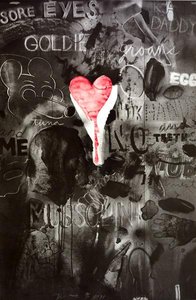
Untitled (436) by Jim Dine

Untitled (436)

Mixed Media

Exploring the Fusion of Form and Materiality This captivating mixed media artwork masterfully blends abstract expressionism with assemblage techniques, creating a layered composition that invites viewers into a world of fragmented identity and human emotion. Through the innovative use of everyday objects—shoes, fabric, and drawn lines—the artist constructs a loosely humanoid figure that embodies both vulnerability and resilience. The piece’s tactile richness and dynamic arrangement evoke a visceral response, making…

2
Braid by Jim Dine

Braid

Etching

Captivating Subject and Artistic Focus This exquisite pencil drawing captures the intricate beauty of a single braid of hair, transforming an everyday object into a compelling work of art. The artist’s meticulous attention to detail highlights the delicate textures, subtle curves, and natural imperfections of the hair, inviting viewers to appreciate the craftsmanship involved. The composition’s straightforward vertical orientation draws the eye along the length of the braid, emphasizing its…

3
The woodcut bathrobe by Jim Dine

The woodcut bathrobe

Colored Pencils

Subject and Composition This captivating artwork presents a stylized, abstract depiction of a figure, likely a woman, dressed in a flowing, colorful garment. The composition emphasizes geometric shapes and bold outlines, creating a rhythmic and harmonious visual experience. The figure’s frontal stance, combined with overlapping shapes, invites viewers to explore the interplay between form and color, evoking a sense of movement and elegance. The subject’s simplified yet expressive form captures…

4
palette II by Jim Dine

palette II

Digital Illustration

Exploring the Intersection of Tradition and Modernity This captivating artwork presents a fresh, abstract reinterpretation of the artist’s palette, a timeless symbol of creativity and artistic process. Through a vibrant interplay of colors and textures, it invites viewers into a dynamic visual dialogue that celebrates both the heritage of traditional art tools and the innovative spirit of contemporary expression. The piece’s central motif, a stylized artist’s palette, is reimagined with…

5
Five Feet of Colorful Tools by Jim Dine

Five Feet of Colorful Tools

Oil On Canvas

Vibrant Celebration of Everyday Objects Immerse yourself in a striking visual dialogue that elevates the mundane to the extraordinary. This artwork features an array of colorful tools, primarily hammers, meticulously arranged along the top of a vast, blank canvas. The composition transforms familiar, utilitarian objects into a lively tapestry of color and form, inviting viewers to reconsider the beauty and significance of everyday craftsmanship. The playful yet chaotic arrangement captures…

6
Two Thieves, One Liar by Jim Dine

Two Thieves, One Liar

Sculpture · Museum Folkwang, Essen

To stand before Jim Dine’s "Two Thieves, One Liar" is to encounter not merely a sculpture, but a moment suspended in time—a tableau vivant rendered in weathered wood and implied narrative. This piece draws the viewer into an intimate, almost conspiratorial space, where three distinct figures—a man in formal attire, a child radiating youthful energy, and a watchful cat—are bound together by an unspoken drama. Dine, whose career has spanned…

7
Four hearts by Jim Dine

Four hearts

Screenprint

Four hearts is a Pop Art paper drawing by Jim Dine. Created in 1969, this screenprint on paper captures a specific moment in the artist's evolution. The work focuses on the shape of the heart, a recurring motif that Dine has explored through various media. Here, the form is distilled into a graphic language of color and line.

8
Three Red Spanish Venuses (1997) by Jim Dine

Three Red Spanish Venuses

1997 · Sculpture · Guggenheim Museum Bilbao, Bilbao

In the heart of Bilbao’s Guggenheim Museum, where the light dances through avant-garde architecture, stands a monumental presence that commands both awe and introspection. Jim Dine’s Three Red Spanish Venuses is not merely a sculpture; it is a visceral encounter with the ghosts of classical beauty reimagined for the contemporary era. Created in 1997, this striking series of three female torsos erupts from the museum's atrium in a bold, saturated…

Jim Dine's famous paintings, numbers 11 to 61

Jim Dine's famous paintings, period by period

The subjects that held Jim Dine's eye

The four subjects that come back most often in these originals, each with its finest example.

The museums that keep Jim Dine's originals

The 8 museums that hold the most of the paintings on this page.

Museum City Works by Jim Dine Paintings from this list
Metropolitan Museum of Art, New YorkMetropolitan Museum of Art New York 3 Blond Hair, Walla Walla Robe, Study for "Garrity Necklace, Number 1"
Museum Folkwang, EssenMuseum Folkwang Essen 2 Two Thieves, One Liar, Youth and the Maiden
San Francisco Museum of Modern Art, San FranciscoSan Francisco Museum of Modern Art San Francisco 2 Hammer Noises, Blue Clamp
Borusan Contemporary, IstanbulBorusan Contemporary Istanbul 2 Yolk 1417, Bouquet
Guggenheim Museum Bilbao, BilbaoGuggenheim Museum Bilbao Bilbao 1 Three Red Spanish Venuses
Israel Museum, JerusalemIsrael Museum Jerusalem 1 Tiger
The Phillips Collection, Washington, D.C.The Phillips Collection Washington, D.C. 1 second phase chief
Museum Boijmans Van Beuningen, RotterdamMuseum Boijmans Van Beuningen Rotterdam 1 Francis Wyndham

Jim Dine across the decades: one unique original for each

Works per decade

Pick a decade to see the original that defines it.

Jim Dine's paintings: questions for the gallery

What is the single most famous work of Jim Dine?Reveal the answer

Untitled (436). Braid and The woodcut bathrobe come next.

Which ten paintings by Jim Dine are the most famous?Reveal the answer

Untitled (436), Braid, The woodcut bathrobe, palette II, Five Feet of Colorful Tools, Two Thieves, One Liar, Four hearts, Three Red Spanish Venuses, Tiger and Welcome home rare birds. The ranking above gives each one's year and museum.

How many works by Jim Dine are known?Reveal the answer

Our catalog holds 65 works by Jim Dine, dated from 1961 to 1997.

Where can the most famous Jim Dine originals be seen?Reveal the answer

Mostly in Metropolitan Museum of Art (New York), Museum Folkwang (Essen) and San Francisco Museum of Modern Art (San Francisco). The museum table above lists them all.

During which period did Jim Dine create the best-known paintings?Reveal the answer

In 1960s: 9 of the 61 works on this page were made then, Tiger among them.

Which famous Jim Dine painting is the earliest, and which the latest?Reveal the answer

On this page, the earliest is Tiger (1961) and the latest Three Red Spanish Venuses (1997).

What subjects did Jim Dine favour?Reveal the answer

Everyday objects (3), Contemporary decor (3) and Symbolic imagery (2), across the 61 works on this page.

What materials did Jim Dine paint with most?Reveal the answer

Sculpture, for 2 of the 61 works on this page.

Which movement does the work of Jim Dine belong to?Reveal the answer

Pop art, judging by the originals on this page.

What Jim Dine originals can I see at the Metropolitan Museum of Art?Reveal the answer

Blond Hair, Walla Walla Robe and Study for "Garrity Necklace, Number 1": the Metropolitan Museum of Art, New York holds 3 of the works on this page.

Jim Dine: a portrait of the artist

Early Life and Artistic Foundations

Jim Dine, born in Cincinnati, Ohio, in 1935, emerged as a pivotal figure bridging the gap between Abstract Expressionism and the burgeoning Pop Art movement. His formative years were steeped in artistic exploration, beginning with evening classes at the Art Academy of Cincinnati under the tutelage of Paul Chidlaw – an experience that instilled within him a deep appreciation for draftsmanship and direct observation. This early training was further solidified by his Bachelor of Fine Arts degree from Ohio University in 1957, laying the groundwork for a career defined by its restless innovation and deeply personal iconography.

Dine’s artistic sensibility wasn't solely shaped by formal education; it was profoundly influenced by his upbringing. The sights and textures of his grandfather’s hardware store – the tools, the materials, the very atmosphere of practical utility – would later become recurring motifs in his work, imbued with a poignant sense of memory and personal narrative. These weren’t merely objects to be depicted, but vessels carrying echoes of childhood experience and familial connection.

The Rise of Happenings and Pop Art Pioneer

By the late 1950s, Dine had relocated to New York City, a crucible of artistic experimentation. He quickly became involved in the avant-garde scene, collaborating with artists like Claes Oldenburg, Allan Kaprow, and musician John Cage to create “happenings” – chaotic, multi-sensory performances that challenged conventional notions of art. His own happening, “30-second the smiling worker,” performed in 1959, was a deliberately disruptive event, a rejection of the prevailing seriousness of Abstract Expressionism and a foreshadowing of the playful irreverence that would characterize Pop Art.

Dine’s inclusion in the groundbreaking 1962 exhibition “New Painting of Common Objects” at the Norton Simon Museum alongside artists like Roy Lichtenstein and Andy Warhol cemented his position within this emerging movement. This exhibition is now recognized as a watershed moment, signaling a shift in American art towards embracing popular culture and everyday objects as legitimate subjects for artistic exploration. Dine’s canvases from this period began to incorporate these commonplace items – tools, clothing, domestic implements – transforming them into powerful symbols of identity, memory, and the human condition.

Assemblage, Autobiography, and Artistic Evolution

The early 1960s saw Dine develop his signature style of assemblage, attaching real objects directly to painted canvases. Works like “Job #1” (1962), now held in the Honolulu Museum of Art’s collection, exemplify this approach – a chaotic yet carefully arranged composition featuring paint cans, brushes, screwdrivers, and pieces of wood. These assemblages weren't simply about depicting objects; they were about creating a tactile, visceral experience for the viewer, blurring the boundaries between painting and sculpture.

Despite achieving both critical and commercial success with this work, Dine expressed growing dissatisfaction with its perceived limitations. A controversial incident in 1966 – a police raid on an exhibition of his work at Robert Fraser’s gallery in London – further fueled his desire to explore new artistic avenues. Following the raid, he relocated to London for four years, continuing to develop his art under Fraser's representation.

Upon returning to the United States in 1971, Dine embarked on a period of intense drawing, honing his skills and exploring more introspective themes. From the late 1970s onward, sculpture regained prominence in his work, followed by a shift towards depicting nature – landscapes, flowers, and particularly Pinocchio – as opposed to man-made objects. This evolution reflects a deepening engagement with timeless myths and archetypes, alongside an enduring fascination with the power of imagery.

Legacy and Enduring Influence

Jim Dine’s influence extends far beyond the realm of visual art. His work has resonated with artists across disciplines, notably inspiring James Rado, co-writer of the musical “Hair,” who attributed the show’s very name to a Dine piece entitled “Hair.” Throughout his career, Dine has received numerous accolades, including election into the National Academy of Design and major retrospective exhibitions at institutions like the Walker Art Center and the Whitney Museum of American Art.

His public art installations – most notably the nine-meter-high bronze statue “Walking to Borås” in Sweden and a similar sculpture of Pinocchio at the Cincinnati Art Museum – demonstrate his ability to translate his artistic vision into monumental forms that engage with public space. The "Technicolor Heart," a vibrant sculpture gracing the campus of Washington State University, further exemplifies his commitment to creating accessible and emotionally resonant art.

Today, Jim Dine continues to create, pushing boundaries and challenging conventions. His work remains a powerful testament to the enduring power of personal experience, memory, and the transformative potential of art – a legacy that ensures his place as one of the most important American artists of the 20th and 21st centuries.