


1


Updated November 2026 · ranked by our popularity score (searches, visits and orders for each work) · 48 works by James Gleeson in our catalogue
In short
Of all the originals James Gleeson left, the most famous is Across the threshold (1958), in the collection of the Art Gallery of New South Wales, Sydney. Close behind it come The oracle (1948) and Untitled (828). Our catalog holds 48 works by James Gleeson; the gallery has kept the 48 the world admires most, each shown with its date, its museum and its story.

The artwork is titled The oracle, a work created by the artist James Gleeson. It is also known by the alternative title Encounter upon a personal shore. This painting was executed in 1948.


“Fête Champêtre, a Lethal Regulation,” painted in 1944 by the visionary James Gleeson, is more than just a depiction of a rural gathering; it's a profound and unsettling exploration of the anxieties simmering beneath the surface of post-war Australia. Measuring an imposing 765 x 765 cm, this large oil on canvas immediately commands attention with its dramatic composition and intensely rendered textures. Gleeson, often considered Australia’s first true surrealist, masterfully…

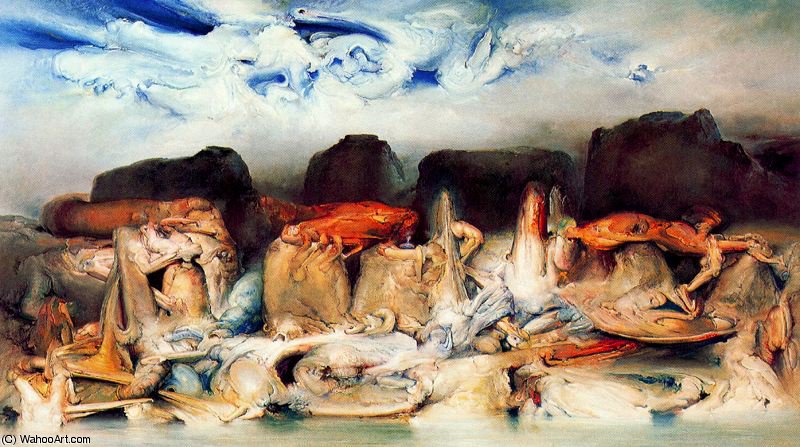

 Untitled (307)
12
 Untitled (214)
13
 Untitled (954)
14
 Untitled (198)
15
 Untitled (453)
16
 Untitled (244)
17
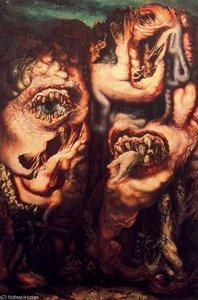 Untitled (181)
18
 Untitled (499)
19
 Untitled (481)
20
 Untitled (772)
21
 Untitled (672)
22
 Untitled (679)
23
 Untitled (988)
24
 Untitled (676)
25
 Untitled (464)
26
 Untitled (973)
27
 Untitled (766)
28
 Untitled (287)
29
 Untitled (137)
30
 Untitled (883)
31
 Untitled (976)
32
 Untitled (339)
33
 Untitled (725)
34
 Untitled (514)
35
 Untitled (730)
36
 Untitled (158)
37
 Untitled (190)
38
 Untitled (312)
39
 Untitled (776)
40
 Untitled (720)
41
 Untitled (102)
42
 Untitled (861)
43
 Untitled (563)
44
 Untitled (488)
45
 Untitled (602)
46
 Untitled (734)
47
 Untitled (132)
48
 Untitled (698)
The 3 museums that hold the most of the paintings on this page.
| Museum | City | Works by James Gleeson | Paintings from this list |
|---|---|---|---|
 Art Gallery of New South Wales |
Sydney | 3 | Across the threshold, The oracle, Flight |
 National Gallery of Australia |
Canberra | 1 | Fête champêtre, a lethal regulation |
 National Gallery of Victoria |
Melbourne | 1 | Signals from the frontier |
The selection follows James Gleeson over 15 years, from 1944 to 1958, keeping the finest originals of each year.
Pick a year to see its originals.
“Fête Champêtre, a Lethal Regulation,” painted in 1944 by the visionary James Gleeson, is more than just a depiction of a rural gathering; it's a profound and unsettling exploration of the anxieties simmering beneath the surface of post-war Australia. Measuring an imposing 765 x 765 cm, this large oil on canvas immediately commands attention with its dramatic composition and intensely rendered textures. Gleeson, often considered Australia’s first true surrealist, masterfully…
The artwork is titled The oracle, a work created by the artist James Gleeson. It is also known by the alternative title Encounter upon a personal shore. This painting was executed in 1948.
Across the threshold (1958), Art Gallery of New South Wales, Sydney. The oracle (1948) and Untitled (828) come next.
43 years old: Across the threshold dates from 1958, and James Gleeson was born in 1915.
Across the threshold, The oracle, Untitled (828), Untitled (965), Untitled (723), Flight, Fête champêtre, a lethal regulation, Signals from the frontier, Untitled (171) and Untitled (530). The ranking above gives each one's year and museum.
Our catalog holds 48 works by James Gleeson, dated from 1944 to 1958.
Mostly in Art Gallery of New South Wales (Sydney), National Gallery of Australia (Canberra) and National Gallery of Victoria (Melbourne). The museum table above lists them all.
On this page, the earliest is Fête champêtre, a lethal regulation (1944) and the latest Across the threshold (1958).
Oil On Canvas, for 2 of the 48 works on this page.
Surrealism, judging by the originals on this page.
Across the threshold, The oracle and Flight: the Art Gallery of New South Wales, Sydney holds 3 of the works on this page.
James Timothy Gleeson (1915-2008) wasn’t merely an artist; he was a conjurer of landscapes, a weaver of nightmares and dreams, and arguably Australia's first true surrealist. Emerging from the post-war artistic landscape, Gleeson forged a singular vision—a world steeped in primal anxieties, echoing with the voices of mythology and psychoanalysis—that continues to resonate today. His work isn’t easily categorized; it’s a potent blend of Australian identity, European influences, and deeply personal symbolism, rendered in bold, impastoed canvases that demand attention and invite contemplation.
Born in Hornsby, New South Wales, Gleeson's early life was marked by a profound sense of displacement. His family’s hotel ownership provided a glimpse into the darker side of Australian society, while his artistic inclinations were nurtured through exposure to influential figures like May Marsden, who steered him towards painting as an outlet for his burgeoning anxieties. This formative period instilled in him a fascination with the subconscious and a desire to confront uncomfortable truths—a theme that would become central to his oeuvre. His initial training at East Sydney Technical College laid the groundwork, but it was his immersion in the works of Dalí, Masson, Freud, and Jung that truly ignited his surrealist sensibilities.
Gleeson’s artistic journey began with a deliberate rejection of conventional representation. Influenced by the European Surrealists—particularly Dalí's exploration of dream imagery and masson’s organic abstraction—he sought to bypass the limitations of visual perception, aiming instead to capture the raw energy of the unconscious mind. His early works, such as “The Sower” (1944), already hinted at this ambition, presenting a distorted landscape populated by enigmatic figures that seemed to emerge from a swirling vortex of color and form. This marked a departure from traditional Australian art, which often focused on pastoral scenes and idealized landscapes; Gleeson was charting a distinctly different course.
The post-war era, with its anxieties surrounding fascism and the looming threat of global conflict, profoundly shaped his artistic concerns. He channeled these fears into powerful, apocalyptic imagery—vast, desolate landscapes dominated by towering rock formations, submerged figures, and unsettling juxtapositions. These weren’t simply depictions of nature; they were symbolic representations of humanity's precarious position within a chaotic universe. His work became a visual meditation on mortality, the fragility of existence, and the enduring power of primal instincts.
Gleeson’s paintings are rich in symbolism, drawing upon mythology, folklore, and psychoanalytic theory to create layered meanings. The recurring motif of the male nude—often depicted as a solitary figure emerging from turbulent waters or crumbling ruins—represents vulnerability, mortality, and the struggle for self-awareness. The use of ochre tones – reminiscent of the Australian outback – creates a sense of both familiarity and alienation, grounding his surreal visions in the landscape of his homeland while simultaneously evoking a timeless, almost biblical quality.
His later works, particularly the “Ubu” diptychs (1970s), exemplify this symbolic language. These monumental canvases depict submerged figures and decaying structures, suggesting the collapse of civilization and the inevitable return to primal chaos. Yet, amidst the devastation, there’s a strange beauty—a sense of resilience and enduring spirit—that speaks to the human capacity for survival and renewal.
James Gleeson's impact on Australian art is undeniable. He was a pioneer in establishing surrealism as a viable artistic movement within the country, challenging conventional notions of beauty and representation. His work continues to be studied and admired for its emotional intensity, symbolic depth, and unique visual language.
In 2004, the National Gallery of Australia mounted a comprehensive retrospective exhibition, “Beyond the Screen of Sight,” which cemented his place as one of Australia’s most important artists. The exhibition drew significant public attention to his work and highlighted its enduring relevance. His legacy extends beyond his paintings; he was also a respected art critic, lecturer, curator, and writer, contributing significantly to the development of Australian art history. His collection was donated to the National Gallery of Australia in 2007, ensuring that his visionary works will continue to inspire generations of artists and viewers.
James Gleeson’s paintings are not merely beautiful images; they are profound statements about the human condition. They confront us with our fears, anxieties, and mortality, while simultaneously offering a glimpse into the hidden depths of the unconscious mind. His work remains a powerful testament to the enduring power of art to challenge, provoke, and ultimately, illuminate the mysteries of existence.