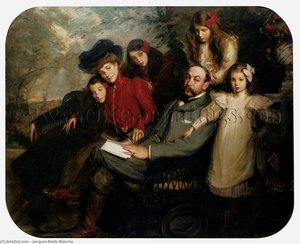
Portrait of Jacques-Émile Blanche

Jacques-Émile Blanche Paintings: The 100 Most Famous, Through a Gallery's Eye

Updated November 2026 · ranked by our popularity score (searches, visits and orders for each work) · 179 works by Jacques-Émile Blanche in our catalogue

In short

To the gallery's eye, Jacques-Émile Blanche's most famous painting is Madame Caroline Franklin Groult (1923), whose original hangs in the Musée Des Beaux, Rouen. Eton Bridge, Windsor and the Horse Guards (1923) and Portrait of Madame Abel Hermant (1888) complete the trio every eye recognises. Of the 179 works by Jacques-Émile Blanche in our catalog, the gallery presents the 100 most famous below, each original with its year, its museum and what makes it unique.

1861 – 1942, 16th arrondissement of Paris Impressionism Most works: Petit Palais

The gallery's top 10 Jacques-Émile Blanche paintings

1
Madame Caroline Franklin Groult (1923) by Jacques-Émile Blanche

Madame Caroline Franklin Groult

1923 · Acrylic On Canvas · Musée Des Beaux, Rouen

Jacques Emile Blanche’s “Madame Caroline Franklin Groult” stands as a quintessential example of Impressionist portraiture, capturing not merely likeness but also the very essence of its subject – a woman radiating quiet dignity and intellectual curiosity. Executed in 1923, this painting transcends mere representation; it's an invitation into a moment frozen in time, reflecting Blanche’s masterful command of light and color to convey a profound sense of inner life.

2
Eton Bridge, Windsor and the Horse Guards (1923) by Jacques-Émile Blanche

Eton Bridge, Windsor and the Horse Guards

1923 · Acrylic On Canvas · Musée Des Beaux, Rouen

Jacques-Émile Blanche (1861-1942) stands as one of the most distinctive figures in French Impressionism, a painter who transcended mere representation to distill the very soul of Parisian society during its golden age – Belle Époque. Born into a wealthy family steeped in artistic tradition, Blanche’s early life was marked by encounters with luminaries like Edouard Manet and Whistler, fostering an aesthetic sensibility that would define his oeuvre for decades.

3
Portrait of Madame Abel Hermant (1888) by Jacques-Émile Blanche

Portrait of Madame Abel Hermant

1888 · Oil On Canvas · Petit Palais, Paris

The air in the room feels heavy with the scent of old silk and soft light. Madame Abel Hermant sits before us, her presence filling the oval frame with a quiet, steady grace. She is captured in a moment of stillness, her gaze meeting the viewer with an expression that carries a hint of melancholy. Her white gown, voluminous and luminous, seems to catch a light emanating from the upper…

4
Henley House Boat on the Thames (1923) by Jacques-Émile Blanche

Henley House Boat on the Thames

1923 · Oil On Panel · Musée Des Beaux, Rouen

In Henley House Boat on the Thames, Jacques-Émile Blanche captures a fleeting moment of leisure and social interaction from about 1923. The scene unfolds beneath a sprawling tent, which is draped with lush floral arrangements that seem to catch the light of a passing afternoon. Within this sheltered space, the atmosphere feels alive with the quiet hum of a gathering. Men and women sit together around dining tables, their presence…

5
Nijinksy in Les Orientales by Jacques-Émile Blanche

Nijinksy in Les Orientales

Oil

The scene unfolds in Nijinsky in Les Orientales, a portrait by Jacques-Émile Blanche. Within this frame, the dancer Vaslav Nijinsky appears, draped in the Siamese costume of Les Orientales. The figure holds a presence that feels immediate, as if the dancer has only just paused amidst a performance. This work captures the essence of the performer in a moment of stillness, rendered about 1910.

6
The Child with the Doll (1900) by Jacques-Émile Blanche

The Child with the Doll

1900 · Oil · Petit Palais, Paris

A young girl sits in a dimly lit interior, her figure positioned slightly to the left of the center. She cradles a doll, a gesture that anchors the composition in a moment of quiet introspection. The lighting, appearing to originate from the upper left, casts a dramatic glow across her face, shoulder, and the heavy folds of her gown. This chiaroscuro effect leaves the surrounding environment in deep shadow, creating…

7
Full Length Portrait of Jean Cocteau (1912) by Jacques-Émile Blanche

Full Length Portrait of Jean Cocteau

1912 · Oil On Canvas · Musée Des Beaux, Rouen

Full Length Portrait of Jean Cocteau is a work by Jacques-Émile Blanche, executed in 1912. The portrait captures the subject, Jean Cocteau, in a full-length pose. Cocteau was a multifaceted French figure, working as a poet, playwright, screenwriter, novelist, designer, film director, visual artist, and critic.

8
Young Girl after a Masked Ball (La petite masque) (1906) by Jacques-Émile Blanche

Young Girl after a Masked Ball (La petite masque)

1906 · Oil On Canvas · Städel Museum, Frankfurt

The scene unfolds within the intimate confines of Young Girl after a Masked Ball (La petite masque), a work that captures a fleeting moment of repose. Painted by Jacques-Émile Blanche in 1906, this oil on canvas invites the viewer into a private, quiet interval. The subject rests in a state of uninhibited relaxation, her presence defined by the soft interplay of light and shadow across her form.

9
Portrait of Henri Guérard (1889) by Jacques-Émile Blanche

Portrait of Henri Guérard

1889 · Oil On Canvas · Petit Palais, Paris

The Portrait of Henri Guérard is an oil on canvas work by the French artist Jacques-Émile Blanche. Painted in 1889, the portrait captures a man who was both an artist and a personal friend to the painter. The sitter is positioned within the quiet confines of a studio, a space where the boundaries between the creator and the subject begin to soften.

10
The Mandarin (1898) by Jacques-Émile Blanche

The Mandarin

1898 · Oil On Canvas · Petit Palais, Paris

The Mandarin by Jacques-Émile Blanche is an oil painting created about 1898. It captures a quiet, intimate moment between a woman and two young children. The figures are gathered closely, their forms emerging from a dark, atmospheric background. This composition focuses the viewer's attention entirely on the tender connection shared between the subjects.

Jacques-Émile Blanche paintings, ranked 11 to 100

11The Pink Capeline (1883) by Jacques-Émile BlancheThe Pink Capeline1883 · Petit Palais 12Presumed Portrait of Henriette Chabot (1886) by Jacques-Émile BlanchePresumed Portrait of Henriette Chabot1886 · Musée de la Vie Romantique 13Portrait of John Lemoine (1887) by Jacques-Émile BlanchePortrait of John Lemoine1887 · Petit Palais 14Mademoiselle Meuriot on Her Pony (1889) by Jacques-Émile BlancheMademoiselle Meuriot on Her Pony1889 · Petit Palais 15Portrait of the painter Jules Chéret (1836-1933), in his studio (1892) by Jacques-Émile BlanchePortrait of the painter Jules Chéret (1836-1933), in his studio1892 · Carnavalet Museum 16Portrait of a Woman (1890) by Jacques-Émile BlanchePortrait of a Woman1890 17Portrait of the artist (1890) by Jacques-Émile BlanchePortrait of the artist1890 18James Joyce by Jacques-Émile BlancheJames Joyce 19Heads of Children (1896) by Jacques-Émile BlancheHeads of Children1896 · Petit Palais 20Portrait of a Woman (1897) by Jacques-Émile BlanchePortrait of a Woman1897 · Petit Palais 21Madame Paul Helleu and Her Son (1898) by Jacques-Émile BlancheMadame Paul Helleu and Her Son1898 22Portrait of Lady Michelham (1905) by Jacques-Émile BlanchePortrait of Lady Michelham1905 · Petit Palais 23Pensive woman with book on a bench (1905) by Jacques-Émile BlanchePensive woman with book on a bench1905 · Bavarian State Painting Collections 24Portrait of Mabel Dodge at Villa Curonia (1911) by Jacques-Émile BlanchePortrait of Mabel Dodge at Villa Curonia1911 · Petit Palais 25The Concert (1910) by Jacques-Émile BlancheThe Concert1910 · Musée d'Art Moderne et Contemporain de Strasbourg 26Portrait of Monsieur Léon Pissard young (1895) by Jacques-Émile BlanchePortrait of Monsieur Léon Pissard young1895 · Petit Palais 27Portrait of Jean Cocteau (1889-1963), writer, in the garden of Offranville (1913) by Jacques-Émile BlanchePortrait of Jean Cocteau (1889-1963), writer, in the garden of Offranville1913 · Carnavalet Museum 28Portrait of Marguerite Decazes de Glucksbierg, Princess Jean de Broglie, from Honorable Mrs Reginald Fellows (1890-1962) (1914) by Jacques-Émile BlanchePortrait of Marguerite Decazes de Glucksbierg, Princess Jean de Broglie, from Honorable Mrs Reginald Fellows (1890-1962)1914 · Carnavalet Museum 29Knightsbridge from Sloane Street, London (Fine December Morning) (1913) by Jacques-Émile BlancheKnightsbridge from Sloane Street, London (Fine December Morning)1913 30Portrait of Madeleine Pissard as Roxane (Love the Physician) (1921) by Jacques-Émile BlanchePortrait of Madeleine Pissard as Roxane (Love the Physician)1921 · Petit Palais 31Portrait of Léon Pissard (1920) by Jacques-Émile BlanchePortrait of Léon Pissard1920 · Petit Palais 32Portrait of René Crevel (1900-1935), writer (1928) by Jacques-Émile BlanchePortrait of René Crevel (1900-1935), writer1928 · Carnavalet Museum 33Tamara Karsavina, ballet dancer of the Ballets Russes (1928) by Jacques-Émile BlancheTamara Karsavina, ballet dancer of the Ballets Russes1928 34Jeanne (1901) by Jacques-Émile BlancheJeanne1901 · Dublin City Gallery The Hugh Lane 35Portrait of Ignacio Zuloaga (1901) by Jacques-Émile BlanchePortrait of Ignacio Zuloaga1901 · Petit Palais 36Fish Market (1929) by Jacques-Émile BlancheFish Market1929 37La semaine du poissen à Dieppe (1929) by Jacques-Émile BlancheLa semaine du poissen à Dieppe1929 38Portrait of James Joyce (1882-1941), Author (1934) by Jacques-Émile BlanchePortrait of James Joyce (1882-1941), Author1934 · National Gallery of Ireland 39Black Rock, Brighton, East Sussex (1938) by Jacques-Émile BlancheBlack Rock, Brighton, East Sussex1938 40Portrait of the Artist's Mother (1895) by Jacques-Émile BlanchePortrait of the Artist's Mother1895 · Musée d'Orsay 41Portrait of the Novelist Colette (1905) by Jacques-Émile BlanchePortrait of the Novelist Colette1905 · Museu Nacional d'Art de Catalunya 42Walter Richard Sickert (1898) by Jacques-Émile BlancheWalter Richard Sickert1898 43Sir Max Beerbohm (1903) by Jacques-Émile BlancheSir Max Beerbohm1903 · The Ashmolean Museum of Art And Archaeology 44Portrait of Madame Emile Blanche, mother of the artist (1891) by Jacques-Émile BlanchePortrait of Madame Emile Blanche, mother of the artist1891 · Petit Palais 45Portrait of Master Errazuriz (1890) by Jacques-Émile BlanchePortrait of Master Errazuriz1890 · Art Gallery of Hamilton 46Mischief (1901) by Jacques-Émile BlancheMischief1901 · Dublin City Gallery The Hugh Lane 47Portrait of Daisy de Broglie (1912) by Jacques-Émile BlanchePortrait of Daisy de Broglie1912 · Petit Palais 48Arrival of the Pacquet Boat, Dieppe by Jacques-Émile BlancheArrival of the Pacquet Boat, Dieppe 49The poet francis viele griffin and his family by Jacques-Émile BlancheThe poet francis viele griffin and his family 50L Hôte (1892) by Jacques-Émile BlancheL Hôte1892 · Musée Des Beaux 51Contemplation (1883) by Jacques-Émile BlancheContemplation1883 · Museum of Fine Arts, St. Petersburg, Florida, USA 52Portrait of Miss Florence Pash (1890) by Jacques-Émile BlanchePortrait of Miss Florence Pash1890 · Cantor Arts Center at Stanford University 53Eugenia Huici de Errazuriz (1890) by Jacques-Émile BlancheEugenia Huici de Errazuriz1890 54FILLETTE (LUCIE ESNAULT AU PSYCHÉ) (1889) by Jacques-Émile BlancheFILLETTE (LUCIE ESNAULT AU PSYCHÉ)1889 55London, Belgrave Square The White House (1886) by Jacques-Émile BlancheLondon, Belgrave Square The White House1886 · Musée Des Beaux 56London Third View of Belgrave Square (1886) by Jacques-Émile BlancheLondon Third View of Belgrave Square1886 · Musée Des Beaux 57LIttle Girl (also known as Lucie Esnault and Reflection) (1889) by Jacques-Émile BlancheLIttle Girl (also known as Lucie Esnault and Reflection)1889 58Dieppe's Beach in August (1893) by Jacques-Émile BlancheDieppe's Beach in August1893 · Musée des Beaux-Arts de Rouen 59Aubrey Beardsley (1895) by Jacques-Émile BlancheAubrey Beardsley1895 60Le chérubin de Mozart (1904) by Jacques-Émile BlancheLe chérubin de Mozart1904 · Musée Des Beaux 61The Donkey Show (1905) by Jacques-Émile BlancheThe Donkey Show1905 62Alexandra of Denmark (1844–1925), Queen Consort of King Edward VII (1905) by Jacques-Émile BlancheAlexandra of Denmark (1844–1925), Queen Consort of King Edward VII1905 · Government Art Collection 63Portrait of Charles Conder (1904) by Jacques-Émile BlanchePortrait of Charles Conder1904 64The Chess Players by Jacques-Émile BlancheThe Chess PlayersJohn and Mable Ringling Museum of Art 65The reader by Jacques-Émile BlancheThe readerNational Museum of Fine Arts 66The pink rose by Jacques-Émile BlancheThe pink roseNational Gallery of Victoria 67The pink living room (1911) by Jacques-Émile BlancheThe pink living room1911 · Musée d'Orsay 68Portrait of Eugenia Huici de Errazuriz by Jacques-Émile BlanchePortrait of Eugenia Huici de Errazuriz 69Portrait of a Woman by Jacques-Émile BlanchePortrait of a Woman 70The false starts, racing at Auteuil by Jacques-Émile BlancheThe false starts, racing at Auteuil 71Self-Portrait with Raphael de Ochoa by Jacques-Émile BlancheSelf-Portrait with Raphael de OchoaCleveland Museum of Art 72Punts at Henley by Jacques-Émile BlanchePunts at Henley 73Trafalgar Square by Jacques-Émile BlancheTrafalgar Square 74Portrait of a gentleman by Jacques-Émile BlanchePortrait of a gentleman 75Portrait of a girl by Jacques-Émile BlanchePortrait of a girl 76Portrait of Degas by Jacques-Émile BlanchePortrait of DegasNorth Carolina Museum of Art 77Girl with the spool of thread by Jacques-Émile BlancheGirl with the spool of thread 78Woman with a Veil by Jacques-Émile BlancheWoman with a Veil 79Portrait of a Barrone in louis XVI Costume by Jacques-Émile BlanchePortrait of a Barrone in louis XVI Costume 80Aubrey Vincent Beardsley by Jacques-Émile BlancheAubrey Vincent BeardsleyNational Portrait Gallery 81Terrace of a Building in Rome by Jacques-Émile BlancheTerrace of a Building in Rome 82The Thaulow Family by Jacques-Émile BlancheThe Thaulow FamilyMusée d'Orsay 83The Martyrdom of Saint Sebastian by Jacques-Émile BlancheThe Martyrdom of Saint Sebastian 84Mr Arsene Alexandre by Jacques-Émile BlancheMr Arsene Alexandre 85Piccadilly Circus by Jacques-Émile BlanchePiccadilly Circus 86Portrait of Madeleine Daughter of General Chardonne by Jacques-Émile BlanchePortrait of Madeleine Daughter of General Chardonne 87Lucie Dans L'Atelier by Jacques-Émile BlancheLucie Dans L'Atelier 88Portrait Of Antonin De Mun As A Young Boy by Jacques-Émile BlanchePortrait Of Antonin De Mun As A Young Boy 89Henry James (1908) by Jacques-Émile BlancheHenry James1908 · National Portrait Gallery 90Thomas Hardy by Jacques-Émile BlancheThomas Hardy 91Thomas Hardy (1840–1928) (1906) by Jacques-Émile BlancheThomas Hardy (1840–1928)1906 92Portrait Of A Girl seated In A Landscape by Jacques-Émile BlanchePortrait Of A Girl seated In A Landscape 93Lady Marjorie Manners (1883–1946) (1909) by Jacques-Émile BlancheLady Marjorie Manners (1883–1946)1909 94Reflections by Jacques-Émile BlancheReflections 95The Coronation of George V (1911) by Jacques-Émile BlancheThe Coronation of George V1911 · Manchester Art Gallery 96Still Life Fish on a Silver Plate (1908) by Jacques-Émile BlancheStill Life Fish on a Silver Plate1908 97A Street Scene in London by Jacques-Émile BlancheA Street Scene in London 98Investiture of the Prince of Wales, George V at Caernavon Castle (1910) by Jacques-Émile BlancheInvestiture of the Prince of Wales, George V at Caernavon Castle1910 · Musée Des Beaux 99Crystal Palace, Sydenham, London (1907) by Jacques-Émile BlancheCrystal Palace, Sydenham, London1907 100Thomas Hardy (1906) by Jacques-Émile BlancheThomas Hardy1906

Jacques-Émile Blanche's famous paintings, period by period

The subjects that held Jacques-Émile Blanche's eye

The four subjects that come back most often in these originals, each with its finest example.

The museums that keep Jacques-Émile Blanche's originals

The 8 museums that hold the most of the paintings on this page.

Museum City Works by Jacques-Émile Blanche Paintings from this list
Petit Palais, ParisPetit Palais Paris 17 Portrait of Madame Abel Hermant, The Child with the Doll, Portrait of Henri Guérard
Musée Des Beaux, RouenMusée Des Beaux Rouen 13 Madame Caroline Franklin Groult, Eton Bridge, Windsor and the Horse Guards, Henley House Boat on the Thames
Carnavalet Museum, ParisCarnavalet Museum Paris 5 Portrait of the painter Jules Chéret (1836-1933), in his studio, Portrait of Jean Cocteau (1889-1963), writer, in the garden of Offranville, Portrait of Marguerite Decazes de Glucksbierg, Princess Jean de Broglie, from Honorable Mrs Reginald Fellows (1890-1962)
Musée d'Orsay, ParisMusée d'Orsay Paris 6 Portrait of the Artist's Mother, The pink living room, The Thaulow Family
Dublin City Gallery The Hugh Lane, DublinDublin City Gallery The Hugh Lane Dublin 2 Jeanne, Mischief
Musée des Beaux-Arts de Rouen, RouenMusée des Beaux-Arts de Rouen Rouen 4 Dieppe's Beach in August
Government Art Collection, LondonGovernment Art Collection London 4 Alexandra of Denmark (1844–1925), Queen Consort of King Edward VII
Manchester Art Gallery, ManchesterManchester Art Gallery Manchester 3 The Coronation of George V

Jacques-Émile Blanche, one signature painting per decade

Works per decade

Pick a decade to see the original that defines it.

Jacques-Émile Blanche's paintings: the gallery answers

Which Jacques-Émile Blanche painting is the most famous of all?Reveal the answer

Madame Caroline Franklin Groult (1923), Musée Des Beaux, Rouen. Eton Bridge, Windsor and the Horse Guards (1923) and Portrait of Madame Abel Hermant (1888) come next.

How old was Jacques-Émile Blanche on completing Madame Caroline Franklin Groult?Reveal the answer

62 years old: Madame Caroline Franklin Groult dates from 1923, and Jacques-Émile Blanche was born in 1861.

Which are Jacques-Émile Blanche's top 10 paintings?Reveal the answer

Madame Caroline Franklin Groult, Eton Bridge, Windsor and the Horse Guards, Portrait of Madame Abel Hermant, Henley House Boat on the Thames, Nijinksy in Les Orientales, The Child with the Doll, Full Length Portrait of Jean Cocteau, Young Girl after a Masked Ball (La petite masque), Portrait of Henri Guérard and The Mandarin. The ranking above gives each one's year and museum.

How many works did Jacques-Émile Blanche create?Reveal the answer

Our catalog holds 179 works by Jacques-Émile Blanche, dated from 1883 to 1938.

Where do Jacques-Émile Blanche's most famous originals hang?Reveal the answer

Mostly in Petit Palais (Paris), Musée Des Beaux (Rouen) and Carnavalet Museum (Paris). The museum table above lists them all.

When did Jacques-Émile Blanche create the most famous paintings?Reveal the answer

In 1900s: 19 of the 100 works on this page were made then, The Child with the Doll among them.

Which are Jacques-Émile Blanche's earliest and latest famous works?Reveal the answer

On this page, the earliest is The Pink Capeline (1883) and the latest Black Rock, Brighton, East Sussex (1938).

Which subjects did Jacques-Émile Blanche return to most?Reveal the answer

Woman (23), Portrait (14) and Man (13), across the 100 works on this page.

Which medium did Jacques-Émile Blanche work in most?Reveal the answer

Oil On Canvas, for 38 of the 100 works on this page.

Which movement is Jacques-Émile Blanche associated with?Reveal the answer

Impressionism, judging by the originals on this page.

Which Jacques-Émile Blanche originals does the Petit Palais hold?Reveal the answer

Portrait of Madame Abel Hermant, The Child with the Doll and Portrait of Henri Guérard: the Petit Palais, Paris holds 17 of the works on this page.

Jacques-Émile Blanche: the artist

Early Life, Family and Training

Jacques-Émile Blanche enters the scene on January 1, 1861, in the 16th arrondissement of Paris, France. His upbringing is defined by the high-society atmosphere of the Passy neighborhood. He grows up in a house with a storied past, once belonging to the Princesse de Lamballe. His father, Émile Blanche, operates a fashionable clinic on the heights of Montmartre, working as a successful psychiatrist. This environment places the young artist within a privileged Parisian milieu from the start.

Education for Jacques-Émile Blanche takes place at the prestigious Lycée Condorcet. While his formal academic path is set, his artistic development follows a more idiosyncratic trajectory. He receives instruction from Henri Gervex and Pierre-Auguste Renoir, yet the influence of these teachers is only part of the story. He also receives lessons from Ferdinand Humbert. Despite these structured encounters, Blanche remains largely self-taught, developing a technical approach that relies heavily on his own observation rather than strict academic doctrine.

Artistic Style and Technique

Blanche rejects the meticulous realism of academic tradition. Instead, he prioritizes the transmission of emotion and atmosphere over the pursuit of precise detail. His technique relies on loose brushwork where visible strokes define the form rather than blended, seamless surfaces. This approach creates a sense of immediacy, capturing the transient qualities of light and character through texture rather than rigid outlines.

The palette is deliberately restrained. He avoids the use of high-contrast, bright hues, opting instead for a muted scheme of ochres, browns, and greys. This tonal harmony allows him to focus on the subtle nuances of his subjects. Influenced by the aesthetics of Edouard Manet and James McNeill Whistler, his work balances a sense of modern spontaneity with a sophisticated control of color. His portraits achieve a specific sensitivity, using these subdued tones to reveal the inner personality and insight of the sitter.

Activity in Paris and London

Blanche moves between two worlds with ease. He is as much at home in England as he is in France, navigating the social and artistic landscapes of both cities. In Paris, his presence is felt through regular exhibitions at the Salon and the Société Nationale des Beaux-Arts. These venues provide the platform for his growing reputation as a successful portrait painter. He does not merely visit the English capital; he returns to London every year starting in 1884, finding great success with each trip. This constant movement between the two capitals defines his professional life.

His integration into the British art scene is solidified by his membership in the New English Art Club. This affiliation places him within the heart of the London art establishment. He builds a professional life that spans the English Channel, securing commissions from prominent figures in both Paris and London. His ability to adapt to these different environments allows him to maintain a steady career as a sought-after portraitist.

Notable Works and Subjects

Blanche’s brush often turned toward the faces of the intellectual and social elite. In 1895, he captured Mabel Beardsley, a portrait that emphasizes a sense of quiet contemplation through a restrained color palette. His ability to translate character into paint is evident in his 1904 portrait of Charles Conder. By 1908, his focus shifted toward the literary giants of the era, resulting in a portrait of Henry James. Later, the artist returned to the complexities of human character in his depictions of James Joyce, which he worked on in 1934 and 1935.

The artist’s scope extended beyond the individual to the atmosphere of music and the movement of urban life. His work includes "The Kreutzer Sonata," a piece that attempts to capture the essence of emotion through sound. He also looked toward the landscape and the grandeur of the city. In 1923, he painted "Eton Bridge, Windsor and the Horse Guards," a composition that captures a bustling tableau of London life, from the military precision of the parade to the skyline of Windsor Castle.

Social Circles and Influences

The drawing room of Blanche's father, a prominent psychiatrist, functions as a crossroads for the Parisian intellectual elite. Here, the boundaries between medicine, literature, and the arts blur during regular Saturday meetings. These gatherings bring together a constellation of celebrities, including figures like Hector Berlioz and Camille Corot. Within this high-society milieu, the young artist encounters Edouard Manet, an encounter that leaves a lasting mark on his developing aesthetic. The atmosphere is one of constant, sophisticated conversation, where the nuances of aesthetic and literary debate are as much a part of the environment as the art itself.

His social orbit extends far beyond the salons of Paris, bridging the gap between the French and English worlds. He moves through the intimate circles of the literary avant-garde, maintaining a close friendship with Marcel Proust. This connection to the era's most significant writers is further evidenced by his presence in the cultural landscape of the time; he is even mentioned in Gertrude Stein's The Autobiography of Alice B. Toklas. His ability to navigate these elite spaces allows him to capture the very essence of the Belle Époque society he inhabits.

Stylistically, Blanche looks toward the past to define his modern approach. His work carries the echoes of 18th-century English painters, particularly the influence of Thomas Gainsborough. This connection to English tradition informs his handling of light and character, blending a continental sensibility with a specific, refined grace. He does not merely document his sitters; he absorbs the atmosphere of the rooms and the personalities of the people who define his world.

Legacy and Where to See Works

Jacques-Émile Blanche died on September 30, 1942. His presence in the art world persists through the physical remains of his canvases, held in various public institutions across Europe. The Musée des Beaux-Arts in Rouen maintains an impressive collection of his work, preserving the visual record of his career. In the United Kingdom, the Manchester Art Gallery houses several pieces, including Mrs Sickert and Miss Winny MacEwan. These works remain accessible to those studying the nuances of his portraiture and his ability to capture the essence of his sitters.

The reach of his oeuvre extends to the Tate collection, where August Morning is held. His ability to navigate the social landscapes of both Paris and London is reflected in the distribution of his paintings across these different cultural centers. Collectors and historians continue to find his specific approach to light and character through these institutional holdings.