Portrait of George Stubbs

The 100 Most Famous George Stubbs Paintings, Each One of a Kind

Updated November 2026 · ranked by our popularity score (searches, visits and orders for each work) · 223 works by George Stubbs in our catalogue

In short

Whistlejacket (1762) is the George Stubbs painting that draws the most eyes; the original belongs to the National Gallery, London. After it, the eye goes to Lion Attacking a Horse (1765) and A Bay Hunter With Two Spaniels (1777). Among the 223 works of George Stubbs in our catalog, these 100 are the most famous, each a unique original presented with its year, its museum and the reason it endures.

1724 – 1806, Liverpool Romanticism Most works: Yale Center for British Art

Top 10 paintings by George Stubbs, through the gallery's eye

1
Whistlejacket (1762) by George Stubbs

Whistlejacket

1762 · Oil On Canvas · National Gallery, London

In this 1762 oil-on-canvas, George Stubbs presents Whistlejacket, a magnificent bay Thoroughbred that seems to surge from the very fabric of the painting. The horse belongs to the Marquess of Rockingham, and its presence is immediate and commanding. It does not merely stand; it rears up, caught in a sudden, powerful movement that defies the stillness of the medium. The animal's muscular frame ripples with a life of its own,…

2
Lion Attacking a Horse (1765) by George Stubbs

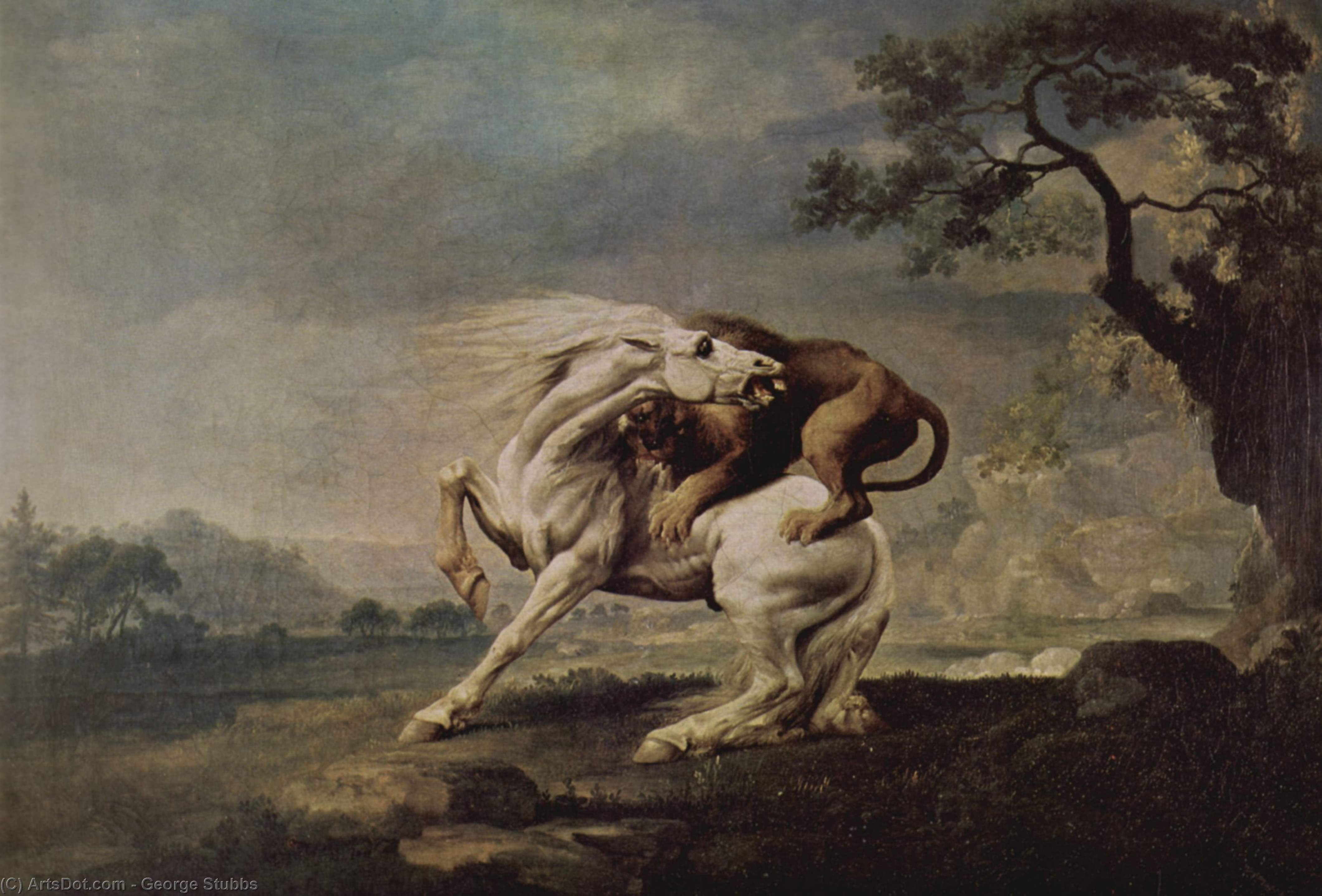
Lion Attacking a Horse

1765 · Oil On Canvas · Yale University Art Gallery, Hartford

A Dramatic Confrontation in Nature George Stubbs' "Lion Attacking a Horse" captures a moment of intense struggle between two majestic animals, set against a backdrop of natural beauty. This powerful scene is rendered with remarkable detail and emotional depth, making it a standout piece in the artist's oeuvre. Masterful Realism and Romanticism Stubbs' style combines meticulous realism with a touch of romanticism, emphasizing the dramatic and emotional aspects of the…

3
A Bay Hunter With Two Spaniels (1777) by George Stubbs

A Bay Hunter With Two Spaniels

1777 · Oil On Canvas

"A Bay Hunter With Two Spaniels" is a captivating artwork by the celebrated English painter George Stubbs, created in 1777. This exquisite piece showcases Stubbs' renowned skill in depicting animals with unparalleled accuracy and grace. The painting features a majestic bay hunter, a breed of horse known for its strength and elegance, accompanied by two playful spaniels. Set against a serene landscape bathed in the soft hues of dawn or…

4
The Grosvenor Hunt (1762) by George Stubbs

The Grosvenor Hunt

1762 · Oil On Canvas

Captivating Scene of 18th Century Hunting Tradition Immerse yourself in a vivid portrayal of a quintessential British hunting scene from the 18th century. This masterful work captures a dynamic moment of camaraderie and action, where mounted hunters, dressed in period attire, navigate a lush landscape under a canopy of vibrant autumn foliage. The scene exudes energy and purpose, reflecting the cultural significance of hunting as both a sport and a…

5
Tiger (1771) by George Stubbs

Tiger

1771 · Oil On Canvas · Virginia Museum of Fine Arts, Richmond

George Stubbs’s “Tiger,” painted in 1771, isn’t merely a depiction of an animal; it's a visceral exploration of power, instinct, and the sublime. This oil painting, now housed within the collections of Google Arts & Culture, immediately commands attention with its dramatic composition and masterful use of light and shadow. The scene unfolds within a shadowy forest, a carefully constructed stage for the tiger’s predatory grace – a creature rendered…

6
Horse Frightened by a Lion (1770) by George Stubbs

Horse Frightened by a Lion

1770 · Acrylic On Canvas · Walker Art Gallery, Liverpool

George Stubbs's "Horse Frightened by a Lion," painted in 1770, isn’t merely a depiction of animals; it’s a visceral exploration of primal fear and the raw power of nature. This monumental oil painting, measuring an impressive 1261 x 1001 cm, commands attention with its masterful use of chiaroscuro – the dramatic interplay of light and shadow – characteristic of the Baroque period yet imbued with a distinctly Romantic sensibility. The…

7
Whistlejacket (1762) by George Stubbs

Whistlejacket

1762 · Oil

In the grand tradition of British sporting art, few works command the room with as much raw vitality and anatomical precision as George Stubbs’s Whistlejacket. Painted in 1762, this monumental canvas transcends the boundaries of a mere portrait, offering instead a breathtaking study of power, grace, and kinetic energy. The subject, a magnificent bay Thoroughbred, is captured in a moment of suspended animation, galloping across a space that feels both…

8
Lord Grosvenor (1765) by George Stubbs

Lord Grosvenor

1765 · Acrylic On Canvas · Kimbell Art Museum, Fort Worth

George Stubbs' "Lord Grosvenor’s Arabian Stallion with a Groom," painted in 1765, isn’t merely a portrait; it’s a meticulously crafted tableau vivant—a snapshot of aristocratic leisure and the profound connection between man and beast. Stubbs, already recognized as the foremost painter of horses of his era, transcends simple representation, instead offering a deeply considered study of anatomy, movement, and psychological nuance. This work exemplifies his pioneering approach to animal painting,…

9
A Lion Attacking a Stag (1766) by George Stubbs

A Lion Attacking a Stag

1766 · Oil On Canvas · Yale Center for British Art, New Haven

Subject and Composition The canvas opens to a dramatic tableau in which a lion, the undisputed monarch of the savannah, has seized a stag mid‑flight. The predator’s muscular frame dominates the foreground, its jaws poised as if about to deliver the decisive bite. Below, the stag’s antlers curl like twisted branches, its body caught in a moment of frantic escape. A solitary bird perches on a branch near the upper…

10
Baronet (1794) by George Stubbs

Baronet

1794 · Oil On Canvas · Yale Center for British Art, New Haven

To gaze upon this depiction of a man mounted on his magnificent steed is to be swept away by the very energy of the late eighteenth century. George Stubbs, master chronicler of equine grace and human dignity, captures a moment brimming with aristocratic vitality. The central figure, the titular Baronet, commands attention not merely through his striking red jacket—a bold splash of color against the muted tones of the background—but…

George Stubbs's famous paintings, numbers 11 to 100

11A Lion attacking a Horse (1770) by George StubbsA Lion attacking a Horse1770 · Yale University Art Gallery 12Lion Devouring a Horse (1763) by George StubbsLion Devouring a Horse1763 · Tate Gallery 13Horse Devoured by a Lion (1763) by George StubbsHorse Devoured by a Lion1763 · Tate Britain 14Foxhound (1760) by George StubbsFoxhound1760 · Yale Center for British Art 15The Fall of Phaëton (1777) by George StubbsThe Fall of Phaëton1777 · National Trust 16Study of a Fowl, Lateral View, with skin and underlying fascial layers removed, from 'A Comparative Anatomical Exposition of the Structure of the Human Body with that of a Tiger and a Common Fowl' by George StubbsStudy of a Fowl, Lateral View, with skin and underlying fascial layers removed, from 'A Comparative Anatomical Exposition of the Structure of the Human Body with that of a Tiger and a Common Fowl'Yale Center for British Art 17Freeman, The Earl of Clarendon's Gamekeeper, with a Dying Doe and Hound (1800) by George StubbsFreeman, The Earl of Clarendon's Gamekeeper, with a Dying Doe and Hound1800 · Yale Center for British Art 18Prince of Wales Phaeton (1793) by George StubbsPrince of Wales Phaeton1793 19Studies for or after "The third Duke of Richmond with the Charleton Hunt" (1750) by George StubbsStudies for or after "The third Duke of Richmond with the Charleton Hunt"1750 · Yale Center for British Art 20A Dark Bay Thoroughbred in a Landscape (1762) by George StubbsA Dark Bay Thoroughbred in a Landscape1762 21King Charles Spaniel (1769) by George StubbsKing Charles Spaniel1769 22The Lincolnshire Ox (1790) by George StubbsThe Lincolnshire Ox1790 · Walker Art Gallery 23'Molly Long Legs' with Her Jockey (1762) by George Stubbs'Molly Long Legs' with Her Jockey1762 · Walker Art Gallery 24Reaper (1795) by George StubbsReaper1795 · Yale Center for British Art 25Captain Samuel Sharpe Pocklington with His Wife, Pleasance, and possibly His Sister, Frances (1769) by George StubbsCaptain Samuel Sharpe Pocklington with His Wife, Pleasance, and possibly His Sister, Frances1769 · National Gallery of Art 26Mares and Foals in a River Landscape (1768) by George StubbsMares and Foals in a River Landscape1768 27Viscount Gormanston's White Dog (1781) by George StubbsViscount Gormanston's White Dog1781 28Margaret Newton (née Coningsby), Countess of Coningsby in the Costume of the Charlton Hunt (1760) by George StubbsMargaret Newton (née Coningsby), Countess of Coningsby in the Costume of the Charlton Hunt1760 · Yale Center for British Art 29Self-Portrait (1759) by George StubbsSelf-Portrait1759 · Yale Center for British Art 30Horse Attacked by a Lion (Episode C) (1768) by George StubbsHorse Attacked by a Lion (Episode C)1768 · Yale Center for British Art 31White Poodle in a Punt (1780) by George StubbsWhite Poodle in a Punt1780 · National Gallery of Art 32Viscount Gormanston's White Dog - George Stubbs (2026) by George StubbsViscount Gormanston's White Dog - George Stubbs2026 33James Stanley (1755) by George StubbsJames Stanley1755 34Two gentlemen going a shooting, with a view of Creswell Crags (1767) by George StubbsTwo gentlemen going a shooting, with a view of Creswell Crags1767 · National Museum in Warsaw 35Two Gentlemen Going a Shooting, with a View of Creswell Crags, Taken on the Spot (1767) by George StubbsTwo Gentlemen Going a Shooting, with a View of Creswell Crags, Taken on the Spot1767 · Yale Center for British Art 36Two Gentlemen Shooting (1769) by George StubbsTwo Gentlemen Shooting1769 · Royal Museums of Fine Arts of Belgium 37John Christian Santhague (d1. 821) (1782) by George StubbsJohn Christian Santhague (d1. 821)1782 · Royal Collection 38Sir Sidney Medows (1701-92) (1778) by George StubbsSir Sidney Medows (1701-92)1778 · Royal Collection 39Phaeton with a Pair of Cream Ponies and a Stable-Lad (1780) by George StubbsPhaeton with a Pair of Cream Ponies and a Stable-Lad1780 · Yale Center for British Art 40George IV (1762-1830), when Prince of Wales (1791) by George StubbsGeorge IV (1762-1830), when Prince of Wales1791 · Royal Collection 41A Bay Horse with a Groom (1791) by George StubbsA Bay Horse with a Groom1791 · Royal Collection 42Portrait of a Gentleman (1791) by George StubbsPortrait of a Gentleman1791 · Royal Collection 43Lion and Lione (1770) by George StubbsLion and Lione1770 · Yale Center for British Art 44Self-Portrait (1775) by George StubbsSelf-Portrait1775 45Cheetah with two Indian servants and a deer (1765) by George StubbsCheetah with two Indian servants and a deer1765 46The Marquess of Rockingham's Arabian Stallion (1780) by George StubbsThe Marquess of Rockingham's Arabian Stallion1780 · Scottish National Gallery 47Pavian and Albino Makake (1780) by George StubbsPavian and Albino Makake1780 48The Marquess of Rockingham (1780) by George StubbsThe Marquess of Rockingham1780 · Scottish National Gallery 49George Stubbs (1781) by George StubbsGeorge Stubbs1781 · National Portrait Gallery 50Hound Coursing a Stag (1762) by George StubbsHound Coursing a Stag1762 · Philadelphia Museum of Art 51Horse Attacked by a Lion (1762) by George StubbsHorse Attacked by a Lion1762 52Greenland Falcon (1780) by George StubbsGreenland Falcon1780 · Yale Center for British Art 53Isabella Salstonstall as Una in Spenser's 'Faerie Queene' (1782) by George StubbsIsabella Salstonstall as Una in Spenser's 'Faerie Queene'1782 · Fitzwilliam College 54Study of the Human Figure, Anterior View, from 'A Comparative Anatomical Exposition of the Structure of the Human Body with that of a Tiger and a Common Fowl' by George StubbsStudy of the Human Figure, Anterior View, from 'A Comparative Anatomical Exposition of the Structure of the Human Body with that of a Tiger and a Common Fowl'Yale Center for British Art 55A Foxhound (1760) by George StubbsA Foxhound1760 · Yale Center for British Art 56A Gentleman driving a Lady in a Phaeton (1787) by George StubbsA Gentleman driving a Lady in a Phaeton1787 57The Farmer's Wife and the Raven, from John Gay's 'Fables' (1786) by George StubbsThe Farmer's Wife and the Raven, from John Gay's 'Fables'1786 · Yale Center for British Art 58Gimcrack with John Pratt up on Newmarket Heath (1765) by George StubbsGimcrack with John Pratt up on Newmarket Heath1765 · Fitzwilliam College 59'Lustre' Held by a Groom (1762) by George Stubbs'Lustre' Held by a Groom1762 · Yale Center for British Art 60The Moose by George StubbsThe Moose 61James Stanley (b.c.1722) (1755) by George StubbsJames Stanley (b.c.1722)1755 · Walker Art Gallery 62A Chestnut Racehorse by George StubbsA Chestnut Racehorse 63Lord and Lady in a Phaeton (1787) by George StubbsLord and Lady in a Phaeton1787 · National Gallery 64George Fothergill of York (1689–1770) (1746) by George StubbsGeorge Fothergill of York (1689–1770)1746 · Ferens Art Gallery 65Bulls Fighting (1786) by George StubbsBulls Fighting1786 · Yale Center for British Art 66Labourers (1761) by George StubbsLabourers1761 · Yale Center for British Art 67James Stanley (1755) by George StubbsJames Stanley1755 · Walker Art Gallery 68The Milbanke and Melbourne Families (1769) by George StubbsThe Milbanke and Melbourne Families1769 · National Gallery 69Joseph Smyth Esquire, Lieutenant of Whittlebury Forest, Northamptonshire, on a Dapple Grey Horse (1764) by George StubbsJoseph Smyth Esquire, Lieutenant of Whittlebury Forest, Northamptonshire, on a Dapple Grey Horse1764 · Fitzwilliam College 70Harvest (1785) by George StubbsHarvest1785 71Portrait of a dark brown and white Newfoundland spaniel (1743) by George StubbsPortrait of a dark brown and white Newfoundland spaniel1743 72Untitled (Hound Chasing a Hare) (1765) by George StubbsUntitled (Hound Chasing a Hare)1765 · Auckland Art Gallery Toi o Tāmaki 73Horse Frightened by a Lion (1762) by George StubbsHorse Frightened by a Lion1762 · Yale Center for British Art 74Turf, with Jockey up, at Newmarket (1765) by George StubbsTurf, with Jockey up, at Newmarket1765 · Yale Center for British Art 75Newmarket Heath, with a Rubbing-down House (1765) by George StubbsNewmarket Heath, with a Rubbing-down House1765 · Yale Center for British Art 76Mares and Foals in a Wooded Landscape (1762) by George StubbsMares and Foals in a Wooded Landscape1762 77Horse Attacked by a Lion (1765) by George StubbsHorse Attacked by a Lion1765 78Cheetah and Stag with Two Indians (1765) by George StubbsCheetah and Stag with Two Indians1765 79Lord Grosvenor's Arabian Stallion with a Groom (1765) by George StubbsLord Grosvenor's Arabian Stallion with a Groom1765 80Newmarket Heath, with a Rubbing Down House (1765) by George StubbsNewmarket Heath, with a Rubbing Down House1765 81Mares and foals are anxious before a looming storm (1765) by George StubbsMares and foals are anxious before a looming storm1765 82Frontal view of the skeleton of a horse, study No. 10 from 'The Anatomy of the Horse' (1766) by George StubbsFrontal view of the skeleton of a horse, study No. 10 from 'The Anatomy of the Horse'1766 83A Repose after Shooting (1770) by George StubbsA Repose after Shooting1770 · Yale Center for British Art 84Portrait of John Nelthorpe as a child (1775) by George StubbsPortrait of John Nelthorpe as a child1775 85Pumpkin with a Stable Lad (1774) by George StubbsPumpkin with a Stable Lad1774 86'Pumpkin' (1773) by George Stubbs'Pumpkin'1773 · Ascott House 87Portrait of a Huntsman (1768) by George StubbsPortrait of a Huntsman1768 88The Moose (1773) by George StubbsThe Moose1773 · The Hunterian Museum and Art Gallery 89Mares and Foals under an Oak Tree (1775) by George StubbsMares and Foals under an Oak Tree1775 90Mares and Foals in a Mountainous Landscape (1769) by George StubbsMares and Foals in a Mountainous Landscape1769 91Lady Reading in a Wooded Park (1770) by George StubbsLady Reading in a Wooded Park1770 92A Horse Frightened by a Lion (1770) by George StubbsA Horse Frightened by a Lion1770 93Otho, with John Larkin up (1768) by George StubbsOtho, with John Larkin up1768 94Portrait of Isabella Saltonstall (1775) by George StubbsPortrait of Isabella Saltonstall1775 95The Third Duke of Dorset's Hunter with a Groom and a Dog (1768) by George StubbsThe Third Duke of Dorset's Hunter with a Groom and a Dog1768 · Metropolitan Museum of Art 96Mother and Child (1774) by George StubbsMother and Child1774 97Lion and Lioness (1771) by George StubbsLion and Lioness1771 · Museum of Fine Arts 98A Lion and Tiger (1779) by George StubbsA Lion and Tiger1779 · Walker Art Gallery 99Lord Clanbrassil with Hunter Mowbrary (1769) by George StubbsLord Clanbrassil with Hunter Mowbrary1769 · The Vestey Gallery of British Sporting Art 100Firetail with his Trainer by the Rubbing-Down House on Newmarket Heath (1773) by George StubbsFiretail with his Trainer by the Rubbing-Down House on Newmarket Heath1773 · Iziko South African National Gallery

George Stubbs's famous paintings, period by period

The subjects that held George Stubbs's eye

The four subjects that come back most often in these originals, each with its finest example.

The museums that keep George Stubbs's originals

The 8 museums that hold the most of the paintings on this page.

Museum City Works by George Stubbs Paintings from this list
Yale Center for British Art, New HavenYale Center for British Art New Haven 33 A Lion Attacking a Stag, Baronet, Foxhound
Walker Art Gallery, LiverpoolWalker Art Gallery Liverpool 9 Horse Frightened by a Lion, The Lincolnshire Ox, 'Molly Long Legs' with Her Jockey
Royal Collection, LondonRoyal Collection London 16 John Christian Santhague (d1. 821), Sir Sidney Medows (1701-92), George IV (1762-1830), when Prince of Wales
National Gallery, LondonNational Gallery London 4 Whistlejacket, Lord and Lady in a Phaeton, The Milbanke and Melbourne Families
Fitzwilliam College, CambridgeFitzwilliam College Cambridge 3 Isabella Salstonstall as Una in Spenser's 'Faerie Queene', Gimcrack with John Pratt up on Newmarket Heath, Joseph Smyth Esquire, Lieutenant of Whittlebury Forest, Northamptonshire, on a Dapple Grey Horse
National Gallery of Art, WashingtonNational Gallery of Art Washington 2 Captain Samuel Sharpe Pocklington with His Wife, Pleasance, and possibly His Sister, Frances, White Poodle in a Punt
Scottish National Gallery, EdinburghScottish National Gallery Edinburgh 2 The Marquess of Rockingham's Arabian Stallion, The Marquess of Rockingham
Tate Gallery, LondonTate Gallery London 2 Lion Devouring a Horse

George Stubbs across the decades: one unique original for each

Works per decade

Pick a decade to see the original that defines it.

George Stubbs's paintings: questions for the gallery

What is the single most famous work of George Stubbs?Reveal the answer

Whistlejacket (1762), National Gallery, London. Lion Attacking a Horse (1765) and A Bay Hunter With Two Spaniels (1777) come next.

At what age did George Stubbs create Whistlejacket?Reveal the answer

38 years old: Whistlejacket dates from 1762, and George Stubbs was born in 1724.

Which ten paintings by George Stubbs are the most famous?Reveal the answer

Whistlejacket, Lion Attacking a Horse, A Bay Hunter With Two Spaniels, The Grosvenor Hunt, Tiger, Horse Frightened by a Lion, Whistlejacket, Lord Grosvenor, A Lion Attacking a Stag and Baronet. The ranking above gives each one's year and museum.

How many works by George Stubbs are known?Reveal the answer

Our catalog holds 223 works by George Stubbs, dated from 1743 to 1800.

Where can the most famous George Stubbs originals be seen?Reveal the answer

Mostly in Yale Center for British Art (New Haven), Walker Art Gallery (Liverpool) and Royal Collection (London). The museum table above lists them all.

During which period did George Stubbs create the best-known paintings?Reveal the answer

In 1760s: 44 of the 100 works on this page were made then, Whistlejacket among them.

Which famous George Stubbs painting is the earliest, and which the latest?Reveal the answer

On this page, the earliest is Portrait of a dark brown and white Newfoundland spaniel (1743) and the latest Freeman, The Earl of Clarendon's Gamekeeper, with a Dying Doe and Hound (1800).

What subjects did George Stubbs favour?Reveal the answer

Landscape (26), Horse (22) and 18th century (15), across the 100 works on this page.

What materials did George Stubbs paint with most?Reveal the answer

Oil On Canvas, for 45 of the 100 works on this page.

Which movement does the work of George Stubbs belong to?Reveal the answer

Romanticism, judging by the originals on this page.

What George Stubbs originals can I see at the Yale Center for British Art?Reveal the answer

A Lion Attacking a Stag, Baronet and Foxhound: the Yale Center for British Art, New Haven holds 24 of the works on this page.

George Stubbs: a portrait of the artist

Early Life, Family and Training

Liverpool, United Kingdom, 1724. George Stubbs enters the world as the son of John Stubbs, a currier, or leather-dresser, and Mary. His childhood is spent within the confines of the family business, handling hides and tools. This early exposure to the physical properties of animal skins provides a tactile foundation for a developing curiosity. By the age of 15, the pull toward visual representation becomes impossible to ignore. He begins his artistic path not through formal academies, but through a relentless, self-directed drive to understand the mechanics of life.

The path is uneven. A brief apprenticeship under Hamlet Winstanley, a painter and engraver from Lancashire, offers a glimpse into the professional trade, but it remains a short chapter. Stubbs seeks something more rigorous than mere imitation. He moves toward York, where the focus shifts from surface appearance to internal structure. Under the guidance of surgeon Charles Atkinson at York County Hospital, he begins a deep study of anatomy. This period of dissection transforms his approach, turning the artist into a student of the skeletal and muscular systems.

He remains largely self-taught, building his technical proficiency by observing the work of 18th-century contemporaries. He absorbs the methods of great artists like Joshua Reynolds and Thomas Gainsborough, yet his focus remains anchored in the scientific. He does not merely want to paint a subject; he wants to understand the tension of the sinew and the placement of the bone beneath the skin. This intersection of the surgical and the aesthetic defines his early development.

Patrons, Workshop and Commissions

Success arrives through the doors of the English aristocracy. By 1759, the 3rd Duke of Richmond commissions three large pictures, a move that secures Stubbs's professional standing. His ability to render the physical reality of animals quickly attracts the attention of leading aristocratic patrons. He moves from the periphery of the art world into the inner circles of the elite, producing works for several dukes and lords. This steady stream of high-status commissions provides the financial stability required to establish a permanent presence in the capital. He eventually purchases a house in Marylebone, London, where he remains for the rest of his life.

The demand for his specific expertise extends to the highest levels of society, as he enjoys royal patronage. His reputation is built on the ability to satisfy the specific desires of owners who view their horses as symbols of status. These patrons seek more than mere likenesses; they require the anatomical precision that Stubbs provides. His workshop becomes a site of significant production, catering to the tastes of a class obsessed with equestrian excellence and the breeding of fine animals.

Technique and Style

Stubbs operates at the intersection of scientific inquiry and fine art. His approach relies on a pioneering realism rooted in the physical reality of the animal form. By combining anatomical exactitude with expressive details, he moves beyond mere likeness to capture the mechanics of life. He uses subtle gradations of shadow to breathe life into every sinew and tendon, rendering the underlying structure of his subjects with a clarity that reflects his deep study of anatomy.

This obsession with the mechanics of movement often manifests in scenes of high tension. He becomes preoccupied with the theme of a wild horse threatened by a lion, a subject he explores through various iterations. These depictions of a lion attacking a horse represent early and significant examples of the Romantic movement. In these works, the focus shifts from the static portrait to the visceral energy of survival, utilizing the tension of musculature to drive the composition.

Key Works and Masterpieces

The year 1766 marks a definitive shift in the intersection of art and science. Stubbs publishes The Anatomy of the Horse, a groundbreaking treatise that moves beyond mere observation. The book contains 18 detailed illustrations, the result of years spent dissecting carcasses to understand the mechanics of life. This work establishes him as an authority on equine structure, providing a visual language for the musculature and tendons that define a living animal.

In the same year, the focus shifts from the internal to the visceral. A Lion Attacking a Stag captures a moment of raw, unscripted survival. The tension is palpable in the rendering of the predator and prey. This theme of conflict—the wild horse threatened by a lion—becomes a recurring obsession, appearing in various iterations throughout his career. It is a study of power and movement that bridges the gap between scientific documentation and the burgeoning Romantic movement.

The height of his equestrian portraiture arrives with Whistlejacket. Commissioned by the 2nd Marquess of Rockingham, the painting depicts a prancing horse against a plain background, breaking from the conventions of the time. The subject's presence is immediate. Around 1780, he produces The Marquess of Rockingham's Arabian Stallion, further cementing his status in the high-society circles of the era. His ability to capture the essence of a specific animal remains his most enduring contribution to the genre.

Where to See the Works Today

The legacy of Stubbs’s anatomical precision survives in the halls of major international institutions. In London, the National Gallery houses Whistlejacket, a large-scale portrait of a thoroughbred race horse. The Tate Gallery also maintains several of his paintings within its collection. These works offer a direct look at the precision that defined his career.

Across the Atlantic, the Yale Center for British Art in New Haven holds a significant number of his works. This collection provides a concentrated view of his output. In the United Kingdom, the Walker Art Gallery in Liverpool preserves his paintings, returning his imagery to the region of his birth. His influence extends beyond the canvas into the scientific realm; his book, The Anatomy of the Horse, remains a fundamental work of reference for the study of equine anatomy.