Portrait of Franz Kline

The 48 Most Famous Franz Kline Paintings, Each One of a Kind

Updated October 2026 · ranked by our popularity score (searches, visits and orders for each work) · 53 works by Franz Kline in our catalogue

In short

Mahoning (1956) is the Franz Kline painting that draws the most eyes; the original belongs to the Whitney Museum of American Art, New York. After it, the eye goes to Black, White, and Gray (1959) and Untitled (1959). Among the 53 works of Franz Kline in our catalog, these 48 are the most famous, each a unique original presented with its year, its museum and the reason it endures.

1910 – 1962, Wilkes-Barre Abstract expressionism Most works: Smithsonian American Art Museum

Top 10 paintings by Franz Kline, through the gallery's eye

1
Mahoning (1956) by Franz Kline

Mahoning

1956 · Oil On Canvas · Whitney Museum of American Art, New York

In the pantheon of Abstract Expressionism, few works command the room with such visceral authority as Franz Kline’s “Mahoning,” completed in 1956. To stand before this monumental canvas is to witness a profound dialogue between presence and absence, a struggle captured in the rhythmic collision of black enamel and stark white space. This is not merely a painting; it is an event. As a cornerstone of the New York School,…

2
Black, White, and Gray (1959) by Franz Kline

Black, White, and Gray

1959 · Oil On Canvas · Metropolitan Museum of Art, New York

Franz Kline’s *Black, White, and Gray*, executed in 1959, stands as an emblem of Abstract Expressionism's core ethos – a paradoxical blend of deliberate process and unrestrained artistic impulse. More than just pigment on canvas, it embodies the spirit of a generation grappling with existential questions while simultaneously striving for visceral emotional resonance.

3
Untitled (1959) by Franz Kline

Untitled

1959 · Oil · Smithsonian American Art Museum, Washington, D.C.

The canvas titled Untitled emerges from the hands of Franz Kline, a presence that commands the space it occupies. Created in 1959, this work exists as a significant expression of the Abstract Expressionism movement. It carries the weight of a specific moment in time, capturing a sense of raw, unmediated energy that defines the era. The piece arrives not as a window into a landscape, but as a direct encounter…

4
New York, N.Y. (1953) by Franz Kline

New York, N.Y.

1953 · Oil On Canvas · Albright-Knox Art Gallery, New York City

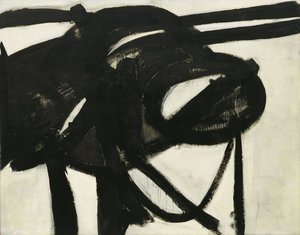
The canvas holds New York, N.Y., an oil on canvas painting by Franz Kline. Created in 1953, this work belongs to the Abstract Expressionist movement. It exists as a collision of heavy, dark gestures against a pale ground.

5
Zinc Yellow (1959) by Franz Kline

Zinc Yellow

1959 · Oil On Canvas · Chrysler Museum of Art, Norfolk

In the pantheon of Abstract Expressionism, few works command the immediate, visceral attention of a room quite like Franz Kline’s Zinc Yellow. Completed in 1959, this monumental canvas serves as a breathtaking masterclass in reductive abstraction, where the boundaries between color and form dissolve into a singular, energetic event. At first glance, the viewer is met with an expansive, luminous field of yellow that seems to vibrate against the stark,…

6
Untitled (1956) by Franz Kline

Untitled

1956 · Acrylic On Canvas

Franz Kline’s “Untitled,” painted in 1956, stands as a cornerstone of American Abstract Expressionism—a movement defined by its rejection of representational imagery and embrace of spontaneous gesture. More than just pigment on canvas, this artwork embodies the profound influence of Kline's personal history and his unwavering dedication to capturing the essence of feeling through uncompromising artistic process.

7
Untitled (1959) by Franz Kline

Untitled

1959 · Black and White Photography · Metropolitan Museum of Art, New York

This monochromatic photograph, dated 1959, captures a candid scene within a dense, wooded environment. The upper two-thirds of the frame are occupied by a heavy canopy of trees and foliage, creating a sense of enclosure through layered, organic lines. Natural daylight filters through the leaves, producing sharp highlights on certain surfaces while casting deep, dark shadows across the background. In the midground, several figures are positioned within a clearing. To…

Franz Kline's famous paintings, numbers 11 to 48

The subjects that held Franz Kline's eye

The four subjects that come back most often in these originals, each with its finest example.

The museums that keep Franz Kline's originals

The 8 museums that hold the most of the paintings on this page.

Museum City Works by Franz Kline Paintings from this list
Smithsonian American Art Museum, Washington, D.C.Smithsonian American Art Museum Washington, D.C. 3 Untitled, Palmerton, Pa., Blueberry Eyes
Metropolitan Museum of Art, New YorkMetropolitan Museum of Art New York 2 Black, White, and Gray, Untitled
Museum of Fine Arts, BostonMuseum of Fine Arts Boston 2 Black on Green, Red, and Yellow, Probst I
Whitney Museum of American Art, New YorkWhitney Museum of American Art New York 1 Mahoning
Albright-Knox Art Gallery, New York CityAlbright-Knox Art Gallery New York City 1 New York, N.Y.
Chrysler Museum of Art, NorfolkChrysler Museum of Art Norfolk 1 Zinc Yellow
Worcester Art Museum, WorcesterWorcester Art Museum Worcester 1 Untitled
Cleveland Museum of Art, ClevelandCleveland Museum of Art Cleveland 1 Accent Grave

Franz Kline across the decades: one unique original for each

Works per decade

Pick a decade to see the original that defines it.

Franz Kline's paintings: questions for the gallery

What is the single most famous work of Franz Kline?Reveal the answer

Mahoning (1956), Whitney Museum of American Art, New York. Black, White, and Gray (1959) and Untitled (1959) come next.

At what age did Franz Kline create Mahoning?Reveal the answer

46 years old: Mahoning dates from 1956, and Franz Kline was born in 1910.

Which ten paintings by Franz Kline are the most famous?Reveal the answer

Mahoning, Black, White, and Gray, Untitled, New York, N.Y., Zinc Yellow, Untitled, Untitled, Study for "Flanders", Untitled and Frederick Blumenstein. The ranking above gives each one's year and museum.

How many works by Franz Kline are known?Reveal the answer

Our catalog holds 53 works by Franz Kline, dated from 1938 to 1961.

Where can the most famous Franz Kline originals be seen?Reveal the answer

Mostly in Smithsonian American Art Museum (Washington, D.C.), Metropolitan Museum of Art (New York) and Museum of Fine Arts (Boston). The museum table above lists them all.

During which period did Franz Kline create the best-known paintings?Reveal the answer

In 1950s: 17 of the 48 works on this page were made then, Mahoning among them.

Which famous Franz Kline painting is the earliest, and which the latest?Reveal the answer

On this page, the earliest is Circus Scene (1938) and the latest Study for "Flanders" (1961).

What subjects did Franz Kline favour?Reveal the answer

Black and white (4), Geometric forms (4) and Black and white art (4), across the 48 works on this page.

What materials did Franz Kline paint with most?Reveal the answer

Oil On Canvas, for 4 of the 48 works on this page.

Which movement does the work of Franz Kline belong to?Reveal the answer

Abstract expressionism, judging by the originals on this page.

What Franz Kline originals can I see at the Smithsonian American Art Museum?Reveal the answer

Untitled, Palmerton, Pa. and Blueberry Eyes: the Smithsonian American Art Museum, Washington, D.C. holds 3 of the works on this page.

Franz Kline: a portrait of the artist

A Life Forged in Contrast: The World of Franz Kline

Franz Kline, a pivotal figure in the Abstract Expressionist movement, remains an artist whose work resonates with raw power and emotional depth. Born in Wilkes-Barre, Pennsylvania, in 1910, his life was marked by early hardship – the suicide of his father when he was just seven years old cast a long shadow, influencing a sensibility that would later find expression in the stark contrasts defining his art. This formative experience led to a nomadic youth and eventual enrollment at Girard College, a Philadelphia boarding school for boys who had lost their fathers. It was here, amidst structured discipline, that Kline’s artistic inclinations began to surface, nurtured by traditional training in illustration and drafting. He continued his studies at Boston University and later honed his skills at the Heatherley School of Fine Art in London, immersing himself in the works of the Old Masters – Rembrandt, Velázquez, El Greco, Goya, Dürer – and absorbing the nuances of Japanese prints. These early influences, though seemingly distant from his eventual abstract style, laid a foundation for his understanding of composition, light, and the expressive potential of line.

From Representation to Revelation: The Evolution of an Abstract Vision

Kline’s artistic journey wasn't immediate or linear. Throughout the 1930s and early 40s, he worked as a figurative painter, creating landscapes, cityscapes, portraits, and even murals. His “Hot Jazz” mural series from 1940, commissioned for a Greenwich Village tavern, signaled a shift towards simplification, hinting at the bold forms to come. However, it was a pivotal encounter with Willem de Kooning in 1948 that truly unlocked his abstract potential. De Kooning suggested projecting one of Kline’s sketches onto a wall using a Bell-Opticon projector – an act that dramatically enlarged and transformed the image, reducing it to its essential strokes. This experience proved revelatory for Kline; he began exploring large-scale abstractions characterized by dynamic black brushstrokes on white canvases. He abandoned representationalism not as a rejection of form, but as a pursuit of pure expression, stripping away narrative content to focus on the visceral impact of gesture and line. The resulting works weren’t merely paintings, they were *events* – energetic confrontations between darkness and light, control and chaos.

The Language of Black and White: Defining Kline's Aesthetic

Kline’s mature style is instantly recognizable for its monochromatic palette—primarily black on white. This wasn’t a limitation but a deliberate choice, emphasizing the interplay of positive and negative space, creating a visual tension that draws the viewer into the heart of the composition. He believed the white was as crucial as the black, not merely an absence of color but an active participant in the dialogue between form and void. His brushstrokes were fluid, dynamic, and often applied with house-painting brushes on large canvases, immersing the spectator within his abstract world. While some observers have noted similarities to Japanese calligraphy, Kline consistently denied any conscious influence, asserting that his work stemmed from a more primal, intuitive source. He frequently titled his paintings after places from his childhood or industrial landscapes – “Lehighton,” “Mahoning” – offering subtle anchors to his personal history without dictating the interpretation of the abstract forms. These titles served as echoes rather than explanations, inviting viewers to engage with the work on their own terms.

Legacy and Influence: A Lasting Impact on Modern Art

By the 1950s, Franz Kline had achieved significant recognition within the New York School—an informal group of artists including Jackson Pollock, Willem de Kooning, Robert Motherwell, and Lee Krasner who were redefining American art. He exhibited at prestigious galleries like Egan Gallery and Sidney Janis Gallery, participated in the Venice Biennale in 1960 (receiving the Italian Ministry of Public Instruction Prize), and taught at Black Mountain College and Pratt Institute. Kline’s influence extended beyond Abstract Expressionism, subtly shaping the development of Minimalism. His reluctance to imbue his work with hidden meanings resonated with artists like Donald Judd and Richard Serra, who sought to reduce art to its essential forms. Tragically, Kline's career was cut short by declining health; diagnosed with rheumatic heart disease in 1961, he died in New York City in 1962 at the age of 51. Despite his relatively brief artistic output, Franz Kline left an indelible mark on modern art, establishing gestural abstraction as a powerful and enduring force. His paintings continue to captivate audiences with their raw energy, emotional intensity, and profound exploration of form and space—a testament to a life forged in contrast and expressed through the bold language of black and white.