


1


Updated October 2026 · ranked by our popularity score (searches, visits and orders for each work) · 93 works by Ernst Fuchs in our catalogue
In short
Of all the originals Ernst Fuchs left, the most famous is THE ANGEL OF HISTORY (1992). Close behind it come THE LOST ORDEAL (1950) and SATAN'S HEAVEN (1954). Our catalog holds 93 works by Ernst Fuchs; the gallery has kept the 93 the world admires most, each shown with its date, its museum and its story.


 untitled (4766)
12
 untitled (8374)
13
 untitled (9849)
14
 untitled (8760)
15
 untitled (3545)
16
 untitled (9147)
17
 untitled (4778)
18
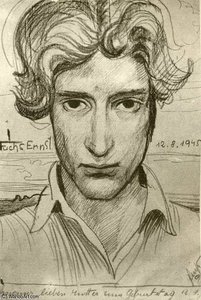 untitled (4410)
19
 untitled (5885)
20
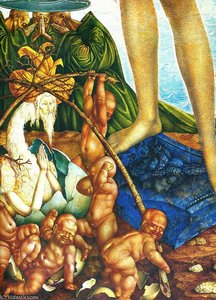 untitled (5692)
21
 untitled (9379)
22
 untitled
23
 untitled (2213)
24
 Looking through space (The golden nose)
25
 untitled (502)
26
 The Sorrowful Rosary
27
 The Lamentation of the ambivalent1947
28
 THE TEMPTATION OF THE VICTOR1949
29
 The spirit of Mercury1954
30
 THE ANGEL OF DEATH OVER THE GATE TO PURGATORY1956
31
 THE WEDDING OF THE UNICHORN1960
32
 Psalm 691960
33
 Metamorphoses of Lucretia1958
34
 The Glorious Rosary1961
35
 Observator Infinitor1972
36
 THE TEMPLE ISLAND1983
37
 SELF-PORTRAIT WITH FEATHER HAT1983
38
 THE ANGEL OF THE LORD1983
39
 THE PEACOCK1986
40
 SOUTHERN FRENCH LANDSCAPE1986
41
 THE ROSE KING1984
42
 THE WHORE BABYLON1995
43
 The Bottom of the World2008
44
 untitled (9598)
45
 untitled (3673)
46
 untitled (9724)
47
 untitled (4885)
48
 untitled (1522)
49
 untitled (4955)
50
 untitled (7564)
51
 untitled (5521)
52
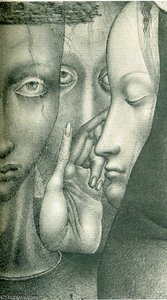 untitled (8257)
53
 untitled (425)
54
 untitled (9120)
55
 untitled (9657)
56
 untitled (8254)
57
 untitled (4743)
58
 untitled (9465)
59
 untitled (8028)
60
 untitled (5515)
61
 untitled (9306)
62
 untitled (4098)
63
 untitled (2965)
64
 untitled (5591)Bavarian State Painting Collections
65
 untitled (195)
66
 untitled (4609)
67
 untitled (8524)
68
 untitled (2917)
69
 untitled (8491)
70
 untitled (8290)
71
 untitled (1705)
72
 untitled (1295)
73
 untitled (9386)
74
 untitled (5306)
75
 untitled (6418)
76
 untitled (4688)
77
 untitled (7680)
78
 untitled (236)
79
 untitled (6367)
80
 untitled (5726)
81
 untitled (5267)
82
 untitled (9551)
83
 untitled (8608)
84
 untitled (1418)
85
 untitled (4223)
86
 untitled (2786)
87
 untitled (3164)
88
 untitled (4782)
89
 untitled (7421)
90
 untitled (3980)
91
 untitled (6804)
92
 untitled (5448)
93
 untitled (1050)
The four subjects that come back most often in these originals, each with its finest example.
The museum that holds the most of the paintings on this page.
| Museum | City | Works by Ernst Fuchs | Paintings from this list |
|---|---|---|---|
 Bavarian State Painting Collections |
Munich | 1 | untitled (5591) |
Pick a decade to see the original that defines it.


THE ANGEL OF HISTORY (1992). THE LOST ORDEAL (1950) and SATAN'S HEAVEN (1954) come next.
62 years old: THE ANGEL OF HISTORY dates from 1992, and Ernst Fuchs was born in 1930.
THE ANGEL OF HISTORY, THE LOST ORDEAL, SATAN'S HEAVEN, Plot 68, SPHINX I, THE VENUS BELT, SODOM, untitled (7580), untitled (4670) and untitled (7755). The ranking above gives each one's year and museum.
Our catalog holds 93 works by Ernst Fuchs, dated from 1947 to 2008.
Mostly in Bavarian State Painting Collections (Munich). The museum table above lists them all.
In 1980s: 6 of the 93 works on this page were made then, THE TEMPLE ISLAND among them.
On this page, the earliest is The Lamentation of the ambivalent (1947) and the latest The Bottom of the World (2008).
Symbols (7), Symbolic imagery (6) and Angels (2), across the 93 works on this page.
Surrealism, judging by the originals on this page.
Ernst Fuchs (1930–2015) was far more than a mere painter; he was a multidisciplinary visionary who wove together the threads of sculpture, architecture, music, and poetry to create a singular, hallucinatory universe. Born in Vienna during a period of profound historical transition, Fuchs emerged from the wreckage of the post-war era not with despair, but with an unquenchable thirst for the sublime. His journey began in the tactile world of sculpture, a discipline that instilled in him a permanent reverence for form and substance. This early foundation allowed him to approach the canvas not as a flat surface, but as a space for architectural depth and physical presence, where figures could breathe within meticulously constructed dreamscapes.
The heart of Fuchs’s legacy lies in his role as a founding pillar of the Vienna School of Fantastic Realism. Established in 1946 alongside luminaries such as Friedensreich Hundertwasser and Arnulf Rainer, this movement sought to move beyond the starkness of pure abstraction by embracing a hyper-detailed, symbolic reality. Influenced heavily by the psychological depths of Jungian archetypes and the transformative mysteries of alchemy, Fuchs used his art to confront existential anxieties through a lens of profound beauty. His work often feels like a window into a collective unconscious, where the boundaries between the physical world and the spiritual realm are perpetually blurred.
What truly distinguishes a Fuchs masterpiece is the technical wizardry of his mischtechnik—a revolutionary revival of Renaissance-era glazing techniques. By layering translucent glazes over meticulously prepared surfaces, he achieved a luminous, inner glow that seems to emanate from within the paint itself. This method allowed him to capture the subtle interplay of light and shadow, lending an almost supernatural vitality to his subjects. Whether depicting the fleshy, unsettling figures of his expressionistic works or the opulent, dreamlike motifs of his more fantastical compositions, the technical precision of his hand ensured that every brushstroke contributed to a sense of overwhelming realism.
This mastery of technique served as the perfect vessel for his complex symbolic language. In his paintings, one might encounter:
Fuchs’s creative impulse was never confined to the studio. His architectural endeavors, most notably his restoration of the Otto Wagner Villa in Hütteldorf, demonstrated his ability to manifest his internal visions in the physical world. By transforming this derelict structure into the Ernst Fuchs Museum, he created a permanent sanctuary for the very magic he spent his life documenting. This act of restoration mirrored his artistic philosophy: taking the fractured pieces of reality and reassembling them into something transcendent and whole.
As we look back on his prolific career, the historical significance of Ernst Fuchs remains undiminished. He stood as a bridge between the classical traditions of the Old Masters and the psychological complexities of the modern age. Through his unwavering dedication to fantastic realism, he reminded the world that even in the darkest of eras, the human imagination possesses the power to construct heavens of light, color, and infinite wonder. His work continues to haunt and inspire, a testament to a life lived at the intersection of the seen and the unseen.
