Portrait of Ed Ruscha

Ed Ruscha Paintings: The 47 Most Famous, Through a Gallery's Eye

Updated October 2026 · ranked by our popularity score (searches, visits and orders for each work) · 47 works by Ed Ruscha in our catalogue

In short

To the gallery's eye, Ed Ruscha's most famous painting is Standard station (1966). OOF (1963) and Norm's, La Cienega, on Fire complete the trio every eye recognises. Of the 47 works by Ed Ruscha in our catalog, the gallery presents the 47 most famous below, each original with its year, its museum and what makes it unique.

born 1937, Omaha Pop art Most works: MOMA - Museum of Modern Art

The gallery's top 10 Ed Ruscha paintings

1
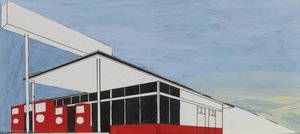
Standard station (1966) by Ed Ruscha

Standard station

1966 · Digital Illustration

Captivating Subject and Iconic Representation This artwork presents a stylized, minimalist depiction of a classic gas station, capturing a quintessential symbol of American roadside culture. Through its simplified yet instantly recognizable form, it evokes the bustling energy of mid-20th-century America, where the gas station was not just a service point but a cultural icon. The composition emphasizes the structural elements of the station, including the canopy, signage, and fuel pumps,…

2
OOF (1963) by Ed Ruscha

OOF

1963 · Acrylic On Canvas · MOMA - Museum of Modern Art, New York City

A Bold Statement in Pop: Deconstructing ‘OOF’ by Edward Ruscha Edward Ruscha's *OOF*, created in 1963, is far more than a simple depiction of an onomatopoeic exclamation. It’s a pivotal work within the Pop Art movement—a moment where language itself became subject matter, divorced from descriptive function and elevated to visual prominence. This large-scale painting, currently residing at the Museum of Modern Art in New York, embodies Ruscha's signature style:…

3
Norm's, La Cienega, on Fire by Ed Ruscha

Norm's, La Cienega, on Fire

Oil On Canvas

Ed Ruscha painted Norm's, La Cienega, on Fire in 1964. The work captures a West Hollywood coffee shop engulfed in flames. Smoke pours from the interior of the building, rising into the air. This structure is a roadside icon, a 24-hour restaurant that has occupied its site in Southern California since 1957.

5
Acting Silly (1974) by Ed Ruscha

Acting Silly

1974 · Silk · Serralves Foundation, Porto

In the vast landscape of Pop Art, few works capture the playful tension between linguistic meaning and visual form as effectively as Edward Joseph Ruscha IV’s 1974 masterpiece, "Acting Silly." This evocative piece serves as a profound meditation on how language can transcend its role as a mere carrier of information to become a sculptural, rhythmic element within a composition. At first glance, the viewer is met with a mesmerizing…

8
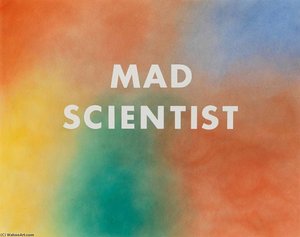
Mad scientist by Ed Ruscha

Mad scientist

Edward Ruscha, a pivotal figure in the Pop Art movement, presents "Mad Scientist," a vibrant and intriguing work that encapsulates his signature style. Born in Omaha, Nebraska, Ruscha's artistic journey led him to Los Angeles where he honed his skills at the Chouinard Art Institute (now California Institute of the Arts). His exploration of American landscapes, typography, and vernacular language has cemented his place as an influential artist.

Ed Ruscha paintings, ranked 11 to 47

Ed Ruscha's famous paintings, period by period

The subjects that held Ed Ruscha's eye

The four subjects that come back most often in these originals, each with its finest example.

The museums that keep Ed Ruscha's originals

The 7 museums that hold the most of the paintings on this page.

Museum City Works by Ed Ruscha Paintings from this list
MOMA - Museum of Modern Art, New York CityMOMA - Museum of Modern Art New York City 1 OOF
Tate Britain, LondonTate Britain London 1 The End -1
Serralves Foundation, PortoSerralves Foundation Porto 1 Acting Silly
Israel Museum, JerusalemIsrael Museum Jerusalem 1 Future Experiences
San Francisco Museum of Modern Art, San FranciscoSan Francisco Museum of Modern Art San Francisco 1 Parts per Trillion
Hayward Gallery, LondonHayward Gallery London 1 Hurting the Word Radio #2
Whitney Museum of American Art, New YorkWhitney Museum of American Art New York 1 The Old Tool & Die Building

Ed Ruscha, one signature painting per decade

Works per decade

Pick a decade to see the original that defines it.

Ed Ruscha's paintings: the gallery answers

Which Ed Ruscha painting is the most famous of all?Reveal the answer

Standard station (1966). OOF (1963) and Norm's, La Cienega, on Fire come next.

How old was Ed Ruscha on completing Standard station?Reveal the answer

29 years old: Standard station dates from 1966, and Ed Ruscha was born in 1937.

Which are Ed Ruscha's top 10 paintings?Reveal the answer

Standard station, OOF, Norm's, La Cienega, on Fire, The End -1, Acting Silly, Pay nothing until april, She Gets Angry at Him, Mad scientist, Future Experiences and Parts per Trillion. The ranking above gives each one's year and museum.

How many works did Ed Ruscha create?Reveal the answer

Our catalog holds 47 works by Ed Ruscha, dated from 1963 to 2004.

Where do Ed Ruscha's most famous originals hang?Reveal the answer

Mostly in MOMA - Museum of Modern Art (New York City), Tate Britain (London) and Serralves Foundation (Porto). The museum table above lists them all.

When did Ed Ruscha create the most famous paintings?Reveal the answer

In 1980s: 7 of the 47 works on this page were made then, Future Experiences among them.

Which are Ed Ruscha's earliest and latest famous works?Reveal the answer

On this page, the earliest is OOF (1963) and the latest The Old Tool & Die Building (2004).

Which subjects did Ed Ruscha return to most?Reveal the answer

Typography (3), Graphic design (2) and American visuals (2), across the 47 works on this page.

Which medium did Ed Ruscha work in most?Reveal the answer

Acrylic On Canvas, for 4 of the 47 works on this page.

Which movement is Ed Ruscha associated with?Reveal the answer

Pop art, judging by the originals on this page.

Ed Ruscha: the artist

Edward Joseph Ruscha IV: A Pioneer of Pop Art

Early Life and Education

  • Born on December 16, 1937, in Omaha, Nebraska, Edward Joseph Ruscha IV grew up in a Roman Catholic family.
  • He showed an early interest in art, particularly cartooning, nurtured by his mother’s support.
  • Ruscha moved to Los Angeles in 1956 and studied at the Chouinard Art Institute (now CalArts) from 1956-1960 under Robert Irwin and Emerson Woelffer.
  • During his time at Chouinard, he co-edited the journal *Orb*, a precursor to alternative newspapers.

Artistic Development and Influences

  • Ruscha’s artistic journey began in the early 1960s, aligning him with the Ferus Gallery group in Los Angeles.
  • He was influenced by a diverse range of artists including Jasper Johns, John McLaughlin, H.C. Westermann, Arthur Dove, Alvin Lustig, and Marcel Duchamp.
  • The work of Edward Hopper, particularly his painting *Gas* (1940), also resonated with Ruscha’s developing style.
  • His early works explored the visual language of commercialism and everyday American life.

Key Themes and Style

  • Ruscha is renowned for his incorporation of text and phrases into paintings, often presented in a flat, deadpan aesthetic.
  • He frequently depicted commonplace subjects like gas stations, motels, and landscapes of Southern California.
  • His photographic books, such as Every Building on the Sunset Strip (1966), are iconic examples of his conceptual approach to art.
  • A key theme in Ruscha’s work is the exploration of vernacular language and the visual culture of Los Angeles.

Major Achievements and Notable Works

  • Some of his most celebrated works include:
    • Standard Station (1966): A quintessential representation of American roadside architecture.
    • Large Trademark (1962): An early example of his word-based paintings.
    • Hollywood (1982): Reflecting the iconic imagery of Los Angeles.
    • Every Building on the Sunset Strip (1966): A groundbreaking photographic book documenting a stretch of Sunset Boulevard.
  • Ruscha’s work challenged traditional notions of painting and photography, blurring the boundaries between art forms.

Historical Significance and Legacy

  • Ruscha is considered a pivotal figure in the Pop Art movement, though his style often transcends easy categorization.
  • His influence extends to contemporary artists working with language, photography, and conceptual art.
  • He helped establish Los Angeles as a significant center for artistic innovation during the 1960s.
  • Ruscha continues to live and work in Culver City, California, remaining an active and influential force in the art world.

All 47 works by Ed Ruscha →