Portrait of Claes Oldenburg

The 32 Most Famous Claes Oldenburg Paintings, a Gallery Selection

Updated October 2026 · ranked by our popularity score (searches, visits and orders for each work) · 32 works by Claes Oldenburg in our catalogue

In short

Of all the originals Claes Oldenburg left, the most famous is Knifeship - (85). Close behind it come Store poster and Split button. Our catalog holds 32 works by Claes Oldenburg; the gallery has kept the 32 the world admires most, each shown with its date, its museum and its story.

1929 – 2022, Malmö Pop art Most works: Yale University Art Gallery

Claes Oldenburg's top 10 paintings: the gallery's choice

1
Knifeship - (85) by Claes Oldenburg

Knifeship - (85)

Digital Photography

Dynamic Fusion of Modernity and Heritage This striking sculpture masterfully combines contemporary artistic innovation with historical architectural elements, creating a captivating dialogue between the past and present. The imposing knife-like structure, rendered with meticulous attention to detail, symbolizes sharpness, conflict, and transformation. Its exaggerated scale and reflective metallic surfaces evoke a sense of power and movement, inviting viewers to contemplate the tension between tradition and modernity. The scene’s layered composition,…

2
Store poster by Claes Oldenburg

Store poster

Acrylic On Canvas

Vibrant Expressionism and Dynamic Composition This captivating artwork bursts with energy and spontaneity, capturing a lively tableau that invites viewers into a world of vivid emotion and playful chaos. Through an abstract or semi-abstract approach, the piece explores the interplay of everyday objects, rendered with vigorous line work and a bold, colorful palette. Its energetic composition evokes a sense of movement and immediacy, making it a compelling centerpiece for modern…

3
Split button by Claes Oldenburg

Split button

Sculpture Bronze

Exploring Modern Minimalism and Playful Abstraction This striking outdoor sculpture captures the imagination with its oversized, abstracted form of a button, transforming a mundane everyday object into a monumental work of art. Crafted with sleek, smooth surfaces and rounded, organic contours, the piece embodies the principles of contemporary minimalism. Its clean lines and polished finish evoke a sense of modern elegance, inviting viewers to reconsider the familiar through a new,…

4
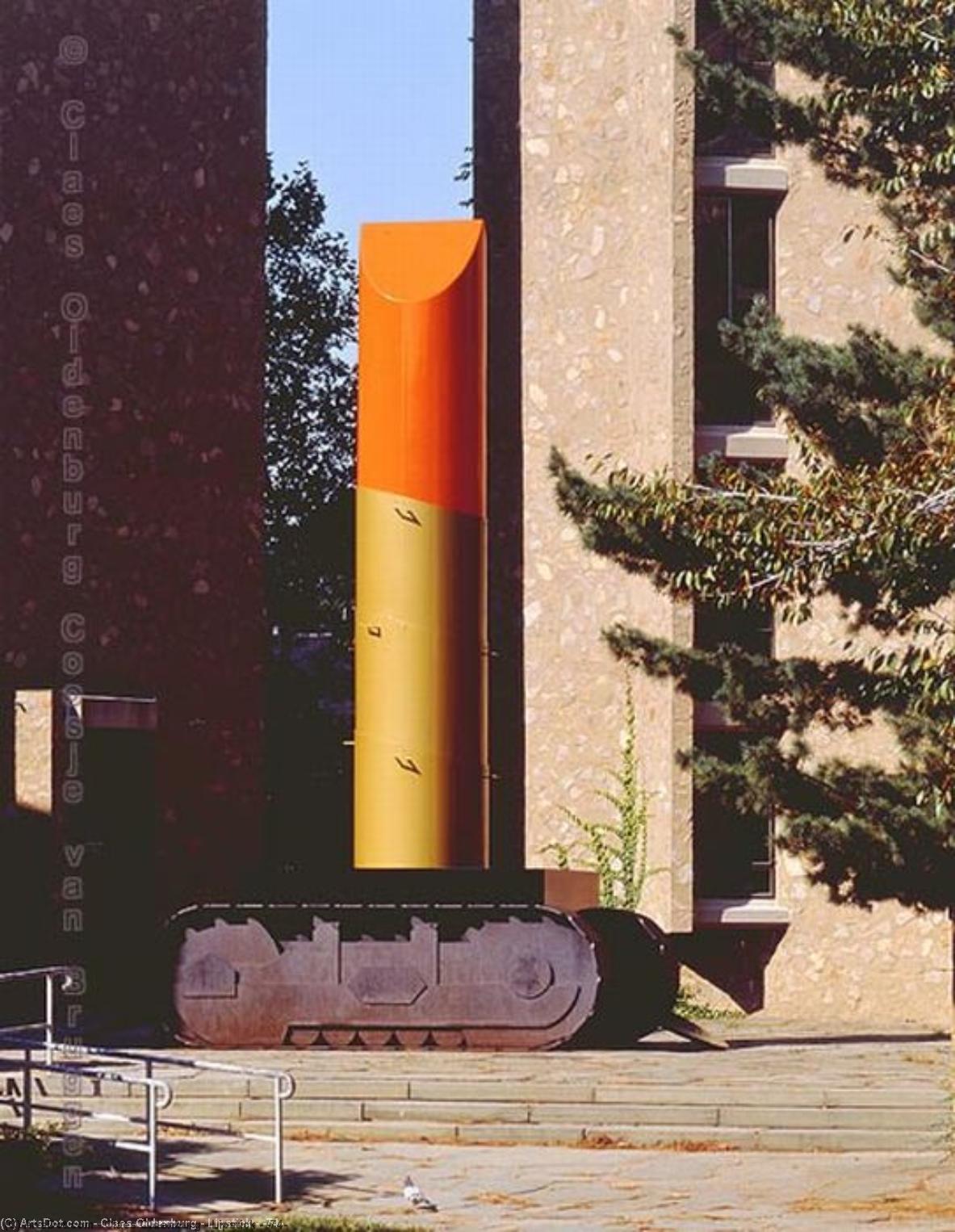
Lipstick - (74) by Claes Oldenburg

Lipstick - (74)

Metal

Subject and Visual Impact This striking sculpture captures the imagination with its bold, oversized depiction of a lipstick, transforming a familiar object into a monumental work of art. Its vibrant colors—rich reds, oranges, and yellows—immediately draw the eye, creating a focal point that commands attention. The piece’s exaggerated scale and vivid palette evoke a sense of playfulness and empowerment, making it a captivating centerpiece in any space. Its sleek, smooth…

5
Free by Claes Oldenburg

Free

Sculpture Bronze

Subject and Concept This striking sculpture captures the universal symbol of love through a bold, oversized representation of the word "LOVE." Its playful, exaggerated form invites viewers to reflect on the power of affection and human connection. The dynamic arrangement of the letters, leaning and interacting with each other, evokes a sense of movement and vitality, making it a compelling focal point in any space. The vibrant colors and monumental…

6
Lipstick (Ascending) on Caterpillar Tracks (1969) by Claes Oldenburg

Lipstick (Ascending) on Caterpillar Tracks

1969 · Sculpture · Yale University Art Gallery, New Haven

To encounter Claes Oldenburg’s Lipstick (Ascending) on Caterpillar Tracks is to witness a profound disruption of the ordinary. Created in 1969, this colossal sculpture serves as one of the most audacious emblems of the Pop Art movement, masterfully transforming the mundane into the monumental. At first glance, the viewer is struck by the sheer, whimsical scale of the work: a gargantuan tube of lipstick, rendered with smooth, sweeping curves, perched…

7
Soft Drainpipe - Blue (Cool) Version (1967) by Claes Oldenburg

Soft Drainpipe - Blue (Cool) Version

1967 · Tate Modern, London

Claes Oldenburg’s “Soft Drainpipe – Blue (Cool) Version,” created in 1967, isn't merely a sculpture; it’s an invitation to reconsider our relationship with everyday objects. This remarkable piece, photographed against a stark white backdrop, immediately draws the eye to its improbable form: a monumental drainpipe rendered entirely from draped and folded fabric. The cool palette of blues—ranging from delicate sky tones to deep navy – establishes an atmosphere of quiet…

8
Two Cheeseburgers, with Everything (Dual Hamburgers) (1962) by Claes Oldenburg

Two Cheeseburgers, with Everything (Dual Hamburgers)

1962 · Plaster · MOMA - Museum of Modern Art, New York City

In the vibrant landscape of twentieth-century art, few works possess the immediate, mouth-watering charm of Claes Oldenburg’s “Two Cheesebusters, with Everything (Dual Hamburgers).” Created in 1962, this sculpture serves as a delicious intersection of Pop Art audacity and sculptural innovation. At first glance, the viewer is presented with a familiar sight: two juicy, meticulously layered cheeseburgers resting side by side. Yet, through Oldenburg’s transformative lens, these everyday objects are stripped…

9
Giant Binoculars (1991) by Claes Oldenburg

Giant Binoculars

1991 · Metal · Public Art in Public Places, California

To encounter Claes Oldenburg’s Giant Binoculars is not merely to view sculpture; it is to experience an abrupt, delightful confrontation with the monumental scale of the mundane. This piece, permanently affixed to the façade of a major urban edifice, transforms everyday instruments—the very tools of observation and curiosity—into colossal statements. Oldenburg, whose genius lay in elevating the commonplace to the realm of high art, forces us to reconsider what we…

The Claes Oldenburg selection continues, 11 to 32

The subjects that held Claes Oldenburg's eye

The four subjects that come back most often in these originals, each with its finest example.

The museums that keep Claes Oldenburg's originals

The 8 museums that hold the most of the paintings on this page.

Museum City Works by Claes Oldenburg Paintings from this list
Yale University Art Gallery, New HavenYale University Art Gallery New Haven 1 Lipstick (Ascending) on Caterpillar Tracks
Tate Modern, LondonTate Modern London 1 Soft Drainpipe - Blue (Cool) Version
MOMA - Museum of Modern Art, New York CityMOMA - Museum of Modern Art New York City 1 Two Cheeseburgers, with Everything (Dual Hamburgers)
Public Art in Public Places, CaliforniaPublic Art in Public Places California 1 Giant Binoculars
Walker Art Center, MinneapolisWalker Art Center Minneapolis 1 Spoonbridge and Cherry (collaboration with van Bruggen)
Whitney Museum of American Art, New YorkWhitney Museum of American Art New York 1 Pat Standing in a Radish Patch
Madison Museum of Contemporary Art, MadisonMadison Museum of Contemporary Art Madison 1 Floating Three-Way Plug
The Mint Museum, CharlotteThe Mint Museum Charlotte 1 Spoon Pier

Claes Oldenburg decade by decade: the original that defines each

Works per decade

Pick a decade to see the original that defines it.

Collectors' questions about Claes Oldenburg's paintings

Which work is Claes Oldenburg most famous for?Reveal the answer

Knifeship - (85). Store poster and Split button come next.

What are the ten most famous Claes Oldenburg paintings?Reveal the answer

Knifeship - (85), Store poster, Split button, Lipstick - (74), Free, Lipstick (Ascending) on Caterpillar Tracks, Soft Drainpipe - Blue (Cool) Version, Two Cheeseburgers, with Everything (Dual Hamburgers), Giant Binoculars and Spoonbridge and Cherry (collaboration with van Bruggen). The ranking above gives each one's year and museum.

How many paintings did Claes Oldenburg leave?Reveal the answer

Our catalog holds 32 works by Claes Oldenburg, dated from 1959 to 1991.

In which museums do Claes Oldenburg's masterpieces hang?Reveal the answer

Mostly in Yale University Art Gallery (New Haven), Tate Modern (London) and MOMA - Museum of Modern Art (New York City). The museum table above lists them all.

In which years did Claes Oldenburg paint the most famous works?Reveal the answer

In 1960s: 3 of the 32 works on this page were made then, Lipstick (Ascending) on Caterpillar Tracks among them.

What are the first and the last famous originals of Claes Oldenburg?Reveal the answer

On this page, the earliest is Pat Standing in a Radish Patch (1959) and the latest Giant Binoculars (1991).

Which subjects did Claes Oldenburg choose most often?Reveal the answer

Sculpture (4), Scale (3) and Urban landscape (2), across the 32 works on this page.

Which technique did Claes Oldenburg use most?Reveal the answer

Sculpture Bronze, for 2 of the 32 works on this page.

To which art movement does Claes Oldenburg belong?Reveal the answer

Pop art, judging by the originals on this page.

Claes Oldenburg: life and work

The Architect of the Everyday: The Visionary World of Claes Oldenburg

To encounter the work of Claes Oldenburg is to witness a delightful subversion of reality, where the mundane is elevated to the monumental and the familiar becomes strangely surreal. Born in Stockholm, Sweden, in 1929, Oldenburg possessed an uncanny ability to strip the ordinary of its invisibility. His artistic journey, which would eventually define much of the Pop Art movement, was rooted in a profound fascination with the textures and shapes of daily life. Whether it was the soft sag of a fabric-covered object or the towering presence of a giant utensil, Oldenburg’s oeuvre challenged the viewer to reconsider the very objects that populate our domestic and urban landscapes.

His early years were shaped by an avant-garde sensibility, absorbing the radical energies of Surrealism and Dada. This foundation allowed him to approach sculpture not as a rigid medium of stone or bronze, but as a fluid language capable of expressing absurdity and wit. After moving to New York in 1956, he became a central figure in the city's burgeoning experimental scene. His early installations, such as The Street (1960) and The Store (1961), were transformative performances of space and commerce, utilizing urban debris and plaster replicas of consumer goods to blur the line between high art and the grit of the marketplace.

Softness, Scale, and the Pop Art Revolution

One of Oldenburg’s most enduring legacies lies in his pioneering development of soft sculpture. By utilizing pliable materials like polyurethane foam and heavy fabrics, he introduced a sense of vulnerability and organic life to inanimate objects. These "floppy" versions of hard items—clothespins, telephones, or even toilets—defied the traditional permanence of sculpture, inviting a tactile, almost psychological engagement from the audience. This technique allowed him to capture the ephemeral essence of consumer culture, rendering the industrial in a state of soft, yielding repose.

As his career progressed, Oldenburg’s ambitions expanded from the intimate scale of the gallery to the grand stage of the public square. In collaboration with his late wife and creative partner, Coosje van Bruggen, his work achieved a new level of architectural grandeur. Together, they mastered the art of the monumental, creating massive installations that integrated seamlessly into the urban fabric while simultaneously disrupting it. Their collaborative spirit breathed life into iconic pieces that transformed city skylines, turning public spaces into playgrounds of imagination.

A Legacy Carved in the Public Imagination

The historical significance of Claes Oldenburg cannot be overstated; he fundamentally altered the relationship between art and the spectator. His work remains a cornerstone of 20th-century art history due to several key achievements:

  • Redefining Materiality: Through his use of soft, yielding materials, he broke the "monumental" tradition of heavy, static sculpture.
  • Pop Art Iconography: He successfully bridged the gap between high culture and popular consumerism, using symbols like hamburgers and lipsticks to comment on modern identity.
  • Public Engagement: His massive outdoor installations, such as the celebrated Spoonbridge & Cherry, democratized art by bringing it out of museums and into the daily paths of millions.
  • Collaborative Vision: His partnership with Coosje van Bruggen demonstrated how shared creative voices could push the boundaries of scale and environmental integration.

Though he passed away in 2022, Oldenburg’s influence persists in every oversized sculpture that makes us pause, smile, or question our surroundings. He left behind a world that feels slightly more magical, reminding us that even the most overlooked object—a spoon, a plug, or a piece of fruit—holds the potential for greatness if viewed through the lens of a truly transformative imagination.

All 32 works by Claes Oldenburg →