Portrait of Albert Bierstadt

The 100 Most Famous Albert Bierstadt Paintings, Each One of a Kind

Updated November 2026 · ranked by our popularity score (searches, visits and orders for each work) · 698 works by Albert Bierstadt in our catalogue

In short

Rocky Mountains (1863) is the Albert Bierstadt painting that draws the most eyes. After it, the eye goes to Rustic Mill (1855) and Among the Sierra Nevada Mountains, California (1868). Among the 698 works of Albert Bierstadt in our catalog, these 100 are the most famous, each a unique original presented with its year, its museum and the reason it endures.

1830 – 1902, Solingen Hudson river school Most works: Buffalo Bill Center of The West

Top 10 paintings by Albert Bierstadt, through the gallery's eye

1
Rocky Mountains (1863) by Albert Bierstadt

Rocky Mountains

1863 · Oil On Canvas

Painted in 1863, this breathtaking landscape exemplifies Albert Bierstadt’s mastery of the Romantic style and his pivotal role within the Hudson River School. More than just a depiction of scenery, it's an immersive experience that captures the sublime grandeur and untamed beauty of the Rocky Mountains – a vision that profoundly shaped America’s perception of its western frontier.

2
Rustic Mill (1855) by Albert Bierstadt

Rustic Mill

1855 · Oil On Canvas

A Pastoral Masterpiece Immerse yourself in the tranquil beauty of this captivating landscape painting by Albert Bierstadt. Created in 1855, this artwork invites viewers into a serene rural scene where nature's splendor takes center stage. The composition features a rustic house nestled among lush greenery and towering trees, evoking a sense of peace and harmony with the natural world. Style and Technique Bierstadt's masterful technique shines through in this detailed…

3
Among the Sierra Nevada Mountains, California (1868) by Albert Bierstadt

Among the Sierra Nevada Mountains, California

1868 · Oil On Canvas · Smithsonian American Art Museum, Washington, D.C.

A Masterpiece of the American West Albert Bierstadt's "Among the Sierra Nevada Mountains, California" is a breathtaking landscape painting that captures the grandeur and untouched beauty of the American West. Created in 1868, this masterpiece is a testament to Bierstadt's skill as a painter and his deep appreciation for nature. Luminous Landscapes and Romantic Realism Bierstadt was a key figure in the Hudson River School, known for their detailed and…

4
Staubbach Falls, Near Lauterbrunnen, Switzerland (1856) by Albert Bierstadt

Staubbach Falls, Near Lauterbrunnen, Switzerland

1856 · Oil On Canvas

A Masterpiece of Nature's Grandeur Albert Bierstadt's *Staubbach Falls, Near Lauterbrunnen, Switzerland* (1856) is a breathtaking testament to the sublime beauty of nature. This luminous landscape captures the majestic Staubbach Falls in Switzerland, surrounded by towering mountains and lush greenery bathed in the warm hues of sunset. The artwork invites viewers into a serene yet awe-inspiring world, where the power and tranquility of nature are harmoniously intertwined. Luminism and Romantic…

5
Forest Sunrise by Albert Bierstadt

Forest Sunrise

Digital

A Serene Forest Landscape Immerse yourself in the tranquil beauty of this captivating forest scene, where soft, ethereal light bathes the landscape in a dreamlike glow. The composition is structured around a central clearing, drawing the viewer's eye into the heart of the forest. Tall trees frame the scene on either side, their branches intertwining to form a natural archway that invites exploration. The ground is covered with fallen leaves…

6
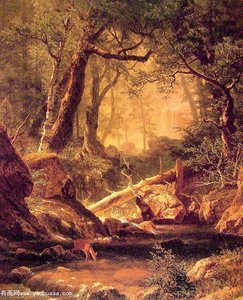
Deer in a Clearing by Albert Bierstadt

Deer in a Clearing

Oil On Canvas

A Serene Woodland Retreat Immerse yourself in the tranquil beauty of this captivating woodland scene, where nature's splendor is captured in exquisite detail. The painting depicts a peaceful forest clearing bathed in the warm glow of either sunrise or sunset, evoking a sense of calm and serenity. Tall trees frame both sides of the scene, creating a natural corridor that enhances depth and perspective. At the heart of the composition,…

7
In the Mountains by Albert Bierstadt

In the Mountains

Oil On Canvas · Wadsworth Atheneum, Hartford

Albert Bierstadt's "In the Mountains" stands as a monumental testament to the Romantic ideals that swept through 19th-century America, specifically within the influential Hudson River School. This breathtaking landscape isn't merely a depiction of a mountain scene; it’s an immersive experience, a carefully constructed panorama designed to evoke awe and reverence for the untamed beauty of the American West. Bierstadt, deeply influenced by his European training – particularly in Düsseldorf…

8
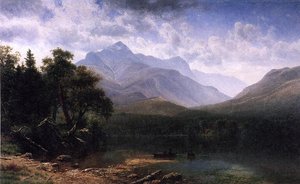
Rock Mountains Lander's Peak'''' (1863) by Albert Bierstadt

Rock Mountains Lander's Peak''''

1863 · Oil On Canvas · Fogg Museum, Cambridge

Albert Bierstadt’s "Rock Mountains Lander's Peak," painted in 1863, stands as a quintessential example of the Hudson River School’s dramatic and romantic approach to landscape painting. This monumental work transcends mere topographical representation; it is an immersive experience, a carefully constructed evocation of awe and reverence for the untamed grandeur of the American West. The scene unfolds with a deliberate sense of scale, dominated by the imposing presence of Lander's…

9
Scene in the Sierra Nevada (1861) by Albert Bierstadt

Scene in the Sierra Nevada

1861 · Oil On Canvas

In the heart of the mid-19th century, as the American frontier beckoned with promises of untold grandeur, Albert Bierstadt captured a moment of profound stillness and monumental scale in “Scene in the Sierra Nevada.” Completed in 1861, this masterpiece serves as a cornerstone of the Hudson River School, an artistic movement that sought to translate the raw, untamed spirit of the wilderness into a language of spiritual reverence. The painting…

10
Yosemite Valley by Albert Bierstadt

Yosemite Valley

Oil On Canvas

In this view of Yosemite Valley, we find ourselves standing before a landscape that feels deeply settled. A river winds its way through the center of the composition, cutting a soft path between banks lined with dense, dark greenery. The water reflects the light in a way that suggests a slow, steady movement through the heart of the wilderness. Scattered throughout the scene are pine trees, some standing close to…

Albert Bierstadt's famous paintings, numbers 11 to 100

11Campfire Site, Yosemite (1873) by Albert BierstadtCampfire Site, Yosemite1873 12Merced River, Yosemite Valley (1866) by Albert BierstadtMerced River, Yosemite Valley1866 · Metropolitan Museum of Art 13A Western Landscape (1870) by Albert BierstadtA Western Landscape1870 14Sacramento River Valley (1872) by Albert BierstadtSacramento River Valley1872 · Thyssen-Bornemisza Museum 15The Coming Storm (1869) by Albert BierstadtThe Coming Storm1869 · Addison Gallery of American Art 16Indian Encampment, Shoshone Village (1860) by Albert BierstadtIndian Encampment, Shoshone Village1860 17Valley of the Yosemite (1864) by Albert BierstadtValley of the Yosemite1864 · Museum of Fine Arts 18Moonlight on the Merced (1864) by Albert BierstadtMoonlight on the Merced1864 · Centennial One Object Exhibit 19Yosemite Valley (Looking Down the Yosemite Valley) (1868) by Albert BierstadtYosemite Valley (Looking Down the Yosemite Valley)1868 · Oakland Museum of California 20Sunset in the Yosemite Valley (1869) by Albert BierstadtSunset in the Yosemite Valley1869 · Haggin Museum 21New England Landscape (1889) by Albert BierstadtNew England Landscape1889 22Evening on the Prairie (1870) by Albert BierstadtEvening on the Prairie1870 · Thyssen-Bornemisza Museum 23The Oregon Trail (1869) by Albert BierstadtThe Oregon Trail1869 · Joslyn Art Museum 24Buffalo Trail the Impending Storm (1869) by Albert BierstadtBuffalo Trail the Impending Storm1869 · National Gallery of Art 25Western Kansas (1875) by Albert BierstadtWestern Kansas1875 26A Rocky Mountain Sheep, Ovis, Montana (1879) by Albert BierstadtA Rocky Mountain Sheep, Ovis, Montana1879 27Sunrise, Yosemite Valley (1870) by Albert BierstadtSunrise, Yosemite Valley1870 · Amon Carter Museum of American Art 28Niagara Falls (1869) by Albert BierstadtNiagara Falls1869 · Fine Arts Museums of San Francisco 29Glen Ellis Falls (1869) by Albert BierstadtGlen Ellis Falls1869 · Zimmerli Art Museum at Rutgers University 30The Wolf River, Kansas (1859) by Albert BierstadtThe Wolf River, Kansas1859 · Detroit Institute of Arts 31Study for Yosemite Valley Glacier Point Trail (1873) by Albert BierstadtStudy for Yosemite Valley Glacier Point Trail1873 32Thunderstorm in the Rocky Mountains (1859) by Albert BierstadtThunderstorm in the Rocky Mountains1859 · Museum of Fine Arts 33Gates of the Yosemite (1882) by Albert BierstadtGates of the Yosemite1882 · Smithsonian American Art Museum 34Sundown at Yosemite (1863) by Albert BierstadtSundown at Yosemite1863 · Thyssen-Bornemisza Museum 35Passing Storm over the Sierra Nevadas (1870) by Albert BierstadtPassing Storm over the Sierra Nevadas1870 · San Antonio Museum of Art 36White Mountains, New Hampshire (1863) by Albert BierstadtWhite Mountains, New Hampshire1863 37Sunset on the Coast (1866) by Albert BierstadtSunset on the Coast1866 38Echo Lake, Franconia Mountains, New Hampshire (1861) by Albert BierstadtEcho Lake, Franconia Mountains, New Hampshire1861 39Moose Hunters Camp (1880) by Albert BierstadtMoose Hunters Camp1880 · Museum of Fine Arts 40Sunlight and Shadow (1862) by Albert BierstadtSunlight and Shadow1862 · Fine Arts Museums of San Francisco 41Mount Ascutney from Claremont, New Hampshire (1862) by Albert BierstadtMount Ascutney from Claremont, New Hampshire1862 42The Morteratsch Glacier, Upper Engadine Valley, Pontresina (1895) by Albert BierstadtThe Morteratsch Glacier, Upper Engadine Valley, Pontresina1895 · Brooklyn Museum 43Cathedral Rocks, Yosemite (1870) by Albert BierstadtCathedral Rocks, Yosemite1870 · Marsh-Billings-Rockefeller National Historical Park 44Sierra Nevada (1873) by Albert BierstadtSierra Nevada1873 · Reynolda House Museum of American Art 45Yosemite Valley, California (1863) by Albert BierstadtYosemite Valley, California1863 · Lowe Gallery 46El Capitan, Yosemite Valley (1875) by Albert BierstadtEl Capitan, Yosemite Valley1875 · Toledo Museum of Art 47Landers Peak by Albert BierstadtLanders Peak 48The Matterhorn by Albert BierstadtThe MatterhornMarsh-Billings-Rockefeller National Historical Park 49Cascading Falls at Sunset (1879) by Albert BierstadtCascading Falls at Sunset1879 50Pioneers of the Woods (1858) by Albert BierstadtPioneers of the Woods1858 · High Museum of Art 51Mount Washington (1862) by Albert BierstadtMount Washington1862 52Cliff House and Bay of San Francisco (1872) by Albert BierstadtCliff House and Bay of San Francisco1872 · Centennial One Object Exhibit 53Falls of Saint Anthony (1887) by Albert BierstadtFalls of Saint Anthony1887 54Yellowstone Falls (1881) by Albert BierstadtYellowstone Falls1881 · Buffalo Bill Center of The West 55Mount Vesuvius at Midnight (1868) by Albert BierstadtMount Vesuvius at Midnight1868 · Cleveland Museum of Art 56yosemite valley twin peaks by Albert Bierstadtyosemite valley twin peaks 57The Emerald Pool by Albert BierstadtThe Emerald PoolChrysler Museum of Art 58Martha Simon, Last of the Narragansetts (1850) by Albert BierstadtMartha Simon, Last of the Narragansetts1850 59Studies of Indian Chiefs Made at Fort Laramie (1850) by Albert BierstadtStudies of Indian Chiefs Made at Fort Laramie1850 · Metropolitan Museum of Art 60Indians near Fort Laramie (1859) by Albert BierstadtIndians near Fort Laramie1859 · Museum of Fine Arts 61View of Glacier Park (1850) by Albert BierstadtView of Glacier Park1850 · Buffalo Bill Center of The West 62California Indian Camp (1866) by Albert BierstadtCalifornia Indian Camp1866 · Oakland Museum of California 63Departure of an Indian War Party (1865) by Albert BierstadtDeparture of an Indian War Party1865 · Tacoma Art Museum 64Indian Beauty (1868) by Albert BierstadtIndian Beauty1868 · New York Historical Society 65St. Lawrence River, from the Citadel, Quebec (1880) by Albert BierstadtSt. Lawrence River, from the Citadel, Quebec1880 · Museum of Fine Arts 66Street in Nassau (1878) by Albert BierstadtStreet in Nassau1878 · Thyssen-Bornemisza Museum 67Interior of a Library (1886) by Albert BierstadtInterior of a Library1886 · Museum of Fine Arts 68Sketch for "The Last of the Buffalo" (1888) by Albert BierstadtSketch for "The Last of the Buffalo"1888 · Buffalo Bill Center of The West 69Study for "The Last of the Buffalo" (1888) by Albert BierstadtStudy for "The Last of the Buffalo"1888 · Fine Arts Museums of San Francisco 70Long's Peak, Estes Park, Colorado by Albert BierstadtLong's Peak, Estes Park, Colorado 71Fishing from a Canoe by Albert BierstadtFishing from a Canoe 72Wooded Landscape (1850) by Albert BierstadtWooded Landscape1850 · Buffalo Bill Center of The West 73On the Saco by Albert BierstadtOn the Saco 74The Old Mill (1855) by Albert BierstadtThe Old Mill1855 75Sunset over the River by Albert BierstadtSunset over the River 76Two Horses (1850) by Albert BierstadtTwo Horses1850 · Buffalo Bill Center of The West 77Giant Redwood Trees of California (1874) by Albert BierstadtGiant Redwood Trees of California1874 78View in Yosemite Valley (1871) by Albert BierstadtView in Yosemite Valley1871 79Canadian Rockies (Lake Louise) (1850) by Albert BierstadtCanadian Rockies (Lake Louise)1850 · Metropolitan Museum of Art 80Study of a Tree (1864) by Albert BierstadtStudy of a Tree1864 · Metropolitan Museum of Art 81Shady Pool, White Mountains, New Hampshire (1869) by Albert BierstadtShady Pool, White Mountains, New Hampshire1869 · Hirshhorn Museum and Sculpture Garden 82Sunrise in the Sierras (1872) by Albert BierstadtSunrise in the Sierras1872 · Smithsonian American Art Museum 83A Stream in the Rocky Mountains (1882) by Albert BierstadtA Stream in the Rocky Mountains1882 · USC Fisher Museum of Art 84Indian Hunters in Canoe (1850) by Albert BierstadtIndian Hunters in Canoe1850 · Buffalo Bill Center of The West 85Gathering Storm (1857) by Albert BierstadtGathering Storm1857 · Hirshhorn Museum and Sculpture Garden 86A View from Sacramento by Albert BierstadtA View from Sacramento 87Sunrise at Glacier Station by Albert BierstadtSunrise at Glacier Station 88Vernal Falls by Albert BierstadtVernal Falls 89The Grizzly Giant Sequoia, Mariposa Grove, California (1876) by Albert BierstadtThe Grizzly Giant Sequoia, Mariposa Grove, California1876 · Los Angeles County Museum of Art 90Landscape (1881) by Albert BierstadtLandscape1881 · Detroit Institute of Arts 91The Mountain Brook (1863) by Albert BierstadtThe Mountain Brook1863 92Sailboats on the Hudson at Irvington (1889) by Albert BierstadtSailboats on the Hudson at Irvington1889 93Farallon Island (1887) by Albert BierstadtFarallon Island1887 · Carnegie Museum of Art 94Ferns and Rocks on an Embankment (1869) by Albert BierstadtFerns and Rocks on an Embankment1869 · Herbert F. Johnson Museum of Art 95Untitled (D2X2CE) (1873) by Albert BierstadtUntitled (D2X2CE)1873 · Metropolitan Museum of Art 96Indian Sunset: Deer by a Lake (1880) by Albert BierstadtIndian Sunset: Deer by a Lake1880 · Yale University Art Gallery 97The Trout Brook (1859) by Albert BierstadtThe Trout Brook1859 · Fogg Museum 98The Blue Grotto, Capri (1857) by Albert BierstadtThe Blue Grotto, Capri1857 · Walters Art Museum 99Grand Tetons by Albert BierstadtGrand Tetons 100Nevada Falls by Albert BierstadtNevada Falls

Albert Bierstadt's famous paintings, period by period

The subjects that held Albert Bierstadt's eye

The four subjects that come back most often in these originals, each with its finest example.

The museums that keep Albert Bierstadt's originals

The 8 museums that hold the most of the paintings on this page.

Museum City Works by Albert Bierstadt Paintings from this list
Buffalo Bill Center of The West, LaramieBuffalo Bill Center of The West Laramie 25 Yellowstone Falls, View of Glacier Park, Sketch for "The Last of the Buffalo"
Museum of Fine Arts, BostonMuseum of Fine Arts Boston 19 Valley of the Yosemite, Thunderstorm in the Rocky Mountains, Moose Hunters Camp
Metropolitan Museum of Art, New YorkMetropolitan Museum of Art New York 10 Merced River, Yosemite Valley, Studies of Indian Chiefs Made at Fort Laramie, Canadian Rockies (Lake Louise)
Thyssen-Bornemisza Museum, MadridThyssen-Bornemisza Museum Madrid 5 Sacramento River Valley, Evening on the Prairie, Sundown at Yosemite
Fine Arts Museums of San Francisco, San FranciscoFine Arts Museums of San Francisco San Francisco 9 Niagara Falls, Sunlight and Shadow, Study for "The Last of the Buffalo"
Smithsonian American Art Museum, Washington, D.C.Smithsonian American Art Museum Washington, D.C. 7 Among the Sierra Nevada Mountains, California, Gates of the Yosemite, Sunrise in the Sierras
Hirshhorn Museum and Sculpture Garden, Washington, D.C.Hirshhorn Museum and Sculpture Garden Washington, D.C. 7 Shady Pool, White Mountains, New Hampshire, Gathering Storm
Fogg Museum, CambridgeFogg Museum Cambridge 3 Rock Mountains Lander's Peak'''', The Trout Brook

Albert Bierstadt across the decades: one unique original for each

Works per decade

Pick a decade to see the original that defines it.

Albert Bierstadt's paintings: questions for the gallery

What is the single most famous work of Albert Bierstadt?Reveal the answer

Rocky Mountains (1863). Rustic Mill (1855) and Among the Sierra Nevada Mountains, California (1868) come next.

At what age did Albert Bierstadt create Rocky Mountains?Reveal the answer

33 years old: Rocky Mountains dates from 1863, and Albert Bierstadt was born in 1830.

Which ten paintings by Albert Bierstadt are the most famous?Reveal the answer

Rocky Mountains, Rustic Mill, Among the Sierra Nevada Mountains, California, Staubbach Falls, Near Lauterbrunnen, Switzerland, Forest Sunrise, Deer in a Clearing, In the Mountains, Rock Mountains Lander's Peak'''', Scene in the Sierra Nevada and Yosemite Valley. The ranking above gives each one's year and museum.

How many works by Albert Bierstadt are known?Reveal the answer

Our catalog holds 698 works by Albert Bierstadt, dated from 1850 to 1895.

Where can the most famous Albert Bierstadt originals be seen?Reveal the answer

Mostly in Buffalo Bill Center of The West (Laramie), Museum of Fine Arts (Boston) and Metropolitan Museum of Art (New York). The museum table above lists them all.

During which period did Albert Bierstadt create the best-known paintings?Reveal the answer

In 1860s: 31 of the 100 works on this page were made then, Rocky Mountains among them.

Which famous Albert Bierstadt painting is the earliest, and which the latest?Reveal the answer

On this page, the earliest is Martha Simon, Last of the Narragansetts (1850) and the latest The Morteratsch Glacier, Upper Engadine Valley, Pontresina (1895).

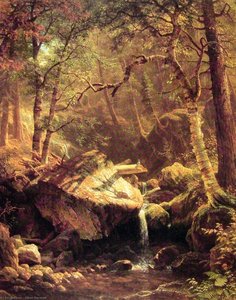
What subjects did Albert Bierstadt favour?Reveal the answer

American west (42), Sky (23) and Landscape (22), across the 100 works on this page.

What materials did Albert Bierstadt paint with most?Reveal the answer

Oil On Canvas, for 64 of the 100 works on this page.

Which movement does the work of Albert Bierstadt belong to?Reveal the answer

Hudson river school, judging by the originals on this page.

What Albert Bierstadt originals can I see at the Buffalo Bill Center of The West?Reveal the answer

Yellowstone Falls, View of Glacier Park and Sketch for "The Last of the Buffalo": the Buffalo Bill Center of The West, Laramie holds 6 of the works on this page.

Albert Bierstadt: a portrait of the artist

Early Life, Family and Training

Albert Bierstadt was born on January 7, 1830, in Solingen, Rhine Province, Prussia, Germany. He was the son of Henry Bierstadt, a cooper, and Christina M. (Tillmans) Bierstadt. His brothers, Edward and Charles, grew up alongside him in a household that moved across the Atlantic when Albert was only a year old. By 1831, the family had settled in New Bedford, Massachusetts. In those early years, he spent his time making sketches with crayons.

By 1851, he had moved on to working with oils. Seeking a more formal way to handle his craft, he left for Germany again in 1853. He spent several years in Düsseldorf studying painting. This period of study focused on the techniques taught by the members of the Düsseldorf School. He worked under the guidance of Worthington Whittredge during his time there, refining how he approached light and the details of the natural world.

The Grand Tour and Western Expeditions

The landscapes that filled his canvases were often born from long treks through the American West. In 1859, he traveled through the territories of Colorado and Wyoming alongside Frederick W. Lander, a land surveyor for the U.S. government. These trips allowed him to see the terrain firsthand as the country expanded. He joined several of these westward movements to capture the scenes he encountered. Later, in 1863, he went west again with the author Fitz Hugh Ludlow. During that specific trip, he spent seven weeks in the Yosemite Valley, observing the sheer cliffs and waterfalls that would later appear in his oil paintings.

His travels were not limited to the American frontier. He moved through many different climates and terrains, from the mountains of Switzerland, Italy, and Germany to the coastal air of the Bahamas. He spent time in Rome, Naples, and Capri, and his movements took him as far as Canada and Alaska. He also spent time in California. These varied locations provided a wide range of light and atmosphere for his sketches and finished works.

Technique and Artistic Style

Bierstadt’s approach to the canvas was shaped by his time in Düsseldorf, where he moved away from the simple crayon sketches of his youth toward a more disciplined, naturalistic style. He often worked en plein air to capture the immediate presence of the landscape, using these observations to inform his larger oil paintings. His work is frequently linked to the Hudson River School and the Rocky Mountain School, blending the detailed precision of his German training with the expansive scale required to depict the American West. He utilized linearism to define the sharp edges of mountain peaks and the intricate textures of forest foliage.

Light is the primary tool in his compositions. He often employed Luminism, a technique that uses a soft, diffused glow to create a sense of atmosphere and depth. This method allowed him to bathe vast valleys in a specific, glowing light that emphasized the scale of the terrain. His later works in the Bahamas showed a shift toward a more expressive use of color, moving away from the controlled Luminist style toward bolder, more brilliant tones. This transition reflected a change in how he approached the subject matter, focusing less on the sublime and more on the daily life of local inhabitants.

Major Commissions and Notable Works

Early works often looked back toward his European training. In 1855, he painted Rustic Mill, a scene of quiet industry by a river valley. By 1856, his brush had captured Staubbach Falls, Near Lauterbrunnen, Switzerland, reflecting the landscapes of his studies in Düsseldorf. These pieces show a focus on how light settles on stone and water before his focus shifted entirely to the American West.

The scale of his work grew alongside the ambitions of his patrons. One of his most significant commissions was The Rocky Mountains, Lander's Peak, which Legrand Lockwood purchased for $25,000. This large canvas was based on sketches and photographs from the 1859 survey expedition. He continued to document the West through the 1860s, completing Valley of the Yosemite in 1864. Later, in 1876, he turned his attention to the massive scale of The Great Trees, Mariposa Grove, California.

Legacy and Lasting Influence

Bierstadt was an important interpreter of the western landscape, providing a way for people to see the scale of the American West. He is credited as the first painter to truly capture its vastness and rusticity. His canvases helped shape how the public perceived these distant territories, turning unknown mountains and valleys into familiar sights for a growing nation. By focusing on the sheer size of the terrain, he moved beyond simple documentation to offer a specific vision of the frontier.

His influence can be seen in the way he handled light and space to convey the physical reality of the wilderness. While his focus shifted toward the Bahamas later in life, his earlier work remains tied to the expansion of the American identity. He used the details of the land to speak to the spirit of the era. His paintings did more than show scenery; they helped define a sense of place for a country still discovering its own borders.

Where to See His Works Today

His canvases can be found in several collections across different continents. In Madrid, the Thyssen-Bornemisza Museum holds four of his paintings, including Evening on the Prairie and The Falls of St. Anthony. These works allow a close look at how he handled light and shadow in large-scale compositions. The Museum of Fine Arts in Boston also maintains a presence with three works, such as Valley of the Yosemite and Moose Hunters Camp.

In the United States, his presence is felt in various institutions. The Brooklyn Museum in New York City contains two of his paintings, including A Storm in the Rocky Mountains and The Morteratsch Glacier, Upper Engadine Valley, Pontresina. The Smithsonian American Art Museum in Washington, D.C. holds one work, Among the Sierra Nevada Mountains, California. In Woodstock, the Marsh-Billings-Rockefeller National Historical Park holds two works, including Cathedral Rocks, Yosemite.