Early Life, Family and Artistic Training
May 22, 1820, marks the beginning of Thomas Worthington Whittredge's life in a log cabin. The setting is a farm near the Little Miami River, located less than 50 miles northeast of Springfield, Ohio. His father, Captain Joseph Whittredge, runs the land. In these early years, the boy finds a different kind of industry. By age sixteen, he has already earned $400 through the grit of frontier survival, trapping animals and selling their pelts.
The transition from the ruggedness of the Ohio farm to the formal discipline of European academies requires a significant shift in direction. In 1849, Whittredge leaves for Europe to pursue professional training. He finds his way to the Düsseldorf Academy in Germany. This period of study lasts five years. He works under the tutelage of Emanuel Leutze, immersing himself in the technical rigor of the Düsseldorf school. During these years, he moves within a circle of fellow artists, absorbing the methods of the academy and refining his approach to the landscape.
Artistic Beginnings in Cincinnati and West Virginia
At seventeen, the path leads to Cincinnati. He enters the trade not as a fine artist, but as an apprentice, working as a house painter's assistant to his brother-in-law. The work is manual and practical. He moves from the brushstrokes of signs and banners toward the more formal demands of portraiture. In Charleston, West Virginia, he attempts to establish himself as a portrait painter, but the season proves discouraging. The focus shifts. By 1843, he turns exclusively to landscape painting.
The 1840s find him back in Cincinnati, operating as a landscape artist. A growing community of art lovers and wealthy patrons begins to emerge in the city, providing the necessary support for his developing vision. He navigates the tension between the practicalities of his early training and the growing demand for scenic views. This period marks the transition from a tradesman to a dedicated observer of the natural world.
Travels Through Europe and the American West
The pull of the Old World leads Whittredge away from the American frontier in 1849. He moves through Belgium and Germany, sketching the banks of the Rhine. The training he receives in the Düsseldorf Academy provides a technical foundation that he carries into a long residency in Italy. From 1854 through 1859, he remains in Italy, absorbing the light and landscape of the Mediterranean. During the summer of 1856, he joins Albert Bierstadt on a sketching trip through Switzerland, a period that marks a significant intersection of his developing style with the experiences of his contemporaries.
The focus shifts back to the American continent as the landscape changes from European valleys to the rugged expanse of the West. In 1865, he makes a journey to the Rocky Mountains. This is followed by a formal tour of the Rocky Mountains in 1866. These excursions move him away from the dramatic, theatrical peaks favored by some of his peers, focusing instead on the quieter, more intimate details of the plains and prairies. His later years see him returning to the continent to explore different territories, traveling to Mexico in 1893 and again in 1896.
Technique and Artistic Style
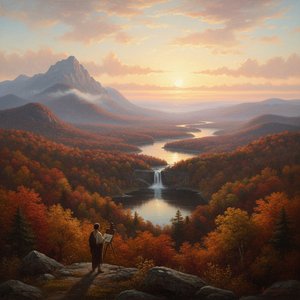
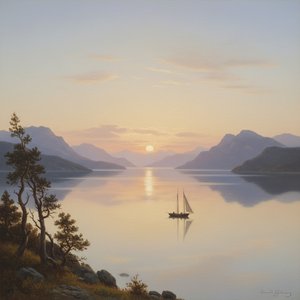
Whittredge moves away from the hard, monotone palette of the Düsseldorf School as his style matures. He finds that such rigid German training cannot fully capture the nuances of the American landscape. Instead, his work evolves into a fusion of European and American influences. He focuses on the way light interacts with the environment, prioritizing soft atmospheric effects over dramatic, theatrical compositions. This approach creates a sense of quietude, where light does not merely illuminate a scene but actively shapes its mood through diffused sunlight and long shadows.
His technical execution relies on a sophisticated layering of color. He employs glazing techniques, applying thin washes of pigment to build up a sense of depth and luminosity within his forest interiors and mountain vistas. To provide a physical presence to the natural world, he utilizes scumbling. This dry brush technique allows him to add tactile texture to the surfaces of trees and rocks. The result is a meticulous, factual rendering of scenic landscapes that balances precise detail with a soft, atmospheric quality.
- On the Cache la Poudre River, Colorado (1876)
- The Pine Cone Gatherers (1866)
- The Trout Pool (1870)
Notable Works and Artistic Achievements
The year 1876 marks a peak in his career, centered on the creation of On the Cache la Poudre River, Colorado. This work captures the river and plains in the foreground against the backdrop of the Rockies. It remains one of his most significant contributions to American landscape painting. Beyond the canvas, his influence extended into the institutional structures of the American art world. He held the presidency of the National Academy of Design from 1874 to 1875, a period of significant professional authority.
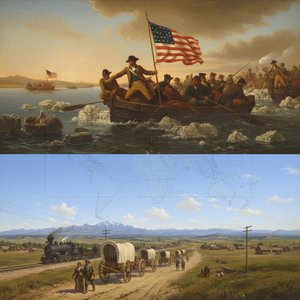
His expertise was sought for major international and domestic exhibitions. He served as a member of the selection committees for both the 1876 Philadelphia Centennial Exposition and the 1878 Paris Exposition. These roles placed him at the center of the era's most important artistic gatherings. Even during his time in Germany, his presence was felt in the works of his contemporaries; he famously posed as George Washington in Emanuel Leutze's painting, Washington Crossing the Delaware.
Legacy and Influence on American Art
Whittredge moves the needle of the Hudson River School into its second generation. He does not merely follow the path cleared by Thomas Cole; he adapts it. While the earlier masters often leaned toward the dramatic, Whittredge finds a different resonance in the quietude of the landscape. His presence in the movement is cemented by his close associations with the era's heavyweights, including Albert Bierstadt and Sanford Robinson Gifford. These connections place him at the center of a shifting American aesthetic, one that moves away from theatricality toward a more nuanced observation of the natural world.
His impact reaches beyond the canvas to influence how an entire generation of artists perceives the American continent. He encourages a shift in focus, prompting others to look closely at the specific, unvarnished beauty of the country's wilderness. This impulse to document the land with meticulous detail helps define a national visual language. His work suggests that the American landscape is not merely a backdrop for grand drama, but a subject worthy of intense, atmospheric study in its own right.
- On the Cache la Poudre River, Colorado (1876)
- The Pine Cone Gatherers (1866)
Where to See His Works Today
His canvases reside in major institutions across the United States, preserved within collections that trace the development of American landscape painting. In New York City, the Metropolitan Museum of Art holds several of his works. The Smithsonian American Art Museum in Washington, D.C., also maintains his paintings in its permanent collection. These locations offer a direct look at the atmospheric light and detailed scenery that defined his career.
The reach of his work extends into the American West and the southern plains. The Amon Carter Museum of American Art in Fort Worth features his depictions of the frontier. In the West, the Utah Museum of Fine Arts in Salt Lake City preserves his paintings, ensuring his vision of the natural world remains accessible to those studying the Hudson River School.
- On the Cache la Poudre River, Colorado (about 1876)
- The Trout Pool (1870)
- The Camp Meeting (1874)
- The Pine Cone Gatherers (1866)
Questions & Answers
In which historical period did Thomas Worthington Whittredge work?
Thomas Worthington Whittredge worked in the 19th-Century period. The period situates the artist's activity in history.
Where are Thomas Worthington Whittredge's artworks grouped by keywords?
Thomas Worthington Whittredge's works can be explored by keyword on the artist's By Keywords page. Each keyword groups the related artworks.
How popular are Thomas Worthington Whittredge's artworks?
The Stats page of Thomas Worthington Whittredge presents statistics computed from the artist's artworks listed on this website.