Portrait of Sol LeWitt

The 40 Most Famous Sol LeWitt Paintings, a Gallery Selection

Updated November 2026 · ranked by our popularity score (searches, visits and orders for each work) · 42 works by Sol LeWitt in our catalogue

In short

Of all the originals Sol LeWitt left, the most famous is Serial Project #1 ABCD (1966), in the collection of the MOMA - Museum of Modern Art, New York City. Close behind it come Wall drawing #1091: arcs, circles and bands (room) (2003) and Distorted Cubes Bozuk Küpler. Our catalog holds 42 works by Sol LeWitt; the gallery has kept the 40 the world admires most, each shown with its date, its museum and its story.

1928 – 2007, Hartford Minimalism Most works: MASS MoCA

Sol LeWitt's top 10 paintings: the gallery's choice

1
Serial Project #1 ABCD (1966) by Sol LeWitt

Serial Project #1 ABCD

1966 · Sculpture · MOMA - Museum of Modern Art, New York City

A systematic arrangement of white cubes and rectangular prisms occupies a grid-like base, set against a stark black void. This geometric composition, titled Serial Project #1 ABCD, functions as an architectural exploration of structure and seriality. Rather than representing a specific building, the work investigates the permutations of simple shapes. The arrangement follows a predetermined algorithm, where the placement of each element is dictated by a logical sequence rather than…

2
Wall drawing #1091: arcs, circles and bands (room) (2003) by Sol LeWitt

Wall drawing #1091: arcs, circles and bands (room)

2003 · Installation Art · Art Gallery of New South Wales, Sydney

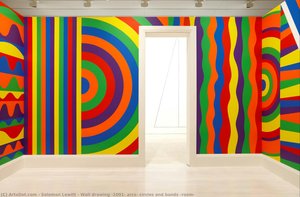
To stand before Wall drawing #1091: arcs, circles and bands (room) is to witness not merely an arrangement of pigment on a surface, but the vibrant echo of artistic reinvention. This monumental piece by Solomon Lewitt captures a moment of profound resurgence in his later career. Where earlier works might have favored a more restrained palette, this drawing explodes with exuberant color—a joyous chromatic symphony applied across the architectural expanse…

3
Distorted Cubes Bozuk Küpler by Sol LeWitt

Distorted Cubes Bozuk Küpler

Painting · Borusan Contemporary, Istanbul

In the realm of conceptual mastery, few works capture the rhythmic pulse of modern abstraction as vibrantly as Sol LeWitt’s Distorted Cubes Bozuk Küpler. This captivating piece serves as a brilliant testament to the artist's ability to transform rigid mathematical precision into a dance of visual delight. At first glance, the viewer is greeted by an intricate mosaic of fourteen distinct colored squares, each meticulously arranged to create a sense…

4
Wall Drawing #391 (1983) by Sol LeWitt

Wall Drawing #391

1983 · Indian Ink · MASS MoCA, Adams

Wall Drawing #391 is an artwork by Solomon Lewitt. Created in April 1983, this two-part drawing occupies a specific space within the MASS MoCA in Adams. The work exists as a structural dialogue between two adjacent surfaces, mapping out a logic that relies on the intersection of planes and the direction of the line.

5
Wall Drawing #831 (1997) by Sol LeWitt

Wall Drawing #831

1997 · Drawing · Guggenheim Museum Bilbao, Bilbao

In the vast landscape of twentieth-century modernism, few names resonate with as much intellectual rigor as Solomon Lewitt. His Wall Drawing #831, created in 1997, serves as a breathtaking testament to the power of the idea over the hand. As a pioneer of both Minimalism and Conceptual Art, Lewitt famously posited that the concept itself is the machine that makes the art. This particular work is not merely a painting…

6
Wall Drawing #915 (1999) by Sol LeWitt

Wall Drawing #915

1999 · Installation Art · MASS MoCA, Adams

Wall Drawing #915 exists as an installation of mathematical precision. Created in 1999, the work utilizes a palette of pastels, anchored by a primary tone of steel blue. The composition relies on geometric patterns and interlocking shapes that transform architectural surfaces into active participants in the art. Through the use of arcs and circles, the piece establishes a rhythmic movement across the wall.

7
Incomplete open cube 5/6 (1974) by Sol LeWitt

Incomplete open cube 5/6

1974 · Metal · Art Gallery of New South Wales, Sydney

Incomplete Open Cube No.5-6 – A Testament to Minimalist Geometry The ‘Incomplete open cubes’ represent a pivotal moment in Sol LeWitt's artistic trajectory, encapsulating the core tenets of his conceptual approach and solidifying his position as one of the pioneers of Minimalism. Created in 1974, this sculpture—a precisely crafted aluminum structure—isn’t merely an object; it’s an embodiment of intellectual rigor distilled into a deceptively simple form. LeWitt himself famously articulated…

8
Kaldor Public Art Project 06: Sol LeWitt 1977 (1977) by Sol LeWitt

Kaldor Public Art Project 06: Sol LeWitt 1977

1977 · Drawing · Kaldor Public Art Projects, Sydney

In the quiet, transformative moment captured in this 1977 photograph, we witness more than just the documentation of a mural; we see the physical manifestation of an idea. Part of the prestigious Kaldor Public Art Project, this work by Solomon LeWitt serves as a profound testament to the power of Conceptualism. The image presents a stark, monochromatic dialogue between two observers and a monumental wall drawing that consumes the architectural…

9
Wall Drawing #146A (2000) by Sol LeWitt

Wall Drawing #146A

2000 · Crayon · MASS MoCA, Adams

In the realm of contemporary minimalism, few names resonate with as much intellectual authority as Solomon LeWitt. His work, particularly the mesmerizing Wall Drawing #14 6A, serves as a profound testament to the power of the concept over the physical object. This particular piece, captured in its striking blue crayon medium, transcends the boundaries of traditional painting to become an immersive environment. As one gazes upon the composition, the distinction…

The Sol LeWitt selection continues, 11 to 40

11Pyramid (2005) by Sol LeWittPyramid2005 · Art Gallery of New South Wales 12Black with White Lines, Vertical Not Touching (1970) by Sol LeWittBlack with White Lines, Vertical Not Touching1970 · MOMA - Museum of Modern Art 13Cubo by Sol LeWittCuboCAMUSAC Cassino Museum of Contemporary Art 14Vertical Lines, Not Touching (1970) by Sol LeWittVertical Lines, Not Touching1970 · MOMA - Museum of Modern Art 15Objectivity (1962) by Sol LeWittObjectivity1962 16Irregular Grid by Sol LeWittIrregular GridElgiz Museum of Contemporary Art 17Wall Drawing #822 (1997) by Sol LeWittWall Drawing #8221997 · MASS MoCA 18Four Color Woodcuts-Curvy Bands I-IV (1996) by Sol LeWittFour Color Woodcuts-Curvy Bands I-IV1996 · Borusan Contemporary 19Kaldor Public Art Project 11: Sol LeWitt 1998 (1998) by Sol LeWittKaldor Public Art Project 11: Sol LeWitt 19981998 · Kaldor Public Art Projects 20Blue Vertical (2000) by Sol LeWittBlue Vertical2000 21Wal Drawing #999 (2001) by Sol LeWittWal Drawing #9992001 · MASS MoCA 22Isometric Figures in Five and Six Colors (2002) by Sol LeWittIsometric Figures in Five and Six Colors2002 · Borusan Contemporary 23Wall Drawing #1171 (2005) by Sol LeWittWall Drawing #11712005 · MASS MoCA 24Wall Drawing #1185 (2005) by Sol LeWittWall Drawing #11852005 · MASS MoCA 25brushstrokes 2 by Sol LeWittbrushstrokes 2CAMUSAC Cassino Museum of Contemporary Art 26Lincoln Center Print by Sol LeWittLincoln Center PrintBorusan Contemporary 27brushstrokes by Sol LeWittbrushstrokesCAMUSAC Cassino Museum of Contemporary Art 28Wall drawing #338: Two part drawing. The wall is divided vertically into two parts. Each part is divided horizontally and vertically into four equal parts. 1st part: Lines in four directions, one direction in each quarter. 2nd part: Lines in four dir.... (1971) by Sol LeWittWall drawing #338: Two part drawing. The wall is divided vertically into two parts. Each part is divided horizontally and vertically into four equal parts. 1st part: Lines in four directions, one direction in each quarter. 2nd part: Lines in four dir....1971 · Art Gallery of New South Wales 29Wall Drawing #340 (1980) by Sol LeWittWall Drawing #3401980 · MASS MoCA 30Untitled by Sol LeWittUntitled 31Untitled from Squares with a Different Line Direction in Each Half Square (3) by Sol LeWittUntitled from Squares with a Different Line Direction in Each Half Square (3) 32Untitled from Squares with a Different Line Direction in Each Half Square by Sol LeWittUntitled from Squares with a Different Line Direction in Each Half Square 33Untitled from Squares with a Different Line Direction in Each Half Square (2) by Sol LeWittUntitled from Squares with a Different Line Direction in Each Half Square (2) 34Wall Drawing #154, #155, #162, #163, #157, #158 by Sol LeWittWall Drawing #154, #155, #162, #163, #157, #158Modern Art Oxford 35Distorted Cubes from Distorted Cubes by Sol LeWittDistorted Cubes from Distorted Cubes 36Distorted Cubes from Distorted Cubes (2) by Sol LeWittDistorted Cubes from Distorted Cubes (2) 37Irregular tower by Sol LeWittIrregular towerCAMUSAC Cassino Museum of Contemporary Art 38Irregular tower by Sol LeWittIrregular towerCAMUSAC Cassino Museum of Contemporary Art 39Irregular Arcs, Bands and Loops by Sol LeWittIrregular Arcs, Bands and LoopsBorusan Contemporary 40Eight-Pointed Stars by Sol LeWittEight-Pointed StarsChrysler Museum of Art

Sol LeWitt's famous paintings, period by period

The subjects that held Sol LeWitt's eye

The four subjects that come back most often in these originals, each with its finest example.

The museums that keep Sol LeWitt's originals

The 8 museums that hold the most of the paintings on this page.

Museum City Works by Sol LeWitt Paintings from this list
MASS MoCA, AdamsMASS MoCA Adams 9 Wall Drawing #391, Wall Drawing #915, Wall Drawing #146A
Borusan Contemporary, IstanbulBorusan Contemporary Istanbul 5 Distorted Cubes Bozuk Küpler, Four Color Woodcuts-Curvy Bands I-IV, Isometric Figures in Five and Six Colors
CAMUSAC Cassino Museum of Contemporary Art, CassinoCAMUSAC Cassino Museum of Contemporary Art Cassino 5 Cubo, brushstrokes 2, brushstrokes
Art Gallery of New South Wales, SydneyArt Gallery of New South Wales Sydney 4 Wall drawing #1091: arcs, circles and bands (room), Incomplete open cube 5/6, Pyramid
MOMA - Museum of Modern Art, New York CityMOMA - Museum of Modern Art New York City 3 Serial Project #1 ABCD, Black with White Lines, Vertical Not Touching, Vertical Lines, Not Touching
Kaldor Public Art Projects, SydneyKaldor Public Art Projects Sydney 2 Kaldor Public Art Project 06: Sol LeWitt 1977, Kaldor Public Art Project 11: Sol LeWitt 1998
Guggenheim Museum Bilbao, BilbaoGuggenheim Museum Bilbao Bilbao 1 Wall Drawing #831
Elgiz Museum of Contemporary Art, İstanbulElgiz Museum of Contemporary Art İstanbul 1 Irregular Grid

Sol LeWitt decade by decade: the original that defines each

Works per decade

Pick a decade to see the original that defines it.

Collectors' questions about Sol LeWitt's paintings

Which work is Sol LeWitt most famous for?Reveal the answer

Serial Project #1 ABCD (1966), MOMA - Museum of Modern Art, New York City. Wall drawing #1091: arcs, circles and bands (room) (2003) and Distorted Cubes Bozuk Küpler come next.

What age was Sol LeWitt when Serial Project #1 ABCD was made?Reveal the answer

38 years old: Serial Project #1 ABCD dates from 1966, and Sol LeWitt was born in 1928.

What are the ten most famous Sol LeWitt paintings?Reveal the answer

Serial Project #1 ABCD, Wall drawing #1091: arcs, circles and bands (room), Distorted Cubes Bozuk Küpler, Wall Drawing #391, Wall Drawing #831, Wall Drawing #915, Incomplete open cube 5/6, Kaldor Public Art Project 06: Sol LeWitt 1977, Wall Drawing #146A and Wall Drawing #793B Certificate. The ranking above gives each one's year and museum.

How many paintings did Sol LeWitt leave?Reveal the answer

Our catalog holds 42 works by Sol LeWitt, dated from 1962 to 2005.

In which museums do Sol LeWitt's masterpieces hang?Reveal the answer

Mostly in MASS MoCA (Adams), Borusan Contemporary (Istanbul) and CAMUSAC Cassino Museum of Contemporary Art (Cassino). The museum table above lists them all.

In which years did Sol LeWitt paint the most famous works?Reveal the answer

In 2000s: 8 of the 40 works on this page were made then, Wall drawing #1091: arcs, circles and bands (room) among them.

What are the first and the last famous originals of Sol LeWitt?Reveal the answer

On this page, the earliest is Objectivity (1962) and the latest Pyramid (2005).

Which subjects did Sol LeWitt choose most often?Reveal the answer

Geometric abstraction (8), Conceptual art (7) and Wall drawing (5), across the 40 works on this page.

Which technique did Sol LeWitt use most?Reveal the answer

Sculpture, for 2 of the 40 works on this page.

To which art movement does Sol LeWitt belong?Reveal the answer

Minimalism, judging by the originals on this page.

Which Sol LeWitt works hang at the MASS MoCA?Reveal the answer

Wall Drawing #391, Wall Drawing #915 and Wall Drawing #146A: the MASS MoCA, Adams holds 9 of the works on this page.

Sol LeWitt: life and work

The Architect of Ideas: The Life and Legacy of Sol LeWitt

In the vast landscape of twentieth-century modernism, few figures cast as long or as intellectually profound a shadow as Solomon LeWitt. Born on September 9, 1928, in Hartford, Connecticut, to a family of Jewish immigrants from Russia, LeWitt’s journey was one defined by the pursuit of pure thought over mere physical execution. His early years were shaped by a rigorous analytical curiosity, a trait nurtured by his studies at Syracuse University between 1945 and 1949. This academic foundation in mathematics and geometry would later become the very heartbeat of his artistic language, allowing him to strip away the decorative excesses of traditional art to reveal the skeletal beauty of logic and structure.

LeWitt’s evolution as an artist was not a sudden rupture but a deliberate migration from the tangible to the conceptual. While his early explorations involved the tactile nature of painting and drawing, he soon found himself increasingly drawn to the idea behind the mark rather than the mark itself. This shift marked the birth of a pioneer who would bridge the gap between Minimalism and Conceptual Art. He began to view the artist not as a craftsman bound by the hand, but as an architect of instructions. By prioritizing the mental blueprint over the finished object, LeWitt challenged the very definition of authorship, suggesting that once an idea is conceived, its physical manifestation is merely a secondary consequence.

The Revolution of the Wall Drawing

The late 1960s witnessed one of the most radical transformations in contemporary art with the emergence of LeWitt’s iconic wall drawings. Rejecting the permanence and preciousness of traditional sculpture, he introduced "structures"—a term he preferred over "sculptures" to emphasize their mathematical essence—and a series of instructions that could be executed by anyone trained to follow them. These works were not merely decorations but lived experiences, often composed of precise geometric patterns, arcs, and interlocking shapes that breathed life into the architectural spaces they inhabited.

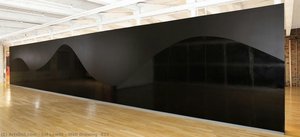
To witness a LeWitt wall drawing is to see logic transformed into poetry. Whether it was the stark, rhythmic repetition found in Black with White Lines, Vertical Not Touching or the vibrant, exuberant energy of Wall Drawing #1091: arcs, circles and bands, his work utilized the power of the line to command space. These pieces often relied on a system of logical, often mathematical instructions that guided assistants or museum installers in their production. This method democratized the act of creation while simultaneously elevating the importance of the concept, ensuring that the artwork existed fundamentally as an intellectual spark before it ever touched a wall.

A Lasting Impression on Modernity

Throughout his prolific career, which spanned decades and included mastery in printmaking, photography, and installation, LeWitt remained steadfast in his commitment to clarity and precision. His ability to find profound beauty in the simplest of forms—such as the striking white Pyramid or the complex, colorful rhythms of his crayon-based wall works—redefined the aesthetic boundaries of the late 20th century. He proved that art could be stripped of its ego and its ornament, yet still retain a soul that resonates deeply with the human desire for order and discovery.

The historical significance of Sol LeWitt cannot be overstated. He provided the vocabulary for generations of artists to explore the boundaries between thought and matter. His legacy lives on in every museum and gallery where the line between the creator and the executor is blurred, and where the strength of an idea is recognized as the ultimate medium. As we look back upon his life, from his beginnings in Hartford to his final days in New York City in 2007, we see a man who did not just make art, but who taught us how to see the profound architecture of thought itself.