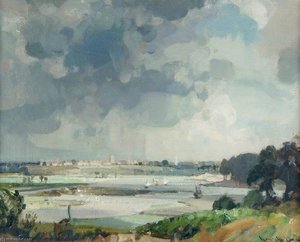
A Life of Light and Landscape
Sir John Alfred Arnesby Brown was a figure of remarkable duality, a man who navigated the physical vigor of professional sport and the delicate, atmospheric nuances of fine art with equal distinction. Born in Nottingham, his early years were marked by a pursuit of athletic excellence; he was an English footballer who famously played for Notts County in the Football League. Yet, it was through the lens of the landscape painter that he would secure his enduring legacy as one of the leading British landscape artists of the 20th century. His journey from the competitive pitches of the late 19th century to the prestigious halls of the Royal Academy is a testament to a profound devotion to the natural world.
His artistic education was rigorous and transformative, beginning with lessons under a local tutor in Nottingham before he moved to the renowned Bushey School of Art in Hertfordshire. There, studying under Hubert von Herkomer, Brown began to cultivate a technique that would become his hallmark. His work was deeply influenced by the plein air ideal and the evocative traditions of the Barbizon School and French Impressionists. This influence manifested in his ability to capture the fleeting qualities of light and atmosphere, turning the English countryside into a stage for luminous, emotive storytelling.
The Pastoral Vision
Brown’s oeuvre is most celebrated for its impressionistic depictions of pastoral landscapes, where the quiet majesty of the countryside is often punctuated by the presence of cattle. He possessed a unique ability to render the textures of the earth and the shifting moods of the sky, creating scenes that felt both timeless and intensely immediate. While his heart often resided in the tranquil meadows of Norfolk—specifically around Haddiscoe, where he eventually settled—his vision was not limited to a single geography. His work frequently captured the serene beauty of the marshes and the rhythmic life of rural England.
As his career matured, Brown’s interests underwent a fascinating evolution. While he remained a master of the pastoral, after 1905, he began to direct his observant eye toward the industrial landscape. He found a new kind of beauty in the structural complexities of rail yards and brickworks around Kings Lynn, proving that his sensitivity to light and form could transcend the idyllic and embrace the burgeoning modernity of his era. This expansion of subject matter demonstrated a profound artistic maturity and an unwavering commitment to documenting the changing face of the British landscape.
Legacy and Recognition
The significance of Sir John Alfred Arnesby Brown extends far beyond the canvas, reaching into the very fabric of British cultural history. His dedication to his craft was recognized with the highest honors, culminating in his knighthood in 1938 for his services to the nation's art. This accolade served as a formal acknowledgment of a career that had successfully bridged the gap between traditional landscape values and the evolving sensibilities of modern impressionism.
His life was also intertwined with the artistic community through his marriage to Mia Edwards, a talented Welsh painter noted for her portraits of children. Together, they shared a life steeped in creativity, moving between the artist colonies of St Ives, Cornwall, and the seasonal beauty of Norfolk. Today, the works of Arnesby Brown continue to resonate within prestigious UK public collections, serving as enduring windows into a vanished era of pastoral peace and atmospheric wonder.
Questions & Answers
What other names is Sir John Alfred Arnesby Brown known by?
Sir John Alfred Arnesby Brown is also known as John Alfred Arnesby Brown.
How can I see every artwork made by Sir John Alfred Arnesby Brown?
Every work by Sir John Alfred Arnesby Brown on this website can be browsed from the artist's All Artworks page.
Where are Sir John Alfred Arnesby Brown's artworks grouped by technique?
Sir John Alfred Arnesby Brown's works can be browsed by medium on the artist's All Medium page.