Portrait of Roman Opałka

Roman Opałka Paintings: The 33 Most Famous, Through a Gallery's Eye

Updated November 2026 · ranked by our popularity score (searches, visits and orders for each work) · 34 works by Roman Opałka in our catalogue

In short

To the gallery's eye, Roman Opałka's most famous painting is table top, whose original hangs in the Biennale Internazionale dell'Antiquariato di Firenze, Florence. Detail 680350-707459 and Relief of a Falling Warrior complete the trio every eye recognises. Of the 34 works by Roman Opałka in our catalog, the gallery presents the 33 most famous below, each original with its year, its museum and what makes it unique.

1931 – 2011, Hocquinghen Conceptual art Most works: The Walsh Gallery at Seton Hall University

The gallery's top 10 Roman Opałka paintings

1
table top by Roman Opałka

table top

In the serene stillness of table top, the viewer is invited into an intimate domestic scene that breathes with a quiet, contemplative energy. The composition centers upon a table draped in a deep blue cloth, a vibrant focal point that anchors the surrounding space. This azure expanse serves as more than just a surface; it acts as a stage for the subtle interplay of light and shadow. The table itself…

2
Detail 680350-707459 by Roman Opałka

Detail 680350-707459

Acrylic On Canvas · Museum Folkwang, Essen

Roman Opałka, a figure both profoundly enigmatic and fiercely conceptual, invites us into a world where the seemingly simple becomes an endless exploration of perception. His work, particularly pieces like “Detail 680350-707459,” transcends mere representation; it’s an invitation to contemplate the nature of surface, pattern, and ultimately, the human experience of time itself. Born in Abbeville, France, in 1931, and later becoming a citizen of Poland, Opałka's life was marked…

3
Relief of a Falling Warrior by Roman Opałka

Relief of a Falling Warrior

Around 435 B.C., the Greek sculptor Phidias enriched the front of the shield at the side of his gold-and-ivory statue of Athena in the Parthenon with scenes of Greeks and Amazons battling in the Trojan War. In Roman times, certain figures from this complex struggle were lifted out of their original context and enlarged to become decorative reliefs for the walls of a colonnade or courtyard.A wounded Greek warrior collapses…

4
Torso of a Fighting Giant by Roman Opałka

Torso of a Fighting Giant

Acrylic On Canvas · Rhode Island School of Design Museum of Art, Providence

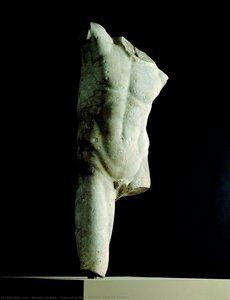
Torso of a Fighting Giant: An Infinite Counting Series Roman Opałka’s “Torso of a Fighting Giant” stands as a testament to minimalist conceptual art and the enduring fascination with time, repetition, and the human form. Created in 1965, this monumental marble sculpture embodies Opałka's signature approach—a relentless pursuit of infinity through meticulously executed detail. The piece isn’t merely aesthetically pleasing; it’s a profound meditation on artistic process and the artist’s…

5
Couch decoration in the form of a horse by Roman Opałka

Couch decoration in the form of a horse

Sculpture Bronze · Rhode Island School of Design Museum of Art, Providence

Roman Opałka's 'Couch Decoration in the Form of a Horse,' a bronze sculpture measuring 17 x 13 cm, is more than just a depiction of equine grace; it’s a poignant meditation on endurance, memory, and the relentless march of time. Crafted by this singular artist between 1965 and 2011 – a period defined by his deeply philosophical engagement with art – the piece resonates with a quiet power born from…

8
Antoninianus by Roman Opałka

Antoninianus

Acrylic On Canvas · The Walsh Gallery at Seton Hall University, South Orange

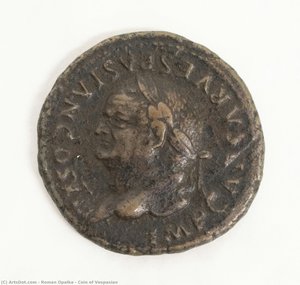
Roman Opałka’s Antoninianus isn’t merely a depiction of an ancient coin; it’s a profound meditation on time, number, and the relentless march of existence. Born in Abbeville-Saint-Lucien, France, in 1931 to Polish parents who later returned to Poland after World War II, Opałka's life was shaped by displacement and a deep engagement with philosophical inquiry. This journey culminated in his singular artistic project: an infinite series of numbered paintings, beginning…

9
Silver Coin by Roman Opałka

Silver Coin

Acrylic On Canvas · The Walsh Gallery at Seton Hall University, South Orange

Roman Opałka, a singular figure in the landscape of contemporary art, dedicated his life to an ambitious project that defies easy categorization – a relentless pursuit of infinity. His work isn't merely about creating images; it’s about constructing systems, exploring the very nature of time, and confronting the human condition through meticulous repetition. “Silver Coin,” a seemingly simple depiction of an antique silver coin, is but one facet of this…

Roman Opałka paintings, ranked 11 to 33

Roman Opałka's famous paintings, period by period

The subjects that held Roman Opałka's eye

The four subjects that come back most often in these originals, each with its finest example.

The museums that keep Roman Opałka's originals

The 5 museums that hold the most of the paintings on this page.

Museum City Works by Roman Opałka Paintings from this list
The Walsh Gallery at Seton Hall University, South OrangeThe Walsh Gallery at Seton Hall University South Orange 18 Denarius of Emperor Tiberius, Antoninianus, Antoninianus
Rhode Island School of Design Museum of Art, ProvidenceRhode Island School of Design Museum of Art Providence 5 Torso of a Fighting Giant, Couch decoration in the form of a horse, Tablet with Greek transcription of Letter from Emperor Hadrian to Common Assembly of Macedonians
Biennale Internazionale dell'Antiquariato di Firenze, FlorenceBiennale Internazionale dell'Antiquariato di Firenze Florence 1 table top
Museum Folkwang, EssenMuseum Folkwang Essen 1 Detail 680350-707459
Indianapolis Museum of Art, IndianapolisIndianapolis Museum of Art Indianapolis 1 ornament with wolf

Roman Opałka, the signature paintings of each year

Every dated original by Roman Opałka on this page was made in 2011: here they are, the most famous first.

Works per year

Pick a year to see its originals.

Roman Opałka's paintings: the gallery answers

Which Roman Opałka painting is the most famous of all?Reveal the answer

table top, Biennale Internazionale dell'Antiquariato di Firenze, Florence. Detail 680350-707459 and Relief of a Falling Warrior come next.

Which are Roman Opałka's top 10 paintings?Reveal the answer

table top, Detail 680350-707459, Relief of a Falling Warrior, Torso of a Fighting Giant, Couch decoration in the form of a horse, Denarius of Emperor Tiberius, Antoninianus, Antoninianus, Silver Coin and Tetradrachm of Nero. The ranking above gives each one's year and museum.

How many works did Roman Opałka create?Reveal the answer

Our catalog holds 34 works by Roman Opałka.

Where do Roman Opałka's most famous originals hang?Reveal the answer

Mostly in The Walsh Gallery at Seton Hall University (South Orange), Rhode Island School of Design Museum of Art (Providence) and Biennale Internazionale dell'Antiquariato di Firenze (Florence). The museum table above lists them all.

When did Roman Opałka create the most famous paintings?Reveal the answer

In 2011: 2 of the 33 works on this page were made then, OPALKA 1965/1 - ∞; Détail 4988006–5006015 among them.

Which subjects did Roman Opałka return to most?Reveal the answer

Time (4), Portrait (4) and Metal (4), across the 33 works on this page.

Which medium did Roman Opałka work in most?Reveal the answer

Acrylic On Canvas, for 8 of the 33 works on this page.

Which movement is Roman Opałka associated with?Reveal the answer

Conceptual art, judging by the originals on this page.

Which Roman Opałka originals does the The Walsh Gallery at Seton Hall University hold?Reveal the answer

Denarius of Emperor Tiberius, Antoninianus and Antoninianus: the The Walsh Gallery at Seton Hall University, South Orange holds 18 of the works on this page.

Roman Opałka: the artist

A Life Dedicated to Counting: The Singular Vision of Roman Opałka

Roman Opałka, born in 1931 in Abbeville-Saint-Lucien, France, to Polish parents, embarked on an artistic journey that defied conventional categorization. His life, marked by displacement and a profound engagement with philosophical inquiry, ultimately led him to create one of the most conceptually rigorous and emotionally resonant bodies of work in contemporary art. The family’s return to Poland in 1946 following World War II deeply impacted Opałka, shaping his early experiences and fueling a lifelong exploration of identity, memory, and the relentless passage of time. He initially trained in lithography at a graphics school in Łódź before continuing his artistic education at the School of Art and Design there, laying the groundwork for an approach that would transcend traditional mediums and embrace conceptual frameworks.

The Genesis of Infinity: OPALKA 1965/1 – ∞

Opałka’s career wasn't a linear progression through styles but rather a constant questioning of artistic boundaries, culminating in the monumental project that would define his legacy: OPALKA 1965/1 – ∞. Beginning on September 1st, 1965, he committed himself to painting canvases sequentially numbered from one onwards. Each canvas bore the next integer in the series, rendered in black against a stark white background. This wasn’t merely an exercise in enumeration; it was a profound meditation on time, mortality, and the human condition. As the numbers grew larger, they began to spill over the edges of the canvases, visually representing the inexorable march forward and the artist's own aging process. The scale of this undertaking is almost incomprehensible – 233 “Details” were completed during his lifetime, encompassing over five million numbers. He meticulously documented each stage, recording himself vocalizing the numbers in Polish before painting them, creating a multi-layered artwork that encompassed visual, auditory, and performative elements. The gradual lightening of the background, beginning in 1972 with the addition of one percent white to each successive canvas, further emphasized the passage of time and the approaching “horizon” of white on white – a symbolic vanishing point representing infinity.

Influences and Artistic Development

While Opałka’s work is often associated with minimalism due to its apparent simplicity, it's an oversimplification that belies the depth of his conceptual concerns. He was profoundly influenced by Marcel Duchamp, particularly Duchamp’s rejection of traditional artistic conventions and embrace of intellectual playfulness. The spirit of Dada and Surrealism also resonated within his early explorations. However, Opałka wasn’t simply mimicking existing movements; he was forging a unique path that drew upon diverse sources. His earlier works reveal a fascination with texture and abstraction, demonstrating a willingness to experiment with various materials and techniques before settling on the rigorous structure of the numbering series. He explored monochrome compositions – his “Chronomes” – and abstract drawings, constantly searching for a visual language capable of expressing his evolving philosophical ideas. These early experiments were crucial stepping stones toward the conceptual clarity and sustained commitment that characterized OPALKA 1965/1 – ∞.

Legacy and Historical Significance

Roman Opałka’s death in 2011 marked the end of an extraordinary artistic life, but his work continues to resonate with audiences today. His relentless dedication to a single, seemingly simple concept challenged conventional notions of artistic creation and offered a powerful meditation on mortality, infinity, and the human condition. His influence can be seen in the works of numerous artists who explore themes of repetition, sequence, and process-based art. Opałka’s project transcends the boundaries of painting; it is a philosophical statement, a performance piece, and a testament to the power of sustained artistic vision. His work remains relevant in contemporary discussions about time, identity, and the search for meaning in an increasingly complex world. Exhibitions of his work have been held in prestigious institutions worldwide, including the Indianapolis Museum of Art, the Philadelphia Museum of Art, and the Museum Pomorskie in Poland, solidifying his place as a significant figure in 20th and 21st-century art history. Opałka’s legacy is not merely one of artistic innovation but also of unwavering commitment to an idea – a testament to the enduring power of conceptual art.