Portrait of Peter De Wint

Peter De Wint Paintings: The 100 Most Famous, Through a Gallery's Eye

Updated November 2026 · ranked by our popularity score (searches, visits and orders for each work) · 224 works by Peter De Wint in our catalogue

In short

To the gallery's eye, Peter De Wint's most famous painting is Bamburgh Castle. A View Of Lincoln From The South At Little Bargate and The Old Bridge complete the trio every eye recognises. Of the 224 works by Peter De Wint in our catalog, the gallery presents the 100 most famous below, each original with its year, its museum and what makes it unique.

1784 – 1849, Stone Romanticism Most works: Yale Center for British Art

The gallery's top 10 Peter De Wint paintings

1
Bamburgh Castle by Peter De Wint

Bamburgh Castle

Oil

This painting presents Bamburgh Castle, a formidable structure situated in Northumberland, England. The British painter Peter De Wint has captured the fortification as it sits perched atop a rugged rocky outcrop. From this elevated vantage point, the castle commands the surrounding landscape, which is characterized by hilly and uneven terrain. The composition places the stone architecture in direct dialogue with the natural elements of the coast.

2
A View Of Lincoln From The South At Little Bargate by Peter De Wint

A View Of Lincoln From The South At Little Bargate

Oil

We are looking at A View Of Lincoln From The South At Little Bargate, a work by the English painter Peter De Wint. This piece reflects the artist's deep connection to the landscape, a pursuit that defined much of his career. De Wint was a versatile practitioner, working with proficiency in both oils and watercolour to capture the nuances of the natural world.

3
The Old Bridge by Peter De Wint

The Old Bridge

Oil

In "The Old Bridge" by Peter De Wint, the eye is immediately drawn to the weathered wooden structure that spans a calm, slow-moving stream. This central bridge anchors the scene, acting as a quiet connection between the riverbanks. On the left side of the timber crossing, two figures pause in mid-conversation. One wears a hat while the other is adorned in a bonnet, their period clothing suggesting a quiet moment…

4
The Harvesters by Peter De Wint

The Harvesters

Watercolor

The Harvesters is a work by the English painter Peter De Wint. Born in 1784 in Stone, Staffordshire, England, De Wint established himself as a significant figure in the tradition of British landscape painting. His practice often focused on the rural topography of the English countryside, capturing the rhythms of agricultural life through both oil and watercolor.

5
The Farmyard (1815) by Peter De Wint

The Farmyard

1815 · Watercolor · Birmingham Museum and Art Gallery, Birmingham

We find ourselves before The Farmyard, a work by Peter De Wint. This piece dates to 1815, a period when the artist was establishing his presence within the British art scene. It is currently held in the collection of the Birmingham Museum and Art Gallery.

6
Caernarvon Castle (1836) by Peter De Wint

Caernarvon Castle

1836 · Watercolor · Birmingham Museum and Art Gallery, Birmingham

There is a certain stillness in this 1836 watercolor that invites a quiet contemplation of the passage of time. The scene presents Caernarvon Castle, a massive, vertical presence that anchors the composition on the left. It sits along a waterfront, its rugged masonry rendered with a sense of weathered permanence. Above, an expansive, overcast sky dominates the upper half of the work, casting a diffused light that softens the edges…

7
Harvest Scene (1834) by Peter De Wint

Harvest Scene

1834 · Watercolor · Birmingham Museum and Art Gallery, Birmingham

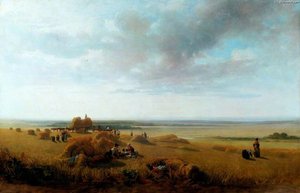
is a watercolor painting by the English painter Peter De Wint. Created in 1834, the work captures a quiet moment of rural life. It presents a vast, open landscape where the earth meets an expansive sky. The scene focuses on the stillness of a pastoral setting, where the light of a late afternoon or an overcast day settles over the fields.

8
Sheltering from the Sun (1835) by Peter De Wint

Sheltering from the Sun

1835 · Watercolor · Birmingham Museum and Art Gallery, Birmingham

The landscape unfolds in Sheltering from the Sun, a watercolor that captures a quiet moment of rest within the natural world. Created by Peter De Wint in 1835, this work presents a scene of pastoral stillness. The artist focuses on the simple, heavy presence of cattle seeking refuge, grounding the viewer in a specific, tranquil instance of rural life.

9
Lynmouth (1844) by Peter De Wint

Lynmouth

1844 · Watercolor · Birmingham Museum and Art Gallery, Birmingham

In Lynmouth, Peter De Wint captures a rugged, rocky gorge where the raw power of nature takes center stage. The scene unfolds around a cascading waterfall that surges through the heart of the landscape. Water rushes downward, its movement driving the eye through a deep perspective that pulls the viewer into the very depths of the ravine. Large, dark boulders sit heavy in the foreground, anchoring the scene before the…

Peter De Wint paintings, ranked 11 to 100

11A Meet In The Grounds Of Raby Castle by Peter De WintA Meet In The Grounds Of Raby Castle 12Figures Loading A Haycart, Beneath A Tree by Peter De WintFigures Loading A Haycart, Beneath A Tree 13Harvesting scene, cheddington by Peter De WintHarvesting scene, cheddington 14The Glebe Farm by Peter De WintThe Glebe Farm 15The Lake At Burghley House by Peter De WintThe Lake At Burghley House 16Coast Scene by Peter De WintCoast SceneYale Center for British Art 17Threshing Corn by Peter De WintThreshing Corn 18Llansantffraid-glan-conway, denbighshire by Peter De WintLlansantffraid-glan-conway, denbighshire 19Near Matlock by Peter De WintNear MatlockYale Center for British Art 20Moored Barges Near Lambeth Palace by Peter De WintMoored Barges Near Lambeth Palace 21Cornfield With A Windmill by Peter De WintCornfield With A Windmill 22Two Rustic Figures by Peter De WintTwo Rustic Figures 23Study For 'elijah' - by Peter De WintStudy For 'elijah' - 24Shepherd and flock on a bridge, near newark by Peter De WintShepherd and flock on a bridge, near newark 25Head Of A Girl- Probably A Study Of Mrs. De Wint by Peter De WintHead Of A Girl- Probably A Study Of Mrs. De Wint 26John Keats by Peter De WintJohn Keats 27Castle on a Hill with a Bridge below by Peter De WintCastle on a Hill with a Bridge belowBirmingham Museum and Art Gallery 28Study of Burdocks by Peter De WintStudy of BurdocksYale Center for British Art 29Barges on a River by Peter De WintBarges on a RiverMuseum of Fine Arts 30Sea Study by Peter De WintSea Study 31A Lake View, Possibly Buttermere From Crummock Water by Peter De WintA Lake View, Possibly Buttermere From Crummock Water 32Pond With Willow Tree And Ducks by Peter De WintPond With Willow Tree And Ducks 33Cattle Beneath A Tree by Peter De WintCattle Beneath A Tree 34A Cottage In A Wooded Landscpe by Peter De WintA Cottage In A Wooded Landscpe 35Landscape Study- A Haystack Near A Church by Peter De WintLandscape Study- A Haystack Near A ChurchYale Center for British Art 36Two Studies Of A Watermill by Peter De WintTwo Studies Of A Watermill 37Cattle Before Ludlow Castle, Shropshire by Peter De WintCattle Before Ludlow Castle, Shropshire 38Cattle On The Edge Of A Lane, A Church Beyond by Peter De WintCattle On The Edge Of A Lane, A Church Beyond 39A coastal landscape by Peter De WintA coastal landscape 40A Barge Near Mooring Posts by Peter De WintA Barge Near Mooring Posts 41Near Penrith by Peter De WintNear Penrith 42A Landscape With Harvesters In The Foreground by Peter De WintA Landscape With Harvesters In The Foreground 43Study of a timber wagon; loading the barge by Peter De WintStudy of a timber wagon; loading the barge 44Still Life With Broom by Peter De WintStill Life With Broom 45Plough Horses by Peter De WintPlough Horses 46Harvest Time- Cumberland by Peter De WintHarvest Time- CumberlandYale Center for British Art 47Cookham-on-thames, Berkshire by Peter De WintCookham-on-thames, Berkshire 48Ash Tree In Ashstead Park by Peter De WintAsh Tree In Ashstead ParkSlovak National Gallery 49Greenwich by Peter De WintGreenwich 50A Barn In A Wooded Landscape by Peter De WintA Barn In A Wooded Landscape 51Bardon Hill, Charnwood Forest, Leicestershire by Peter De WintBardon Hill, Charnwood Forest, Leicestershire 52Middleham, Yorkshire by Peter De WintMiddleham, Yorkshire 53Manor House And Church, Lytes Cary, Somerset by Peter De WintManor House And Church, Lytes Cary, Somerset 54Malmesbury Abbey by Peter De WintMalmesbury Abbey 55Borough Cathedral by Peter De WintBorough Cathedral 56Dunster, Somerset by Peter De WintDunster, SomersetFitzwilliam Museum 57A Yorkshire Road by Peter De WintA Yorkshire RoadYale Center for British Art 58A Mill In France by Peter De WintA Mill In France 59Bristol cathedral from the south by Peter De WintBristol cathedral from the south 60Harvest Time - by Peter De WintHarvest Time -Yale Center for British Art 61Gloucester by Peter De WintGloucester 62Chelsea Old Bridge, London by Peter De WintChelsea Old Bridge, London 63Achilles Statue, Hyde Park, London by Peter De WintAchilles Statue, Hyde Park, London 64Landscape With Willow Tree by Peter De WintLandscape With Willow Tree 65Haymaking On The Banks Of A Lincolnshire River by Peter De WintHaymaking On The Banks Of A Lincolnshire River 66Chester by Peter De WintChester 67A Study For 'the Ferry' - Snowdon From Llyn Padarn, North Wales by Peter De WintA Study For 'the Ferry' - Snowdon From Llyn Padarn, North Wales 68Woodland Scene by Peter De WintWoodland Scene 69Hay Wagons by Peter De WintHay Wagons 70Figures And A Horse And Cart On A Country Track by Peter De WintFigures And A Horse And Cart On A Country Track 71Extensive Landscape by Peter De WintExtensive LandscapeBirmingham Museum and Art Gallery 72A View Of Richmond, Yorkshire With A Footbridge In The Foreground by Peter De WintA View Of Richmond, Yorkshire With A Footbridge In The Foreground 73A Country Road With Traveller On Horseback by Peter De WintA Country Road With Traveller On Horseback 74A Cornfield by Peter De WintA Cornfield 75Landscape with haystacks by Peter De WintLandscape with haystacks 76The Ferry by Peter De WintThe Ferry 77Lincolnshire Cornfield Near Horncastle by Peter De WintLincolnshire Cornfield Near Horncastle 78A Wooded Track by Peter De WintA Wooded Track 79A Wooded Landscape With A Rainbow by Peter De WintA Wooded Landscape With A Rainbow 80A Country Road; And A Companion Work by Peter De WintA Country Road; And A Companion Work 81View Of Ludlow Castle by Peter De WintView Of Ludlow Castle 82Still Life With Rake by Peter De WintStill Life With Rake 83Building A Hayrick - by Peter De WintBuilding A Hayrick - 84Barden Tower, Yorkshire by Peter De WintBarden Tower, Yorkshire 85View Over Flat Country by Peter De WintView Over Flat Country 86A Haywagon In An Open Landscape by Peter De WintA Haywagon In An Open Landscape 87View Of Exeter by Peter De WintView Of Exeter 88The Farm Pond by Peter De WintThe Farm Pond 89Great Mitton, Lancashire, From The Ribble, With Longridge Fell Beyond by Peter De WintGreat Mitton, Lancashire, From The Ribble, With Longridge Fell Beyond 90Shipbuilding On The Yorkshire Coast by Peter De WintShipbuilding On The Yorkshire Coast 91Men Working On The Lincolnshire Heathland by Peter De WintMen Working On The Lincolnshire Heathland 92Harvesters In The Fields Above The Valley Of The Lune, Cumbria by Peter De WintHarvesters In The Fields Above The Valley Of The Lune, Cumbria 93Grasmere And Helm Crag, Cumbria by Peter De WintGrasmere And Helm Crag, Cumbria 94Loading a Haywain by Peter De WintLoading a Haywain 95Harvesting scene by Peter De WintHarvesting scene 96View Of Elizabeth Castle, St Helier, Jersey by Peter De WintView Of Elizabeth Castle, St Helier, Jersey 97Three Cart-horses In Traces by Peter De WintThree Cart-horses In Traces 98Harvesting, Probably On The Lincolnshire Cliff by Peter De WintHarvesting, Probably On The Lincolnshire Cliff 99Landscape With Cows And Barn by Peter De WintLandscape With Cows And Barn 100Two Men In Punts by Peter De WintTwo Men In Punts

Peter De Wint's famous paintings, period by period

The subjects that held Peter De Wint's eye

The four subjects that come back most often in these originals, each with its finest example.

The museums that keep Peter De Wint's originals

The 5 museums that hold the most of the paintings on this page.

Museum City Works by Peter De Wint Paintings from this list
Yale Center for British Art, New HavenYale Center for British Art New Haven 22 Coast Scene, Near Matlock, Study of Burdocks
Birmingham Museum and Art Gallery, BirminghamBirmingham Museum and Art Gallery Birmingham 8 The Farmyard, Caernarvon Castle, Harvest Scene
Fitzwilliam MuseumFitzwilliam Museum 2 Dunster, Somerset
Museum of Fine Arts, BostonMuseum of Fine Arts Boston 1 Barges on a River
Slovak National Gallery, BratislavaSlovak National Gallery Bratislava 1 Ash Tree In Ashstead Park

Peter De Wint, one signature painting per decade

Works per decade

Pick a decade to see the original that defines it.

Peter De Wint's paintings: the gallery answers

Which Peter De Wint painting is the most famous of all?Reveal the answer

Bamburgh Castle. A View Of Lincoln From The South At Little Bargate and The Old Bridge come next.

Which are Peter De Wint's top 10 paintings?Reveal the answer

Bamburgh Castle, A View Of Lincoln From The South At Little Bargate, The Old Bridge, The Harvesters, The Farmyard, Caernarvon Castle, Harvest Scene, Sheltering from the Sun, Lynmouth and A Woman Sorting Washing. The ranking above gives each one's year and museum.

How many works did Peter De Wint create?Reveal the answer

Our catalog holds 224 works by Peter De Wint, dated from 1815 to 1844.

Where do Peter De Wint's most famous originals hang?Reveal the answer

Mostly in Yale Center for British Art (New Haven), Birmingham Museum and Art Gallery (Birmingham) and Fitzwilliam Museum. The museum table above lists them all.

When did Peter De Wint create the most famous paintings?Reveal the answer

In 1830s: 3 of the 100 works on this page were made then, Caernarvon Castle among them.

Which are Peter De Wint's earliest and latest famous works?Reveal the answer

On this page, the earliest is The Farmyard (1815) and the latest Lynmouth (1844).

Which subjects did Peter De Wint return to most?Reveal the answer

Landscape (18), Scenes (7) and Atmospheric light (7), across the 100 works on this page.

Which medium did Peter De Wint work in most?Reveal the answer

Watercolor, for 6 of the 100 works on this page.

Which movement is Peter De Wint associated with?Reveal the answer

Romanticism, judging by the originals on this page.

Which Peter De Wint originals does the Yale Center for British Art hold?Reveal the answer

Coast Scene, Near Matlock and Study of Burdocks: the Yale Center for British Art, New Haven holds 7 of the works on this page.

Peter De Wint: the artist

Early Life and Training

  • Birth and Family: Peter de Wint was born on January 21, 1784, in Stone, Staffordshire, England. His father was a physician of Dutch descent who had emigrated from New York.
  • Initial Career Path: Initially destined for the medical profession like his father, De Wint's artistic inclinations led him to London in 1802.
  • Apprenticeship with John Raphael Smith: He became an apprentice to John Raphael Smith, a mezzotint engraver and portrait painter. This provided foundational skills in drawing and engraving techniques.
  • Formal Training under John Varley: In 1806, De Wint secured his freedom from the apprenticeship by producing eighteen oil paintings. Subsequently, he studied under John Varley, a prominent watercolorist, who introduced him to Dr. Monro’s informal academy for young artists. This environment fostered exposure to influential figures like Turner and Girtin.

Artistic Style and Development

  • Early Exhibitions: De Wint began exhibiting at the Royal Academy in 1807, quickly gaining recognition for his landscapes.
  • Membership in Artistic Societies: He became an Associate of the Old Watercolour Society in 1810 and a full member the following year, solidifying his position within the British art scene.
  • Watercolor Mastery: De Wint is widely regarded as one of the foremost English watercolorists. His ability to capture subtle nuances of light and atmosphere with a limited palette—typically consisting of just ten pigments—is particularly noteworthy. He favored ivory-tinted Creswick paper, contributing to the delicate quality of his works.
  • Oil Painting: While primarily known for watercolors, De Wint also worked in oils, demonstrating versatility.

Key Themes and Subjects

  • Lincolnshire Landscapes: A significant portion of De Wint’s oeuvre features landscapes inspired by his frequent visits to Lincolnshire. These paintings often depict idyllic scenes of haymaking, rural cottages, and expansive views of the countryside, reflecting a deep appreciation for the English landscape.
  • Genre and Subject Matter: His subjects often reflected a Romantic sensibility, emphasizing emotion, atmosphere, and the beauty of nature. He also produced portraits, including a notable oil painting of John Keats.

Legacy and Historical Significance

  • Critical Acclaim: Alfred William Rich famously asserted that De Wint “ever came nearer painting a perfect picture than did Peter de Wint,” highlighting his exceptional skill and artistic vision.
  • Influence on Later Artists: De Wint’s delicate watercolor technique and atmospheric landscapes influenced subsequent generations of British artists, contributing to the development of English landscape painting.
  • Museum Holdings: His works are held in prestigious collections worldwide, including Tate Britain, the Victoria and Albert Museum, and The Collection (Lincoln), attesting to their enduring artistic merit and historical significance.
  • Death: He died on January 30, 1849, in London.