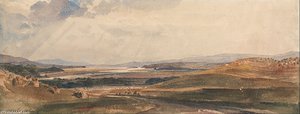
A View Of Lincoln From The South At Little Bargate
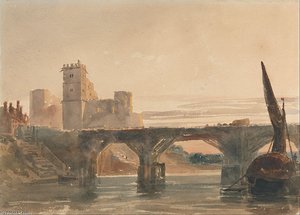
The Old Bridge
Creative periods: mature period
Corpus themes:
romantic landscape
atmospheric light
lincolnshire scenes
de wint's lincolnshire focus
de wint's vision
Works on this site: 224
Born: 1784, Stone, United Kingdom
Typical colors:
putty
rosy brown
Copyright status: Public domain
Topics explored:
landscape
buildings
scenes
rivers
animals
Early Life and Training
Birth and Family: Peter de Wint was born on January 21, 1784, in Stone, Staffordshire, England. His father was a physician of Dutch descent who had emigrated from New York.
Initial Career Path: Initially destined for the medical profession like his father, De Wint's artistic inclinations led him to London in 1802.
Apprenticeship with John Raphael Smith: He became an apprentice to John Raphael Smith, a mezzotint engraver and portrait painter. This provided foundational skills in drawing and engraving techniques.
Formal Training under John Varley: In 1806, De Wint secured his freedom from the apprenticeship by producing eighteen oil paintings. Subsequently, he studied under John Varley, a prominent watercolorist, who introduced him to Dr. Monro’s informal academy for young artists. This environment fostered exposure to influential figures like Turner and Girtin.
Artistic Style and Development
Early Exhibitions: De Wint began exhibiting at the Royal Academy in 1807, quickly gaining recognition for his landscapes.
Membership in Artistic Societies: He became an Associate of the Old Watercolour Society in 1810 and a full member the following year, solidifying his position within the British art scene.
Watercolor Mastery: De Wint is widely regarded as one of the foremost English watercolorists. His ability to capture subtle nuances of light and atmosphere with a limited palette—typically consisting of just ten pigments—is particularly noteworthy. He favored ivory-tinted Creswick paper, contributing to the delicate quality of his works.
Oil Painting: While primarily known for watercolors, De Wint also worked in oils, demonstrating versatility.
Key Themes and Subjects
Lincolnshire Landscapes: A significant portion of De Wint’s oeuvre features landscapes inspired by his frequent visits to Lincolnshire. These paintings often depict idyllic scenes of haymaking, rural cottages, and expansive views of the countryside, reflecting a deep appreciation for the English landscape.
Genre and Subject Matter: His subjects often reflected a Romantic sensibility, emphasizing emotion, atmosphere, and the beauty of nature. He also produced portraits, including a notable oil painting of John Keats.
Legacy and Historical Significance
Critical Acclaim: Alfred William Rich famously asserted that De Wint “ever came nearer painting a perfect picture than did Peter de Wint,” highlighting his exceptional skill and artistic vision.
Influence on Later Artists: De Wint’s delicate watercolor technique and atmospheric landscapes influenced subsequent generations of British artists, contributing to the development of English landscape painting.
Museum Holdings: His works are held in prestigious collections worldwide, including Tate Britain, the Victoria and Albert Museum, and The Collection (Lincoln), attesting to their enduring artistic merit and historical significance.
Death: He died on January 30, 1849, in London.
By the OriginalUniqueArt.com Editorial Team
Quiz
There is only one correct answer for each question.
Question 1:
What was Peter de Wint's initial career path before becoming an artist?
Question 2:
Under which prominent watercolorist did De Wint receive formal training?
Question 3:
Which region of England was a frequent source of inspiration for De Wint's landscapes?
Question 4:
What is notable about De Wint’s watercolor technique?
Discover the serene landscapes of Peter De Wint (1784-1849), a master of British Romanticism. Explore his life, technique & investment potential with expert insights from OriginalUniqueArt.
Discover the captivating landscapes of Anthony Vandyke Copley Fielding, a master of Romantic watercolour painting. Explore his life, technique, and legacy with OriginalUniqueArt – your source for museum-quality art reproductions & expert appraisal.
Immerse yourself in the soul of the English countryside with our curated guide to John Constable's top 25 masterpieces. Explore the emotive landscapes and Romanticism techniques that define his legacy. Find museum-quality art reproductions at OriginalUniqueArt.com. Discover all masterpieces online.
What are the 3 top-ranked paintings by Peter De Wint on ArtsDot.com?
Bamburgh Castle, A View Of Lincoln From The South At Little Bargate, The Old Bridge
What art period did Peter De Wint belong to?
19th Century
When and where was Peter De Wint born?
1784, Stone, United Kingdom
Who is Peter De Wint?
Early Life and Training
Birth and Family: Peter de Wint was born on January 21, 1784, in Stone, Staffordshire, England. His father was a physician of Dutch descent who had emigrated from New York.
Initial Career Path: Initially destined for the medical profession like his father, De Wint's artistic inclinations led him to London in 1802.
Apprenticeship with John Raphael Smith: He became an apprentice to John Raphael Smith, a mezzotint engraver and portrait painter. This provided foundati
How many of Peter De Wint's paintings are on ArtsDot.com?