Portrait of Moritz Daniel Oppenheim

The 24 Most Famous Moritz Daniel Oppenheim Paintings, Each One of a Kind

Updated November 2026 · ranked by our popularity score (searches, visits and orders for each work) · 28 works by Moritz Daniel Oppenheim in our catalogue

In short

Marriage Portrait of Charlotte de Rothschild (1836) is the Moritz Daniel Oppenheim painting that draws the most eyes; the original belongs to the Israel Museum, Jerusalem. After it, the eye goes to The Presentation at the Synagogue (Das Schultragen) (1869) and The Conclusion of the Sabbath (Sabbath-Ausgang) (1866). Among the 28 works of Moritz Daniel Oppenheim in our catalog, these 24 are the most famous, each a unique original presented with its year, its museum and the reason it endures.

1800 – 1882, Hanau Romanticism Most works: The Jewish Museum

Top 10 paintings by Moritz Daniel Oppenheim, through the gallery's eye

1
Marriage Portrait of Charlotte de Rothschild (1836) by Moritz Daniel Oppenheim

Marriage Portrait of Charlotte de Rothschild

1836 · Oil On Canvas · Israel Museum, Jerusalem

A young woman sits poised in a moment of quiet grace, her presence filling the space with a serene, romantic light. She is draped in voluminous white and silver sleeves that catch the soft, directional light, creating a play of shadows across the delicate folds of her gown. Her skin glows with a luminous quality, contrasting against the deep, lush greens of the fruit tree behind her. A warm gold…

2
The Presentation at the Synagogue (Das Schultragen) (1869) by Moritz Daniel Oppenheim

The Presentation at the Synagogue (Das Schultragen)

1869 · Oil On Canvas · The Jewish Museum, New York City

A small hand reaches out to grasp the cold, metallic finials of a Torah binder. This object, sewn from strips of swaddling cloth used during circumcision, carries the weight of a child's name and a family's hope. Within the grand hall of the synagogue, the air feels heavy with the grey and black tones of an oil painting that captures a singular moment of transition. A father leans toward his…

3
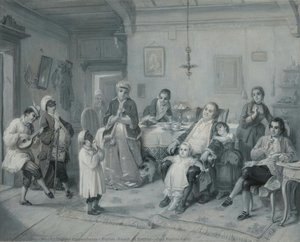
The Conclusion of the Sabbath (Sabbath-Ausgang) (1866) by Moritz Daniel Oppenheim

The Conclusion of the Sabbath (Sabbath-Ausgang)

1866 · Oil On Canvas · The Jewish Museum, New York City

Step closer and observe the quietude within this room. We find ourselves in a domestic space, a dining room caught in that delicate, flickering moment between the sacred rest of the Sabbath and the return to the labors of the week. The scene is centered upon a man lighting candles, a gesture that marks the havdalah ceremony. Around him, a multigenerational family and a Talmud student are gathered, their presence…

4
The Examination (Das Verhören) (1868) by Moritz Daniel Oppenheim

The Examination (Das Verhören)

1868 · Oil On Canvas · The Jewish Museum, New York City

Moritz Daniel Oppenheim's "The Examination," painted in 1868, is more than just a domestic scene; it’s a poignant window into the heart of 19th-century Jewish family life. This intimate portrait, rendered with remarkable sensitivity and detail, captures a moment of quiet contemplation within a warmly lit living space – a space that speaks volumes about tradition, education, and familial bonds. The painting immediately draws the viewer in, not with grand…

5
Portrait of a Young Woman at her Desk (1825) by Moritz Daniel Oppenheim

Portrait of a Young Woman at her Desk

1825 · Oil · Israel Museum, Jerusalem

A young woman is seated at a desk in this 1825 oil portrait. She is positioned slightly off-center, facing the viewer with a calm, steady expression. Her upper body and hands are the primary focus of this medium shot, captured at eye level. She wears a gown of a deep burgundy hue, the fabric appearing smooth and lustrous under the light. The sleeves and folds of the garment suggest a…

6
Marriage Portrait of Charlotte von Rothschild (1836) by Moritz Daniel Oppenheim

Marriage Portrait of Charlotte von Rothschild

1836 · Oil On Canvas · Israel Museum, Jerusalem

The Marriage Portrait of Charlotte von Rothschild is an oil on canvas painted by Moritz Daniel Oppenheim in 1836. The sitter is Charlotte von Rothschild, a German-born British socialite. She was a member of the Rothschild banking family of Naples. The portrait captures her at a moment of significant transition, marked by her family's prominent standing.

7
Portrait of Kalmann Meyer Carl von Rothschild (1851) by Moritz Daniel Oppenheim

Portrait of Kalmann Meyer Carl von Rothschild

1851 · Oil On Canvas · Israel Museum, Jerusalem

The Portrait of Kalmann Meyer Carl von Rothschild is an oil painting by the German artist Moritz Daniel Oppenheim. Created about 1851, this work captures a man of significant standing. Oppenheim was commissioned to paint several portraits of prominent members of the Rothschild banking dynasty, documenting their presence through the lens of mid-nineteenth-century realism.

8
Portrait of Adolph Carl von Rothschild (1850) by Moritz Daniel Oppenheim

Portrait of Adolph Carl von Rothschild

1850 · Oil On Canvas · Israel Museum, Jerusalem

This work is the Portrait of Adolph Carl von Rothschild, a formal depiction rendered by the German painter Moritz Daniel Oppenheim. Created about 1850, the portrait captures Baron Adolph Carl von Rothschild, a prominent figure within the influential Rothschild banking dynasty. The sitter's presence is marked by a quiet, dignified gravity that reflects his status during the mid-nineteenth century.

9
Sabbath Rest (1866) by Moritz Daniel Oppenheim

Sabbath Rest

1866 · Oil On Canvas

The oil on canvas titled Sabbath Rest, also known as Sabbath-Ruhe auf der Gasse, was painted in 1866. This work belongs to the hand of Moritz Daniel Oppenheim, an artist born in 1800 in Hanau, Germany. He lived until 1882 in Frankfurt, Germany. The painting captures a specific moment of stillness, a pause in the rhythm of daily life.

10
The Kindling of the Hanukkah Lights (1880) by Moritz Daniel Oppenheim

The Kindling of the Hanukkah Lights

1880 · Oil · Israel Museum, Jerusalem

A quiet domesticity defines this 1880 scene, where a Jewish family gathers to observe the Hanukkah ritual. The composition utilizes a deep perspective, drawing the eye from the foreground figures through an open doorway into a secondary room where others sit in repose. Soft, directional light enters from the left, casting gentle shadows that define the heavy drapery and the textures of period clothing. The palette is muted and monochromatic,…

Moritz Daniel Oppenheim's famous paintings, numbers 11 to 24

Moritz Daniel Oppenheim's famous paintings, period by period

The subjects that held Moritz Daniel Oppenheim's eye

The four subjects that come back most often in these originals, each with its finest example.

The museums that keep Moritz Daniel Oppenheim's originals

The 4 museums that hold the most of the paintings on this page.

Museum City Works by Moritz Daniel Oppenheim Paintings from this list
The Jewish Museum, New York CityThe Jewish Museum New York City 12 The Presentation at the Synagogue (Das Schultragen), The Conclusion of the Sabbath (Sabbath-Ausgang), The Examination (Das Verhören)
Israel Museum, JerusalemIsrael Museum Jerusalem 6 Marriage Portrait of Charlotte de Rothschild, Portrait of a Young Woman at her Desk, Marriage Portrait of Charlotte von Rothschild
Ascott House, Leighton BuzzardAscott House Leighton Buzzard 1 The Elector of Hesse Entrusting Mayer Amschel Rothschild (1743–1812), with His Treasure
National Portrait Gallery, LondonNational Portrait Gallery London 1 Lionel Nathan de Rothschild

Moritz Daniel Oppenheim across the decades: one unique original for each

Works per decade

Pick a decade to see the original that defines it.

Moritz Daniel Oppenheim's paintings: questions for the gallery

What is the single most famous work of Moritz Daniel Oppenheim?Reveal the answer

Marriage Portrait of Charlotte de Rothschild (1836), Israel Museum, Jerusalem. The Presentation at the Synagogue (Das Schultragen) (1869) and The Conclusion of the Sabbath (Sabbath-Ausgang) (1866) come next.

At what age did Moritz Daniel Oppenheim create Marriage Portrait of Charlotte de Rothschild?Reveal the answer

36 years old: Marriage Portrait of Charlotte de Rothschild dates from 1836, and Moritz Daniel Oppenheim was born in 1800.

Which ten paintings by Moritz Daniel Oppenheim are the most famous?Reveal the answer

Marriage Portrait of Charlotte de Rothschild, The Presentation at the Synagogue (Das Schultragen), The Conclusion of the Sabbath (Sabbath-Ausgang), The Examination (Das Verhören), Portrait of a Young Woman at her Desk, Marriage Portrait of Charlotte von Rothschild, Portrait of Kalmann Meyer Carl von Rothschild, Portrait of Adolph Carl von Rothschild, Sabbath Rest and The Kindling of the Hanukkah Lights. The ranking above gives each one's year and museum.

How many works by Moritz Daniel Oppenheim are known?Reveal the answer

Our catalog holds 28 works by Moritz Daniel Oppenheim, dated from 1814 to 1880.

Where can the most famous Moritz Daniel Oppenheim originals be seen?Reveal the answer

Mostly in The Jewish Museum (New York City), Israel Museum (Jerusalem) and Ascott House (Leighton Buzzard). The museum table above lists them all.

During which period did Moritz Daniel Oppenheim create the best-known paintings?Reveal the answer

In 1860s: 9 of the 24 works on this page were made then, The Presentation at the Synagogue (Das Schultragen) among them.

Which famous Moritz Daniel Oppenheim painting is the earliest, and which the latest?Reveal the answer

On this page, the earliest is Self-Portrait (1814) and the latest The Kindling of the Hanukkah Lights (1880).

What subjects did Moritz Daniel Oppenheim favour?Reveal the answer

Woman (5), Man (5) and Jewish family life (3), across the 24 works on this page.

What materials did Moritz Daniel Oppenheim paint with most?Reveal the answer

Oil On Canvas, for 13 of the 24 works on this page.

Which movement does the work of Moritz Daniel Oppenheim belong to?Reveal the answer

Romanticism, judging by the originals on this page.

What Moritz Daniel Oppenheim originals can I see at the The Jewish Museum?Reveal the answer

The Presentation at the Synagogue (Das Schultragen), The Conclusion of the Sabbath (Sabbath-Ausgang) and The Examination (Das Verhören): the The Jewish Museum, New York City holds 12 of the works on this page.

Moritz Daniel Oppenheim: a portrait of the artist

A Visionary of Jewish Identity

Moritz Daniel Oppenheim (1800-1882) stands as a singular figure in the annals of German art history, serving as a profound pioneer of Jewish artistic representation. Born in Hanau, Germany, his life and work were deeply rooted in a commitment to documenting and celebrating the nuances of Jewish life and culture during the transformative nineteenth century. He was often hailed as the first Jewish painter to achieve widespread recognition within the mainstream artistic landscape, moving beyond mere biographical detail to create an oeuvre that embodies a vital visual record of a community navigating the complexities of modernization while striving to preserve its sacred traditions.

Oppenheim's artistic journey began with foundational training under Conrad Westermayr in his birthplace, where he first absorbed the principles of German Romantic painting. However, his true professional ascent was catalyzed by his enrollment at the Munich Academy of Arts at the age of seventeen. It was within these prestigious halls that he honed his technical mastery alongside contemporaries such as Wilhelm Leibl and Johann Baptist Eberhard Krauss. Seeking to expand his horizons, Oppenheim embarked on a transformative period of study abroad, traveling to Paris to study under Jean-Baptiste Regnault and later to Rome. In Italy, mentored by luminaries like Bertel Thorwaldsen and the Nazarene painter Johann Friedrich Overbeck, his style evolved into a sophisticated blend of meticulous observation and classical influence. This Roman period was particularly pivotal, as it infused his work with a sense of historical gravity that would later inform his depictions of Jewish rituals and daily life.

The Art of Intimacy and Tradition

The heart of Oppenheim’s contribution to art lies in his ability to transform the domestic sphere into a stage for profound cultural narrative. His paintings often focus on intimate scenes of Jewish family life, capturing the quiet dignity of ritual and the warmth of communal bonds. Through his brush, the mundane becomes monumental. In works such as The Conclusion of the Sabbath (Sabbath-Ausgang), he employs masterful realism and subtle symbolism to depict the poignant transition from the sacred rest of the Sabbath back into the temporal world, inviting the viewer to witness the sanctity of family ritual.

His ability to weave historical context with personal emotion is perhaps most evident in his genre paintings that document specific cultural milestones. For instance:

  • The Wedding (Die Trauung): A breathtakingly detailed depiction of a 1866 Jewish wedding within the Frankfurt ghetto, where Oppenheim captures the splendor of traditional attire and the solemnity of the marriage canopy, offering a rare, preserved glimpse into a vanishing way of life.
  • The Return of the Volunteer: In this stunning oil painting from 1834, he explores the intersection of Jewish heritage and broader European history, portraying a soldier returning from the Wars of Liberation to a family still living according to ancient customs, effectively illustrating the tension between Napoleonic-era political shifts and enduring religious identity.

Legacy and Historical Significance

Beyond his technical skill, Oppenheim’s work is inextricably linked to the Wissenschaft des Judentums movement—a scholarly effort to establish Jewish history and culture as a respected academic field. His paintings functioned as visual scholarship, providing a dignified and authentic representation of a community that was often marginalized in the broader European art canon. By portraying Jewish subjects with the same level of detail, dignity, and Romantic grandeur typically reserved for aristocratic or mythological themes, he challenged existing prejudices and asserted the importance of Jewish identity within the German cultural fabric.

Ultimately, the legacy of Moritz Daniel Oppenheim is one of resilience and visibility. He did not merely paint scenes; he constructed a visual language for an era of transition. His ability to capture the delicate balance between the old world and the new ensures that his work remains a vital touchstone for understanding the nineteenth-century Jewish experience, making him an indispensable figure in the history of both German Romanticism and the global narrative of Jewish art.