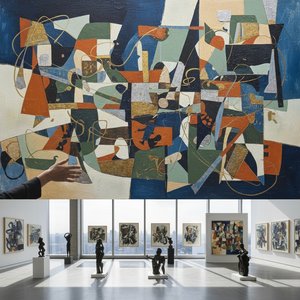
María Dolores Barreda: A Sculptor of Silence and Memory
Born in Madrid, Spain, in 1954, María Dolores Barreda’s artistic journey is one defined by a profound engagement with the intangible – identity, memory, and the very architecture of language. From her early beginnings immersed in the vibrant Spanish art scene, she has cultivated a distinctive style characterized by minimalism, negative space, and an almost meditative approach to form. Her work isn't about grand pronouncements; instead, it’s a delicate exploration of what remains unspoken, a quiet invitation to contemplate the echoes of experience.
Barreda’s formative years were spent navigating the complexities of a rapidly changing Spain. This period undoubtedly shaped her artistic sensibility, fostering an awareness of historical narratives and personal recollections – themes that consistently surface in her work. While she initially gained recognition within the Spanish art community through exhibitions in galleries and museums across Spain and Europe, Barreda's approach quickly distinguished itself. Her use of materials like paper, often manipulated with meticulous precision, creates a sense of fragility and vulnerability, mirroring the ephemeral nature of memory.
The Language of Form: Minimalism and Negative Space
At the heart of Barreda’s artistic practice lies a masterful command of minimalism. She doesn't rely on overt ornamentation or dramatic color palettes; rather, she employs a restrained aesthetic to draw attention to the fundamental elements of form and space. This deliberate simplicity is further enhanced by her strategic use of negative space – areas devoid of visual content that paradoxically become integral to the overall composition. These voids aren’t simply absences; they actively shape the viewer's perception, inviting them to fill in the gaps with their own experiences and interpretations.
Her geometric shapes are not merely decorative elements but rather carefully considered building blocks, each contributing to a larger conceptual framework. The precision of her lines and the deliberate arrangement of these forms suggest a deep understanding of spatial relationships – a subtle choreography of visual elements that speaks volumes without uttering a single word. This approach aligns with a broader trend in contemporary art—a move away from representational imagery towards abstraction as a means of exploring universal themes.
Notable Works and Exhibitions
Barreda’s artistic output is marked by a series of compelling works that showcase her unique vision. “Title:III Drawing Room” (2018), created using paper, exemplifies her ability to imbue an ordinary material with profound emotional resonance. The delicate layering and subtle textures invite viewers to consider the complexities of domestic space and the memories it holds.
- Visual Image of the III Hall of Abstract Art: A striking photographic documentation of a sculpture created by Barreda, capturing its form and texture in meticulous detail.
- 110 AEPE Exposition: This painting serves as a testament to her artistic vision, demonstrating her ability to convey complex ideas through abstract forms.
- 57 San Isidro: A thought-provoking piece that highlights Barreda’s skill and attention to detail, inviting viewers to contemplate the work's hidden meanings.
Her exhibitions have been held at prestigious venues such as the Asociación Española de Pintores y Escultores (Madrid, Spain), further solidifying her position within the Spanish art landscape. The association’s commitment to supporting and promoting artists aligns perfectly with Barreda's dedication to exploring the depths of human experience through abstract expression.
Beyond the Canvas: Influences and Legacy
While Barreda’s work is firmly rooted in contemporary abstraction, her artistic lineage can be traced back to a rich tradition of Spanish art. The influence of minimalist movements like that of Sol LeWitt and Agnes Martin are evident in her restrained palette and geometric forms. However, she transcends these influences by imbuing her work with a distinctly personal voice – one shaped by her own experiences and reflections on memory and identity.
Furthermore, Barreda’s engagement with the concept of “negative space” echoes the principles of Zen Buddhism, which emphasizes the importance of emptiness as a pathway to enlightenment. Her art, in this sense, becomes a visual meditation—an invitation to quiet the mind and contemplate the fundamental truths of existence.
María Dolores Barreda’s work continues to resonate with audiences around the world, offering a powerful reminder that true artistic expression often lies not in what is seen but in what remains unspoken. Her legacy as a sculptor of silence and memory will undoubtedly endure for generations to come. To learn more about her work, visit https://OriginalUniqueArt.com/@/maría dolores barreda. For a deeper understanding of the Spanish art scene, explore the fundació joan miró museum in barcelona, spain, and its extensive collection of modern and contemporary art.