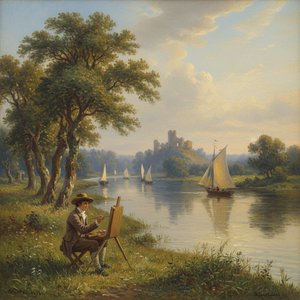
A Life Between Continents
Louis John Steele was a man whose life was shaped by the movement of people and the shifting borders of Europe and the Pacific. Born in Reigate, Surrey, on 30 January 1842, he carried the traditions of his English roots into the grand studios of France and Italy. His early years were defined by rigorous training at the École nationale supérieure des Beaux-Arts in Paris, a place where the weight of classical tradition was felt in every brushstroke. He later traveled to Florence, absorbing the light and history of Italy before returning to the turbulent atmosphere of Paris during the Franco-Prussian War and the Paris Commune.
By the 1870s, Steele had established himself within the British art scene, exhibiting his paintings at the Royal Academy of Arts in 1872 and 1875. His work during this period reflected a deep connection to the academic standards of the time. However, life eventually led him far from the familiar streets of Surrey. Around 1886, for reasons of health, he emigrated to New Zealand, settling in Auckland. This move marked a significant change in his surroundings, as he traded the established art circles of Europe for the developing colonial landscape of a new home.
The Auckland Studio
In Auckland, Steele found a new purpose and a new subject matter. He opened a studio in an arcade on Shortland Street, a space that became a hub for his creative output. While he continued to paint portraits and racehorses, he began to engage deeply with the history and people of New Zealand. His training in the Royal Academy manner allowed him to approach these local themes with a sense of scale and drama. He often worked on large canvases, sometimes collaborating with other artists like Kennett Watkins or his former pupil, Charles Frederick Goldie.
His interests were broad, ranging from historical scenes to the lives of the Māori people. One of his most notable works, The Arrival of the Maori in New Zealand, created in 1898, was a large-scale collaboration with Goldie. This painting drew direct inspiration from Théodore Géricault’s Raft of the Medusa, applying European Romanticism to the foundational stories of the New Zealand landscape. His ability to blend these classical influences with local narratives helped define a specific era of colonial art.
Legacy and Final Years
Steele's career was marked by a dedication to his craft that lasted until his death in Auckland on 12 December 1918. He left behind a body of work that captured both the individual faces of his community and the larger historical movements of his time. His paintings, such as his large oil depiction of Sir John Logan Campbell at Kilbryde, have occasionally resurfaced in recent years, reminding collectors of the depth of his technical skill.
The impact of his teaching also lived on through his students, most notably Charles Frederick Goldie, who would go on to become a significant figure in New Zealand art. Through this lineage, Steele's influence reached into the next generation of painters. His life remains a story of an artist who successfully transplanted the formal elegance of European academies into the soil of a new nation.
Questions & Answers
How many artworks by Louis John Steele are available to browse?
You can browse 12 artworks by Louis John Steele on the All Artworks page.
Where are Louis John Steele's artworks grouped by palette?
The By Palettes page groups Louis John Steele's artworks by their color palettes.
Can I browse Louis John Steele's works by mood?
The artist's Mood Room page shows Louis John Steele's artworks arranged by their atmosphere.