A Master of Parisian Atticism
Laurent de La Hyre stands as a luminous figure in the history of French art, a painter whose brush captured the transition from the dramatic intensity of the Baroque to the refined elegance of the neoclassical style known as Parisian Atticism. Born in Paris, his life and work were deeply rooted in the cultural atmosphere of his home city. Though he never traveled to Italy, the spirit of the Italian Renaissance permeated his studio through the presence of foreign masters in Paris and his dedicated study of works like those of Primaticcio at Fontainebleau. This connection allowed him to weave a unique tapestry of classical ideals, blending the masterful use of light and shadow reminiscent of Caravaggio with a distinctively French sense of grace and clarity.
His early training under Georges Lallemand provided the foundational skills that would later allow him to become an innovative storyteller on canvas. In his formative years, La Hyre developed a painterly style characterized by captivating colors and delicately posed figures. As his career progressed, he moved toward a more sober and grave aesthetic, a development that would profoundly influence the next generation of French painters, such as Eustache Le Sueur. His ability to imbue classical narratives with psychological depth transformed mere historical depictions into profound explorations of human emotion and civic duty.
Narrative Depth and Classical Harmony
The brilliance of La Hyre’s oeuvre lies in his capacity to breathe life into myth and history through meticulous composition and symbolic resonance. He was an artist who utilized his superior skills as a storyteller to portray subjects that were rarely seen, often drawing from classical literature and tragedy. His works frequently function as tableaux vivants, where every gesture and averted glance hints at the intricate web of relationships and unspoken tensions within the scene.
In his celebrated works, one can observe a masterful command of several key elements:
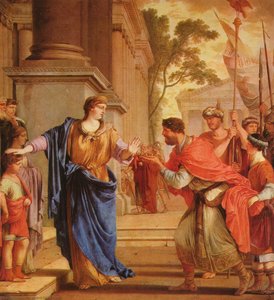
- Classical Narrative: He often explored themes of tragedy, duty, and myth, such as in his depiction of Cyrus announcing a pardon, where he balanced royal authority with personal pathos.
- Light and Shadow: Drawing from the influence of Italian masters, he used light to direct the viewer's gaze and create a palpable sense of realism.
- Architectural Framing: La Hyre skillfully employed classical architecture—doorways, furniture, and structural elements—to frame his narratives and immerse the viewer in the drama.
- Color Palette: His use of color ranged from the vibrant energy of red and blue to more delicate, contemplative hues like purple, contributing to the emotional resonance of his subjects.
Whether depicting the strength of Theseus or the intellectual grace found in allegorical figures, La Hyre’s work remains a testament to the power of harmony and proportion. His legacy is not merely found in the beauty of his finished canvases but in his role as a bridge between eras, helping to define a period of French art marked by gravity, simplicity, and an enduring devotion to classical ideals.
Questions & Answers
Can I sort Laurent De La Hyre's artworks by color?
The Spectral Index page organizes Laurent De La Hyre's artworks by color.
How is Laurent De La Hyre's career divided into periods?
A chronological account of Laurent De La Hyre's work is available on the artist's Chronicle page, where the artworks pass in order of creation, chapter by chapter.
Where are Laurent De La Hyre's artworks grouped by palette?
Laurent De La Hyre's works can be browsed by color palette on the artist's By Palettes page.