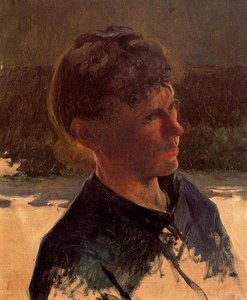
Portrait of José Jiménez Aranda

The 75 Most Famous José Jiménez Aranda Paintings, Each One of a Kind

Updated November 2026 · ranked by our popularity score (searches, visits and orders for each work) · 76 works by José Jiménez Aranda in our catalogue

In short

Una desgracia (1890) is the José Jiménez Aranda painting that draws the most eyes. After it, the eye goes to El Quijote 4 and Small naturalists. Among the 76 works of José Jiménez Aranda in our catalog, these 75 are the most famous, each a unique original presented with its year, its museum and the reason it endures.

1837 – 1903, Seville Costumbrista Most works: Museo del Prado

Top 10 paintings by José Jiménez Aranda, through the gallery's eye

1
Una desgracia (1890) by José Jiménez Aranda

Una desgracia

1890 · Oil

We are looking at Una desgracia, a work from 1890 by the Spanish painter José Jiménez Aranda. This piece represents a significant moment in the artist's career, marking a shift toward the costumbrismo style that would define much of his later output. It is a somber, black and white depiction of a group of people gathered before a building under construction. The scene, set in the 19th century, captures a…

2
El Quijote 4 by José Jiménez Aranda

El Quijote 4

Oil

The artwork titled El Quijote 4 is a creation by the Spanish painter José Jiménez Aranda. It captures a specific, restless moment drawn from the literary world of Miguel de Cervantes. Within the frame, the knight Don Quixote and his companion Sancho Panza are mounted upon their horses. They move through a landscape of sudden motion, caught in the midst of an encounter or a skirmish involving several other figures.…

3
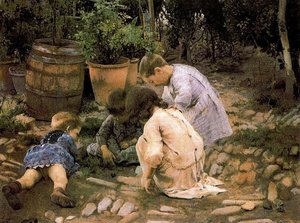
Small naturalists by José Jiménez Aranda

Small naturalists

Oil On Canvas

Three children crouch upon the earth, their bodies forming a soft triangle of curiosity. They are bent low, eyes fixed on the small, moving lives hidden among the stones and dirt. A large barrel and several terracotta pots sit in the background, grounding the scene in a lived-in, unmanicured space. The light is diffused, as if filtered through a heavy, overcast sky, casting no harsh shadows upon the ground. Everything…

4
Figaro's Shop (1875) by José Jiménez Aranda

Figaro's Shop

1875 · Oil On Canvas · Walters Art Museum, Baltimore

The afternoon sun spills across a dusty street, casting soft shadows that dance against the weathered plaster of a building. In front of a doorway, life unfolds in a quiet, rhythmic pulse. A man sits with a guitar, his fingers coaxing melodies from the strings, while others gather around a table, lost in the easy gravity of conversation. There is a sense of a world caught in mid-breath. A woman’s…

5
The old naturalist (1880) by José Jiménez Aranda

The old naturalist

1880 · Oil

A single man stands amidst a silent assembly of taxidermied birds. He is dressed in the heavy, structured attire of the 18th century, wearing a tricorne hat and a long frock coat that anchors him to the floorboards. His mouth is open, caught in a sudden gasp or a sharp intake of breath. Around him, the stillness of the museum room is broken only by the presence of these preserved…

6
The Hato (1896) by José Jiménez Aranda

The Hato

1896 · Oil On Canvas

The Hato emerges from the brush of José Jiménez Aranda, a painter who carries the spirit of Seville, Spain, within his work. Born in 1837, Aranda brings a deep understanding of light and shadow to this scene. The painting, created about 1896, captures a quiet, suspended moment in a sun-dappled woodland. It is a scene of rest where a large, reclining hunting dog and a sleeping infant share a peaceful…

7
Spring in Seville (1903) by José Jiménez Aranda

Spring in Seville

1903 · Oil On Canvas · Fundacion Banco Santander, Madrid

Spring in Seville by José Jiménez Aranda presents a large-scale oil on canvas composition created about 1903. The subject matter focuses on the various festivities and traditions associated with the season in Seville, Spain. The painting incorporates specific cultural references, including elements of bullfighting, known as corridas de toros. These elements are integrated into a dense arrangement of figures and objects that characterize the local customs of the period.

8
The first child by José Jiménez Aranda

The first child

Oil

The work suggests a mythological or historical narrative, focusing on the fundamental bonds of family and the vulnerability of new life. The interplay of light across the subjects creates a sense of privacy, as if the viewer has stumbled upon a sacred, secluded moment. There is a palpable tension between the serenity of the sleeping infant and the watchful, slightly anxious energy of the adults. This duality captures a fleeting…

9
Don Quixote and Sancho Panza by José Jiménez Aranda

Don Quixote and Sancho Panza

Oil On Canvas

The composition centers on two figures mounted on horses, moving along a dirt road. To the left, a man sits atop a horse, while to the right, another man follows on a separate mount. These two figures, Don Quixote and Sancho Panza, occupy the primary space of the canvas. In the middle ground, a dog is positioned near the center-right area. Several other people are scattered throughout the background, some…

José Jiménez Aranda's famous paintings, numbers 11 to 75

José Jiménez Aranda's famous paintings, period by period

The subjects that held José Jiménez Aranda's eye

The four subjects that come back most often in these originals, each with its finest example.

The museums that keep José Jiménez Aranda's originals

The 4 museums that hold the most of the paintings on this page.

Museum City Works by José Jiménez Aranda Paintings from this list
Museo del Prado, MadridMuseo del Prado Madrid 3 En la iglesia, Retrato de Sorolla, La esclava
Walters Art Museum, BaltimoreWalters Art Museum Baltimore 1 Figaro's Shop
Fundacion Banco Santander, MadridFundacion Banco Santander Madrid 1 Spring in Seville
Museo Carmen Thyssen Málaga, MalagaMuseo Carmen Thyssen Málaga Malaga 1 A Pass in the Bullring

José Jiménez Aranda across the decades: one unique original for each

Works per decade

Pick a decade to see the original that defines it.

José Jiménez Aranda's paintings: questions for the gallery

What is the single most famous work of José Jiménez Aranda?Reveal the answer

Una desgracia (1890). El Quijote 4 and Small naturalists come next.

At what age did José Jiménez Aranda create Una desgracia?Reveal the answer

53 years old: Una desgracia dates from 1890, and José Jiménez Aranda was born in 1837.

Which ten paintings by José Jiménez Aranda are the most famous?Reveal the answer

Una desgracia, El Quijote 4, Small naturalists, Figaro's Shop, The old naturalist, The Hato, Spring in Seville, The first child, Don Quixote and Sancho Panza and A Pass in the Bullring. The ranking above gives each one's year and museum.

How many works by José Jiménez Aranda are known?Reveal the answer

Our catalog holds 76 works by José Jiménez Aranda, dated from 1870 to 1903.

Where can the most famous José Jiménez Aranda originals be seen?Reveal the answer

Mostly in Museo del Prado (Madrid), Walters Art Museum (Baltimore) and Fundacion Banco Santander (Madrid). The museum table above lists them all.

During which period did José Jiménez Aranda create the best-known paintings?Reveal the answer

In 1880s: 3 of the 75 works on this page were made then, The old naturalist among them.

Which famous José Jiménez Aranda painting is the earliest, and which the latest?Reveal the answer

On this page, the earliest is A Pass in the Bullring (1870) and the latest Spring in Seville (1903).

What subjects did José Jiménez Aranda favour?Reveal the answer

Portrait (5), People (4) and Landscape (4), across the 75 works on this page.

What materials did José Jiménez Aranda paint with most?Reveal the answer

Oil On Canvas, for 5 of the 75 works on this page.

Which movement does the work of José Jiménez Aranda belong to?Reveal the answer

Costumbrista and Contemporary realism, judging by the originals on this page.

What José Jiménez Aranda originals can I see at the Museo del Prado?Reveal the answer

En la iglesia, Retrato de Sorolla and La esclava: the Museo del Prado, Madrid holds 3 of the works on this page.

José Jiménez Aranda: a portrait of the artist

A Life Immersed in Light and Shadow

José Jiménez Aranda, born in the vibrant city of Seville in 1837, was a painter who navigated the complex currents of 19th-century Spanish art with remarkable versatility. His life, spanning just over six decades, coincided with an era of profound transformation—socially, politically, and artistically—and his work serves as a compelling reflection of this dynamic period. From rigorous academic training to embracing the influence of masters like Goya and Velázquez, and later finding inspiration in the luminous scenes championed by Mariano Fortuny, Aranda’s artistic journey was one of continuous evolution. He wasn't merely a recorder of his time; he was an interpreter, capturing both the grandeur of historical moments and the quiet intimacy of everyday life with equal skill. The tragic loss of his wife and daughter in 1892 cast a long shadow over his later years, prompting a return to Seville where he dedicated himself to teaching and continued to refine his distinctive style, leaving behind a legacy that continues to resonate within Spanish art history.

Formative Years and Artistic Pilgrimages

Aranda’s artistic inclinations were nurtured from an early age, receiving initial instruction from Manuel Cabral and Eduardo Cano de la Peña. This foundational training proved crucial when, in 1851, he entered the Real Academia de Bellas Artes de Santa Isabel de Hungría in Seville. The Academy provided a rigorous grounding in classical techniques, but it was his subsequent travels that truly ignited his artistic vision. A pivotal moment came during an extended stay in Rome between 1871 and 1878, where he encountered the work of Mariano Fortuny. Fortuny’s influence is palpable in Aranda's paintings from this period—a shared fascination with luminous color, meticulous detail, and a penchant for depicting elegant scenes often set in historical contexts. This wasn't simply imitation; Aranda absorbed Fortuny’s techniques and adapted them to his own sensibilities. Before Rome, however, he immersed himself in the masterpieces of Spanish art at the Museo del Prado in Madrid, studying the works of Goya and Velázquez with a discerning eye. These masters instilled in him an appreciation for dramatic lighting, psychological depth, and the power of observation—qualities that would become hallmarks of his own style. He also spent time as a restorer and designer of stained glass in Jerez de la Frontera, further honing his technical skills and developing a keen understanding of color and composition.

Parisian Refinement and Costumbrista Visions

The years Aranda spent in Paris (1881-1890) were arguably the most commercially successful of his career. He specialized in what became known as “tableautin” painting—small-scale genre scenes, often depicting 18th-century life with a refined elegance reminiscent of Fortuny. These works found favor among collectors and established Aranda’s reputation as a skilled and sophisticated painter. However, upon returning to Madrid, his artistic focus shifted. He began to explore *costumbrismo*, a distinctly Spanish genre that focused on depicting the customs, traditions, and everyday life of the people. Paintings like “Una Desgracia” (A Disaster) from 1890 demonstrate this new direction—a poignant portrayal of human suffering rendered with both realism and emotional depth. This work earned him a first medal at the Nacional exhibition, solidifying his position as a leading figure in Spanish art. It was a move away from the purely decorative towards a more socially conscious form of representation, reflecting a growing engagement with the realities of contemporary Spain.

A Monumental Legacy: Don Quijote and Beyond

While Aranda produced numerous paintings throughout his career—dynamic bullfighting scenes like “A Pass in the Bullring” (1870), insightful social commentaries such as “Slave for Sale” (c. 1897)—it is perhaps his illustrations for a tercentenary edition of *Don Quijote* that represent his most ambitious and enduring achievement. He created an astonishing 689 highlighted drawings for this project, a monumental undertaking that showcased not only his technical virtuosity but also his deep understanding of Cervantes’ masterpiece. These illustrations are more than mere accompaniments to the text; they are interpretations—vivid, expressive renderings of iconic scenes and characters that capture the spirit of the novel. Beyond *Don Quijote*, Aranda dedicated himself to teaching at the Academy of Fine Arts in Seville after returning to his birthplace, nurturing a new generation of Spanish artists including Daniel Vázquez Díaz, Eugenio Hermoso, Ricardo López Cabrera, Manuel González Santos, and Sanz Arizmendi. His influence extended beyond his own artistic output, shaping the course of Spanish painting for years to come. He became a pivotal figure in the Alcala de Guadaíra circle of landscape painters, further enriching the artistic landscape of Spain.

Enduring Significance

José Jiménez Aranda’s legacy lies in the breadth and depth of his work—from the elegant historical scenes influenced by Fortuny to the insightful portrayals of everyday life rooted in *costumbrismo*. He was a master of technique, known for his meticulous attention to detail, refined brushwork, and ability to capture the essence of Spanish culture. His illustrations for Don Quijote stand as a testament to his versatility and artistic vision, cementing his place as a significant figure in 19th-century Spanish art. Though perhaps not as widely recognized today as some of his contemporaries, Aranda’s paintings continue to captivate viewers with their beauty, sensitivity, and enduring relevance—a lasting tribute to a life dedicated to the pursuit of artistic excellence. His ability to blend technical skill with emotional depth ensures that his work will continue to inspire and resonate with audiences for generations to come.