Portrait of John Glover

The 32 Most Famous John Glover Paintings, a Gallery Selection

Updated October 2026 · ranked by our popularity score (searches, visits and orders for each work) · 33 works by John Glover in our catalogue

In short

Of all the originals John Glover left, the most famous is The Artist's House and Garden, in the collection of the Art Gallery of South Australia, Adelaide. Close behind it come A Corroboree in Van Diemen's Land (1840) and Natives on the Ouse River, Van Diemen (1838). Our catalog holds 33 works by John Glover; the gallery has kept the 32 the world admires most, each shown with its date, its museum and its story.

1767 – 1849, Houghton on the Hill Romanticism Most works: Art Gallery of New South Wales

John Glover's top 10 paintings: the gallery's choice

1
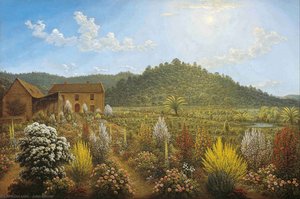
The Artist's House and Garden by John Glover

The Artist's House and Garden

Acrylic On Canvas · Art Gallery of South Australia, Adelaide

John Glover: Capturing Tranquility in Rural England John Glover (1767 – 1849), born in Leicestershire, England, possessed an innate artistic sensibility that blossomed early in life. From humble beginnings as the youngest son of a farming family at Houghton-on-the-Hill, young John demonstrated a remarkable talent for both drawing and calligraphy. This skill led to his appointment as a writing master at the Free School in Appleby, providing him with a…

2
A Corroboree in Van Diemen's Land (1840) by John Glover

A Corroboree in Van Diemen's Land

1840 · Oil On Canvas · The Louvre, Paris

This evocative canvas, depicting A Corroboree in Van Diemen's Land, transports the viewer into a moment suspended between the earthly and the spiritual. It is more than a mere depiction of an Aboriginal gathering; it is a profound meditation on culture, resilience, and the enduring power of ritual set against the vast, mysterious backdrop of the Australian wilderness. The scene unfolds under a luminous, ethereal moonlight, casting the central clearing…

3
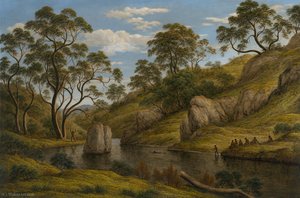
Natives on the Ouse River, Van Diemen (1838) by John Glover

Natives on the Ouse River, Van Diemen

1838 · Oil · Art Gallery of New South Wales, Sydney

John Glover’s “Natives on the Ouse River, Van Diemen” – A Pioneer of Australian Landscape Painting John Glover (1767-1849) stands as a monumental figure in the annals of Australian art history—often hailed as "the father of Australian landscape painting." His artistic journey began modestly in Leicestershire, England, where he honed his skills as a drawing master and embraced both oil and watercolor mediums. However, it was his emigration to Tasmania…

4
Patterdale farm (1840) by John Glover

Patterdale farm

1840 · Oil · Art Gallery of New South Wales, Sydney

Painted toward the end of John Glover’s career, this landscape captures a moment of quietude within a lush, green expanse. The composition centers on a field where cows graze peacefully, their forms scattered across the foreground and receding into the distance. A solitary figure, likely a farmer or shepherd, moves through the scene, tending to the livestock. Above, a heavy, cloudy sky adds a sense of atmospheric depth, casting a…

The John Glover selection continues, 11 to 32

The subjects that held John Glover's eye

The four subjects that come back most often in these originals, each with its finest example.

The museums that keep John Glover's originals

The 8 museums that hold the most of the paintings on this page.

Museum City Works by John Glover Paintings from this list
Art Gallery of New South Wales, SydneyArt Gallery of New South Wales Sydney 6 Natives on the Ouse River, Van Diemen, Patterdale farm, Ullswater, early morning
National Gallery of Australia, CanberraNational Gallery of Australia Canberra 6 Patterdale landscape with cattle, The Island of Madeira, Mount Wellington and Hobart Town from Kangaroo Point
Art Gallery of South Australia, AdelaideArt Gallery of South Australia Adelaide 3 The Artist's House and Garden, A corroboree of natives in Mills Plains, A view of the artist's house and garden, in Mills Plains, Van Diemen's Land
Birmingham Museum and Art Gallery, BirminghamBirmingham Museum and Art Gallery Birmingham 3 Conway, North Wales, Landscape with Trees and Cattle, Mountain Stream
Calke AbbeyCalke Abbey 3 A View of Calke Park with a View of Lower Dog Kennel Pond, Figures, Cattle and Sheep, Boathouse in Calke Park, A Woodland River Landscape
The Louvre, ParisThe Louvre Paris 1 A Corroboree in Van Diemen's Land
National Library of Wales, AberystwythNational Library of Wales Aberystwyth 1 Snowdon & Dolbadern Castle, north Wales
National Gallery of Victoria, MelbourneNational Gallery of Victoria Melbourne 1 The River Nile, Van Diemen's Land, from Mr Glover's farm

John Glover decade by decade: the original that defines each

Works per decade

Pick a decade to see the original that defines it.

Collectors' questions about John Glover's paintings

Which work is John Glover most famous for?Reveal the answer

The Artist's House and Garden, Art Gallery of South Australia, Adelaide. A Corroboree in Van Diemen's Land (1840) and Natives on the Ouse River, Van Diemen (1838) come next.

What are the ten most famous John Glover paintings?Reveal the answer

The Artist's House and Garden, A Corroboree in Van Diemen's Land, Natives on the Ouse River, Van Diemen, Patterdale farm, Conway, North Wales, Landscape with Trees and Cattle, Mountain Stream, View of Patterdale, Westmorland, A View of Calke Park with a View of Lower Dog Kennel Pond, Figures, Cattle and Sheep and Boathouse in Calke Park. The ranking above gives each one's year and museum.

How many paintings did John Glover leave?Reveal the answer

Our catalog holds 33 works by John Glover, dated from 1797 to 1840.

In which museums do John Glover's masterpieces hang?Reveal the answer

Mostly in Art Gallery of New South Wales (Sydney), National Gallery of Australia (Canberra) and Art Gallery of South Australia (Adelaide). The museum table above lists them all.

In which years did John Glover paint the most famous works?Reveal the answer

In 1810s: 6 of the 32 works on this page were made then, Landscape with Trees and Cattle among them.

What are the first and the last famous originals of John Glover?Reveal the answer

On this page, the earliest is Conway, North Wales (1797) and the latest A Corroboree in Van Diemen's Land (1840).

Which subjects did John Glover choose most often?Reveal the answer

Landscape (8), Victorian era (2) and Cows (2), across the 32 works on this page.

Which technique did John Glover use most?Reveal the answer

Oil, for 2 of the 32 works on this page.

To which art movement does John Glover belong?Reveal the answer

Romanticism, judging by the originals on this page.

Which John Glover works hang at the Art Gallery of New South Wales?Reveal the answer

Natives on the Ouse River, Van Diemen, Patterdale farm and Ullswater, early morning: the Art Gallery of New South Wales, Sydney holds 6 of the works on this page.

John Glover: life and work

Early Life and Artistic Foundations

John Glover, born February 18, 1767, in the tranquil Leicestershire countryside of England, possessed an innate artistic sensibility that blossomed early in life. From humble beginnings as the youngest son of a farming family at Houghton-on-the-Hill, young John demonstrated a remarkable talent for both drawing and calligraphy. This skill led to his appointment as a writing master at the Free School in Appleby, a position that provided him with a stable foundation while nurturing his burgeoning artistic inclinations. It was during this period that Glover began to explore painting in both oil and watercolour, receiving instruction from notable artists of the time such as William Payne and potentially John 'Warwick' Smith. These early lessons instilled within him a deep appreciation for picturesque views and a dedication to capturing the beauty of the natural world through sketching tours – a practice that would define his artistic journey for decades to come. He quickly developed an eye for composition, light, and atmosphere, skills he honed while meticulously documenting the landscapes around him.

A Rising Star in the British Art World

Glover’s dedication and talent did not go unnoticed. In 1805, he became a member of the prestigious Old Water Colour Society, quickly ascending to the position of president in 1807. This marked a significant turning point in his career, solidifying his reputation within the British art establishment. He exhibited extensively at both the Royal Academy and the Society of British Artists, showcasing his evolving style and captivating audiences with his romantic landscapes. Glover became particularly known for what were termed “Italianate” scenes – not literal depictions of Italy, but rather idealized visions of Britain and Southern Europe infused with a distinctly classical sensibility. His work drew heavily from the influence of Claude Lorrain, earning him the affectionate moniker "the English Claude." This comparison was apt; like his admired predecessor, Glover masterfully employed luminous skies, harmonious compositions, and an overall sense of idyllic beauty in his paintings. By 1820, he had established his own gallery in London, a testament to his growing success and artistic independence.

A New World, A Transformed Vision

In 1831, at the age of sixty-four, John Glover made a bold decision that would irrevocably alter both his life and his art: he emigrated with his family to Van Diemen’s Land (now Tasmania), Australia. This was not merely a relocation; it was a leap into the unknown, driven by a desire for new opportunities and a fascination with the untamed beauty of the Antipodes. Upon arrival, Glover acquired a substantial land grant at Mills Plains, which he christened Patterdale after a cherished location in the Lake District – a poignant reminder of his English roots. However, Australia was unlike anything he had ever encountered. The landscape demanded a new approach, and Glover responded with remarkable adaptability. He gradually moved away from the idealized romanticism of his earlier work, embracing a more naturalistic and atmospheric style that reflected the unique qualities of the Tasmanian environment. His palette underwent a transformation, incorporating olive greens, ochres, misty greys, and intense blues to capture the distinctive light and atmosphere of the Australian bush, particularly the majestic eucalyptus trees.

Legacy as the “Father of Australian Landscape Painting”

Glover’s pioneering depictions of the Australian landscape cemented his place in art history. Notable works such as "Launceston and the River Tamar," "At Matlock - mist rising," and perhaps most significantly, "Natives on the Ouse River, Van Diemen’s Land" stand as testaments to his artistic vision and historical importance. “Natives on the Ouse River” is particularly noteworthy for its reflection of European perceptions of an idyllic Antipodean landscape, a complex portrayal that invites critical examination. He is rightfully considered the "father of Australian landscape painting," not simply because he was among the first to depict the continent’s natural beauty, but because he established a new approach – one that moved beyond colonial art styles and embraced the unique character of the land. His influence extended far beyond his lifetime; The John Glover Society was founded to honor his legacy, commissioning a statue in his likeness and awarding an annual prize for Tasmanian landscape paintings. Today, Glover’s paintings are held in major art galleries throughout Australia and internationally, continuing to inspire artists and captivate audiences with their beauty, technical skill, and enduring historical significance. He remains a pivotal figure in the development of Australian art, a testament to the power of artistic vision and the transformative potential of embracing a new world.