Portrait of Jan Van Os

Jan Van Os Paintings: The 51 Most Famous, Through a Gallery's Eye

Updated November 2026 · ranked by our popularity score (searches, visits and orders for each work) · 52 works by Jan Van Os in our catalogue

In short

To the gallery's eye, Jan Van Os's most famous painting is Still Life with Flowers, Fruit and Birds (1774), whose original hangs in the Rijksmuseum, Amsterdam. Still Life with Friut and Flowers (1790) and Flowers and Fruits on a Stone Cornice, with Mouse and Lizard (1771) complete the trio every eye recognises. Of the 52 works by Jan Van Os in our catalog, the gallery presents the 51 most famous below, each original with its year, its museum and what makes it unique.

1744 – 1808, Middelharnis Baroque Most works: Fitzwilliam Museum

The gallery's top 10 Jan Van Os paintings

1
Still Life with Flowers, Fruit and Birds (1774) by Jan Van Os

Still Life with Flowers, Fruit and Birds

1774 · Oil On Canvas · Rijksmuseum, Amsterdam

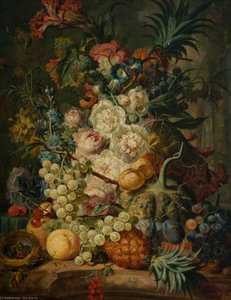
Still Life with Flowers, Fruit and Birds is a work by the Dutch painter Jan Van Os. He was born in Middelharnis, Netherlands. This painting emerged from a lineage of creators, as he was a member of the Van Os family of artists. The canvas captures a dense arrangement of botanical and organic life, centered around a pyramidal cluster of flora and fauna.

2
Still Life with Friut and Flowers (1790) by Jan Van Os

Still Life with Friut and Flowers

1790 · Oil On Canvas · Speed Art Museum, Louisville

Still Life with Friut and Flowers is an oil on canvas work by the Dutch painter Jan Van Os. Created about 1790, this composition reflects the artist's long-standing dedication to the meticulous study of botanical and organic subjects. Van Os, who was born in Middelharnis, Netherlands, brought a specific technical precision to his depictions of nature that became a hallmark of his practice.

3
Flowers and Fruits on a Stone Cornice, with Mouse and Lizard (1771) by Jan Van Os

Flowers and Fruits on a Stone Cornice, with Mouse and Lizard

1771 · Oil On Canvas

A heavy stone cornice anchors the composition, its gritty surface catching a sharp, directional light. Upon this ledge, a pineapple sits with its rough, patterned skin, its warm orange hues contrasting against the deep shadows of the background. Beside it, a cluster of grapes spills downward, some translucent and pale green, others a bruised, dark purple. A sliced melon reveals its moist, glistening interior, its flesh catching the light like…

4
Still Life with Flowers and Fruit (1775) by Jan Van Os

Still Life with Flowers and Fruit

1775 · Oil On Canvas · Centraal Museum, Utrecht

This work, titled Still Life with Flowers and Fruit, was painted by Jan Van Os around 1775. The artist, who was born in Middelharnis, Netherlands, on 23 February 1744, developed a specific command over the textures of the natural world. His practice often focused on the quiet, detailed observation of botanical and organic life, moving away from his earlier interest in seascapes to find a more intimate subject matter.

5
river-landscape with sheep (1769) by Jan Van Os

river-landscape with sheep

1769 · Oil On Canvas

In this monochrome, black and white reproduction of an 18th-century landscape oil painting, Jan Van Os captures a serene river scene. The work, titled river-landscape with sheep, was created about 1769. A small flock of sheep grazes upon a grassy bank in the foreground, some standing while others rest in the quietude. To the left, a dark, thatched-roof cottage sits near the water's edge, while a large, leafy tree anchors…

6
Winter Landscape by Jan Van Os

Winter Landscape

Oil On Panel

The painting titled Winter Landscape belongs to the hand of Jan Van Os. Born in 1744 in Middelharnis, Netherlands, the artist established a presence within a significant Dutch artistic lineage. His life spanned the transition of the eighteenth century, concluding in 1808.

7
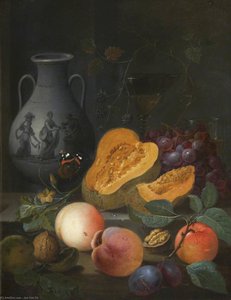
Still Life of Flowers (1776) by Jan Van Os

Still Life of Flowers

1776 · Oil On Canvas · Bavarian State Painting Collections, Munich

Still Life of Flowers is an oil painting by Jan Van Os, executed in 1776. The artist, born in Middelharnis, Netherlands, in 1744, was a central figure in a significant Dutch artistic dynasty. His work reflects the technical precision and aesthetic sensibilities characteristic of the late eighteenth century.
8
Boats and Sailboats on a Quiet Sea (1780) by Jan Van Os

Boats and Sailboats on a Quiet Sea

1780 · Oil · Städel Museum, Frankfurt

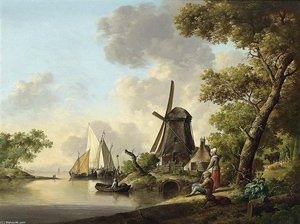
In this oil painting, titled Boats and Sailboats on a Quiet Sea, we encounter a serene maritime scene composed by Jan Van Os. Created in 1780, the work captures a moment of stillness upon the water. It belongs to a period in the artist's career when he focused on the expansive horizons of seascapes, a pursuit that preceded his later, more celebrated focus on floral and fruit still lifes.

9
Flowers (1780) by Jan Van Os

Flowers

1780 · Oil On Canvas · Art Gallery of South Australia, Adelaide

In this 1780 oil painting, Jan van Os presents a dense, lush arrangement of botanical life that feels almost heavy with its own vitality. A large, ornate ceramic vase sits at the center, overflowing with a variety of blooms that spill outward in a controlled yet organic chaos. The composition draws the eye through a collection of roses, tulips, and anemones, their petals rendered with a meticulous attention to texture…

10
Still life of Plants, Flowers and Fruit (1787) by Jan Van Os

Still life of Plants, Flowers and Fruit

1787 · Watercolor · Rijksmuseum, Amsterdam

Still life of Plants, Flowers and Fruit is a work by Jan Van Os. Created in 1787, this composition captures a dense arrangement of botanical life. The artist, Jan Van Os, focused his attention on the quiet presence of nature through this specific grouping. It is a study of organic forms resting together in a singular moment.

Jan Van Os paintings, ranked 11 to 51

11Dutch Ships Under the Breeze (1800) by Jan Van OsDutch Ships Under the Breeze1800 12Still Life with Dead Birds, Camellia and Fruit (1800) by Jan Van OsStill Life with Dead Birds, Camellia and Fruit1800 13Flowers, grapes, plums, walnuts and a melon on a stone ledge (1800) by Jan Van OsFlowers, grapes, plums, walnuts and a melon on a stone ledge1800 14Still Life with Fruit (1808) by Jan Van OsStill Life with Fruit1808 · The Frick Pittsburgh 15Flowers by Jan Van OsFlowersNational Museum in Kraków 16Dutch Vessels in a Calm Water by Jan Van OsDutch Vessels in a Calm WaterSzépművészeti Múzeum 17Dutch Vessels in a Calm Water by Jan Van OsDutch Vessels in a Calm WaterSzépművészeti Múzeum 18Still life with Flowers and Fruit by Jan Van OsStill life with Flowers and FruitMuseum Mayer van den Bergh 19Blomsterstycke by Jan Van OsBlomsterstyckeNationalmuseum 20Flowers by Jan Van OsFlowers 21Flowers And Fruit by Jan Van OsFlowers And FruitFitzwilliam Museum 22Flowers And Fruit - by Jan Van OsFlowers And Fruit - 23Dutch Vessels In Calm Water by Jan Van OsDutch Vessels In Calm WaterNational Gallery 24Fruit, Flowers And A Fish by Jan Van OsFruit, Flowers And A FishNational Gallery 25Still Life Of Flowers by Jan Van OsStill Life Of Flowers 26Still Life Of Summer Flowers by Jan Van OsStill Life Of Summer Flowers 27Fruit And Flowers In A Terracotta Vase by Jan Van OsFruit And Flowers In A Terracotta VaseNational Gallery 28Flower Piece by Jan Van OsFlower Piece 29Vase Of Flowers And Fruit by Jan Van OsVase Of Flowers And FruitFitzwilliam Museum 30Still Life - Grapes And Peaches In A Basket by Jan Van OsStill Life - Grapes And Peaches In A Basket 31Roses, Peony, Auricula And Fritillary In A Vase by Jan Van OsRoses, Peony, Auricula And Fritillary In A VaseDudmaston Hall 32Still Life With Dead Bird, Fruit And Flowers by Jan Van OsStill Life With Dead Bird, Fruit And Flowers 33Fruit by Jan Van OsFruit 34Flowers, Grapes And Dove On A Stone Ledge by Jan Van OsFlowers, Grapes And Dove On A Stone Ledge 35Still Life Of Fruit And Flowers With Bird's Nest On A Marble Ledge by Jan Van OsStill Life Of Fruit And Flowers With Bird's Nest On A Marble Ledge 36Still Life With Roses, Larkspur And Fruit, With A Partridge by Jan Van OsStill Life With Roses, Larkspur And Fruit, With A PartridgeDudmaston Hall 37A Vase Of Flowers by Jan Van OsA Vase Of FlowersFitzwilliam Museum 38Still Life With Fruit, Flowers And Fish by Jan Van OsStill Life With Fruit, Flowers And FishFitzwilliam Museum 39Fruit Piece by Jan Van OsFruit PieceFitzwilliam Museum 40Still-Life by Jan Van OsStill-Life 41Summer Landscape by Jan Van OsSummer Landscape 42Still Life by Jan Van OsStill Life 43Fruits And Flowers by Jan Van OsFruits And FlowersFitzwilliam Museum 44Still Life Of Flowers And Fruit by Jan Van OsStill Life Of Flowers And Fruit 45Flowers In A Goldfish Bowl In A Landscape With A Tower by Jan Van OsFlowers In A Goldfish Bowl In A Landscape With A Tower 46Still Life With Fruit And Flowers by Jan Van OsStill Life With Fruit And Flowers 47Still Life - Flowers And Fruit - by Jan Van OsStill Life - Flowers And Fruit - 48Roses, Tulips And Crown Imperial In A Vase With A Bird's Nest by Jan Van OsRoses, Tulips And Crown Imperial In A Vase With A Bird's NestDudmaston Hall 49Still Life - Flowers And Fruit by Jan Van OsStill Life - Flowers And Fruit 50Flower Piece - by Jan Van OsFlower Piece - 51River Landscape by Jan Van OsRiver Landscape

Jan Van Os's famous paintings, period by period

The subjects that held Jan Van Os's eye

The four subjects that come back most often in these originals, each with its finest example.

The museums that keep Jan Van Os's originals

The 8 museums that hold the most of the paintings on this page.

Museum City Works by Jan Van Os Paintings from this list
Fitzwilliam MuseumFitzwilliam Museum 6 Flowers And Fruit, Vase Of Flowers And Fruit, A Vase Of Flowers
National Gallery, LondonNational Gallery London 3 Dutch Vessels In Calm Water, Fruit, Flowers And A Fish, Fruit And Flowers In A Terracotta Vase
Dudmaston HallDudmaston Hall 3 Roses, Peony, Auricula And Fritillary In A Vase, Still Life With Roses, Larkspur And Fruit, With A Partridge, Roses, Tulips And Crown Imperial In A Vase With A Bird's Nest
Rijksmuseum, AmsterdamRijksmuseum Amsterdam 2 Still Life with Flowers, Fruit and Birds, Still life of Plants, Flowers and Fruit
Szépművészeti Múzeum, BudapestSzépművészeti Múzeum Budapest 2 Dutch Vessels in a Calm Water, Dutch Vessels in a Calm Water
Speed Art Museum, LouisvilleSpeed Art Museum Louisville 1 Still Life with Friut and Flowers
Centraal Museum, UtrechtCentraal Museum Utrecht 1 Still Life with Flowers and Fruit
Bavarian State Painting Collections, MunichBavarian State Painting Collections Munich 1 Still Life of Flowers

Jan Van Os, one signature painting per decade

Works per decade

Pick a decade to see the original that defines it.

Jan Van Os's paintings: the gallery answers

Which Jan Van Os painting is the most famous of all?Reveal the answer

Still Life with Flowers, Fruit and Birds (1774), Rijksmuseum, Amsterdam. Still Life with Friut and Flowers (1790) and Flowers and Fruits on a Stone Cornice, with Mouse and Lizard (1771) come next.

How old was Jan Van Os on completing Still Life with Flowers, Fruit and Birds?Reveal the answer

30 years old: Still Life with Flowers, Fruit and Birds dates from 1774, and Jan Van Os was born in 1744.

Which are Jan Van Os's top 10 paintings?Reveal the answer

Still Life with Flowers, Fruit and Birds, Still Life with Friut and Flowers, Flowers and Fruits on a Stone Cornice, with Mouse and Lizard, Still Life with Flowers and Fruit, river-landscape with sheep, Winter Landscape, Still Life of Flowers, Boats and Sailboats on a Quiet Sea, Flowers and Still life of Plants, Flowers and Fruit. The ranking above gives each one's year and museum.

How many works did Jan Van Os create?Reveal the answer

Our catalog holds 52 works by Jan Van Os, dated from 1769 to 1808.

Where do Jan Van Os's most famous originals hang?Reveal the answer

Mostly in Fitzwilliam Museum, National Gallery (London) and Dudmaston Hall. The museum table above lists them all.

When did Jan Van Os create the most famous paintings?Reveal the answer

In 1770s: 4 of the 51 works on this page were made then, Still Life with Flowers, Fruit and Birds among them.

Which are Jan Van Os's earliest and latest famous works?Reveal the answer

On this page, the earliest is river-landscape with sheep (1769) and the latest Still Life with Fruit (1808).

Which subjects did Jan Van Os return to most?Reveal the answer

Flowers (29), Grapes (15) and Fruit (10), across the 51 works on this page.

Which medium did Jan Van Os work in most?Reveal the answer

Oil On Canvas, for 14 of the 51 works on this page.

Which movement is Jan Van Os associated with?Reveal the answer

Baroque and Dutch golden age, judging by the originals on this page.

Which Jan Van Os originals does the Fitzwilliam Museum hold?Reveal the answer

Flowers And Fruit, Vase Of Flowers And Fruit and A Vase Of Flowers: the Fitzwilliam Museum holds 6 of the works on this page.

Jan Van Os: the artist

The Legacy of Jan van Os

Jan van Os stands as a central figure in a remarkable Dutch artistic dynasty, a painter whose life and work were deeply intertwined with the rich traditions of his homeland. Born in Middelharnis, Netherlands, he emerged from a lineage of creators that would leave an indelible mark on the history of still life painting. His early training under Aert Schouman in The Hague provided him with a foundational mastery that allowed him to navigate the evolving tastes of the eighteenth century. While his professional journey began with the expansive horizons of seascapes, he eventually found his true calling in the intimate, meticulously detailed world of floral and fruit compositions.

The artist's personal life was as much a part of the artistic landscape as his canvases. In 1775, he married Susanna de La Croix, an accomplished pastellist and the daughter of the portraitist Pieter Frederik de la Century. This union not only solidified his place within a community of skilled makers but also established a domestic environment where art was the primary language. Through this connection, Jan van Os became the patriarch of a family of painters, serving as a teacher to his children, including Maria Margaretha van Os and Pieter Gerardus van Os, ensuring that his technical precision and aesthetic sensibilities were passed down through generations.

Mastery of the Still Life

The brilliance of Jan van Os lies in his ability to breathe life into the inanimate. Drawing inspiration from the legendary Jan van Huysum, he perfected a style characterized by breathtaking realism and a vibrant use of color. His floral arrangements are often presented with a sense of theatrical elegance, frequently resting upon a marble ledge set against a deep green background that allows the petals to glow with an almost supernatural light. Every element of his work—from the delicate texture of a petal to the heavy sheen of ripening fruit—was rendered with an obsessive attention to detail that captivated the viewer.

Beyond mere decoration, his works often captured a sense of fleeting beauty and the passage of time. In masterpieces such as Still Life With Dead Bird, Fruit And Flowers, he blended the lushness of nature with more poignant, somber elements, creating a dialogue between life and decay. This ability to balance the exuberant vitality of a blooming rose with the stillness of a taxidermied bird demonstrates a profound emotional depth. His technique was not merely about imitation but about capturing the very essence of his subjects, making each composition a window into a meticulously observed world.

Historical Significance

The importance of Jan van Os extends far beyond his individual achievements as a painter and poet. He was a cornerstone of the Van Os family of artists, a group that helped sustain the prestige of Dutch painting during a period of significant transition. By recording himself in the painters' confraternity in 1773, he formally entered a lineage of professionals dedicated to the elevation of their craft. His influence is seen not only in his own oeuvre but also in the subsequent successes of his children, who carried his meticulous approach into the nineteenth century.

His contribution to the genre of still life remains a testament to the enduring power of observation. Through his work, the traditions of the Dutch Golden Age were preserved and reinterpreted for a new era, blending classical influences with a refined, late-eighteenth-century elegance. Today, his paintings serve as vital links to a period where the mastery of light, texture, and composition reached a pinnacle of sophistication, leaving behind a legacy of beauty that continues to resonate within the halls of art history.