


1


Updated November 2026 · ranked by our popularity score (searches, visits and orders for each work) · 137 works by James Stark in our catalogue
In short
Of all the originals James Stark left, the most famous is Sandling's Ferry. Close behind it come Landscape With A Cottage and Distant View Of Windsor. Our catalog holds 137 works by James Stark; the gallery has kept the 100 the world admires most, each shown with its date, its museum and its story.


 Landscape - A Woody Lane Near Hastings
12
 Canal Scene
13
 Sheep Washing
14
 The Road To The Farm
15
 View On The Yare Near Thorpe Church, Norfolk
16
 Road Scene At Intwood
17
 Landscape with Thatched CottageAuckland Art Gallery Toi o Tāmaki
18
 Forest landscape with a road and a riverNational Museum in Warsaw
19
 Hale Farm Water Meadows
20
 On Hale Farm Water Meadows
21
 Aylesford Church, Kent
22
 Figures Resting On A Wayside, Near Bradeston
23
 On The Farm
24
 Landscape -
25
 Cattle Grazing
26
 Magpie Island, Henley On Thames
27
 Figures In A Punt By A Cottage
28
 Cromer, Norfolk
29
 Counting The Sheep
30
 Woodland Landscape
31
 Cattle And Goats Resting By A Lake
32
 A Wooded Landscape With Countryfolk Resting By A Pond
33
 A Gypsy Encampment
34
 Eel Traps
35
 Haymaking
36
 Figures On A Path By A Stream, A Valley Beyond
37
 The Midday Break
38
 View Of Uxbridge, Middlesex
39
 Fish Ponds, Hastings
40
 Eel Catchers By The Sluice, Trump's Mill, North Wales
41
 Landscape -
42
 A View In The New Forest
43
 A shepherd and his flock by a brook at allswater, cumberland
44
 The Edge Of The Wood
45
 Milking The Cows
46
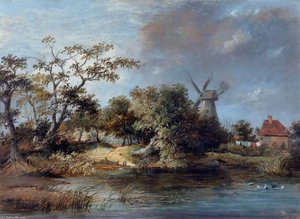 Ponds And A Windmill, Hastings
47
 Buckenham Common, Norfolk
48
 A Track To Home
49
 A Drover And His Flock In A Wooded Landscape
50
 Hay making; a horse study
51
 Landscape -
52
 Near NorwichFitzwilliam Museum
53
 View Across The Field To The Church
54
 The Forest Gate
55
 Sheep Dip
56
 Landscape On The Norfolk Coast
57
 Whitlingham From Old Thorpe Grove, Norfolk -
58
 Landscape -
59
 Encampment in a Wooded Landscape
60
 The Forest Oak
61
 View Of Richmond Park With Figures On A Path And Cattle Beyond
62
 Woody Landscape
63
 Windsor Great Park, Near Bears Rails
64
 Landscape And Trees
65
 Parkland Landscape With A Gardener By A Pond
66
 Landscape, A Country Road
67
 Rustic Scene
68
 Lock Scene
69
 A Dyke Head
70
 View In Windsor ForestNunnington Hall
71
 Marlborough Forest
72
 Cattle In The Woods
73
 A Barge On The Yare - Sunset
74
 The Edge Of A Wood -
75
 Sunlit Norfolk River Landscape
76
 Wooded landscape
77
 Woodland Scene
78
 Windsor Castle, Windsor And Maidenhead
79
 Landscape -
80
 A View From NorwichKelvingrove Art Gallery and Museum
81
 On The Yare - A Wooded River Landscape With Cattle, A Figure And A Cottage
82
 A Lane Near Norwich, Norfolk
83
 The Willow Stream
84
 The Road Through A Wood
85
 Landscape
86
 Figures On A Hay Barge With Windmills And A Church Beyond
87
 Road Through A Forest
88
 Gowbarrow ParkScottish National Gallery
89
 A Donkey In A Wood
90
 Road Scene At Intwood -
91
 Landscape With A Church
92
 Lake Scene, With Two Men Fishing
93
 Sheep Washing -
94
 Cattle Watering In A Wooded Landscape, With A Wherry Near Norwich
95
 Landscape With A Road Winding Through Trees With Figures
96
 Travellers On A Wooded Track
97
 Whitlingham From Old Thorpe Grove, Norfolk
98
 River Scene, Cattle In Foreground
99
 Landscape - (8)
100
 Cottage In A WoodBirmingham Museum and Art Gallery
The four subjects that come back most often in these originals, each with its finest example.
The 7 museums that hold the most of the paintings on this page.
| Museum | City | Works by James Stark | Paintings from this list |
|---|---|---|---|
 Auckland Art Gallery Toi o Tāmaki |
Auckland | 1 | Landscape with Thatched Cottage |
 National Museum in Warsaw |
Warsaw | 1 | Forest landscape with a road and a river |
 Fitzwilliam Museum |
1 | Near Norwich | |
 Nunnington Hall |
1 | View In Windsor Forest | |
 Kelvingrove Art Gallery and Museum |
Glasgow | 1 | A View From Norwich |
 Scottish National Gallery |
Edinburgh | 1 | Gowbarrow Park |
 Birmingham Museum and Art Gallery |
Birmingham | 1 | Cottage In A Wood |
Sandling's Ferry. Landscape With A Cottage and Distant View Of Windsor come next.
Sandling's Ferry, Landscape With A Cottage, Distant View Of Windsor, Faggot Gatherers By A Stream, A Wayside Encampment, Landscape -, A Wooded Landscape With Figures On A Track, A Cottage Beyond, Wood Gatherers, Figures And Animals Before Cottages In A Wooded Landscape and A Woody Landscape. The ranking above gives each one's year and museum.
Our catalog holds 137 works by James Stark.
Mostly in Auckland Art Gallery Toi o Tāmaki (Auckland), National Museum in Warsaw (Warsaw) and Fitzwilliam Museum. The museum table above lists them all.
Landscape (29), Wood (14) and Rural landscape (13), across the 100 works on this page.
Norwich school, judging by the originals on this page.
James Stark was a prominent English landscape painter and a key member of the Norwich School of painters. His career spanned several decades, marked by periods of both acclaim and financial struggle. He served as Vice-President (1828) and President (1829) of the Norwich Society of Artists, demonstrating his standing within the artistic community.


