


1


Updated November 2026 · ranked by our popularity score (searches, visits and orders for each work) · 71 works by Jack Levine in our catalogue
In short
To the gallery's eye, Jack Levine's most famous painting is Man with the Stained Glass Eye (1952). Untitled (644) and Untitled (809) complete the trio every eye recognises. Of the 71 works by Jack Levine in our catalog, the gallery presents the 69 most famous below, each original with its year, its museum and what makes it unique.


 The Syndicate1939
12
 The End of the Line1948 · The Phillips Collection
13
 Portrait of a Girl1946
14
 Reception in Miami1948
15
 Homage To Boston1949
16
 Hezekiah1956
17
 35 Minutes from Times Square1956
18
 The Scribe1956
19
 Girl with Red Hair1962 · New Britain Museum of American Art
20
 The Last Waltz1962
21
 Flowers1962
22
 The Green Cloche1962
23
 The Turnkey1956
24
 Untitled (407)
25
 Untitled (800)
26
 Untitled (666)
27
 Untitled (402)
28
 Untitled (635)
29
 Untitled (313)
30
 Untitled (833)
31
 Untitled (414)
32
 Untitled (988)
33
 Untitled (306)
34
 Untitled (772)
35
 Untitled (415)
36
 Untitled (337)
37
 Untitled (764)
38
 Untitled (252)
39
 Untitled (381)
40
 Untitled (901)
41
 Untitled (836)
42
 Untitled (273)
43
 Untitled (818)
44
 Untitled (751)
45
 Untitled (922)
46
 Untitled (166)
47
 Untitled (207)
48
 Untitled (904)
49
 Untitled (134)
50
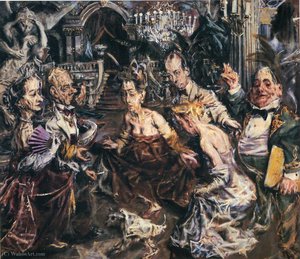 Untitled (170)
51
 Untitled (622)
52
 Untitled (434)
53
 Untitled (600)
54
 Untitled (962)
55
 Untitled (444)
56
 Untitled (816)
57
 Untitled (635)
58
 Untitled (491)
59
 Untitled (782)
60
 Untitled (265)
61
 Untitled (796)
62
 Untitled (196)
63
 Untitled (389)
64
 Untitled (744)
65
 Untitled (966)
66
 Untitled (832)
67
 Untitled (377)
68
 Untitled (199)
69
 Act Of Legislature1949
The four subjects that come back most often in these originals, each with its finest example.
The 2 museums that hold the most of the paintings on this page.
| Museum | City | Works by Jack Levine | Paintings from this list |
|---|---|---|---|
 The Phillips Collection |
Washington, D.C. | 1 | The End of the Line |
 New Britain Museum of American Art |
New Britain | 1 | Girl with Red Hair |
Pick a decade to see the original that defines it.


Man with the Stained Glass Eye (1952). Untitled (644) and Untitled (809) come next.
37 years old: Man with the Stained Glass Eye dates from 1952, and Jack Levine was born in 1915.
Man with the Stained Glass Eye, Untitled (644), Untitled (809), Untitled (836), Untitled (604), Untitled (578), Untitled (259), Untitled (284), The Passing Scene and Burlesque Dancer Verso (Untitled). The ranking above gives each one's year and museum.
Our catalog holds 71 works by Jack Levine, dated from 1939 to 1962.
Mostly in The Phillips Collection (Washington, D.C.) and New Britain Museum of American Art (New Britain). The museum table above lists them all.
In 1940s: 7 of the 69 works on this page were made then, The Passing Scene among them.
On this page, the earliest is The Syndicate (1939) and the latest Girl with Red Hair (1962).
Portrait (4), Reflection (3) and Elderly man (2), across the 69 works on this page.
Social realism, judging by the originals on this page.


