Portrait of Isidor Kaufmann

The 44 Most Famous Isidor Kaufmann Paintings, Each One of a Kind

Updated November 2026 · ranked by our popularity score (searches, visits and orders for each work) · 45 works by Isidor Kaufmann in our catalogue

In short

Courthouse waiting room (1887) is the Isidor Kaufmann painting that draws the most eyes. After it, the eye goes to Portrait of Eduard Kaufmann (1890-1965) (1900) and Portrait of a Sephardic Jew (1900). Among the 45 works of Isidor Kaufmann in our catalog, these 44 are the most famous, each a unique original presented with its year, its museum and the reason it endures.

1853 – 1921, Arad Realism Most works: Israel Museum

Top 10 paintings by Isidor Kaufmann, through the gallery's eye

1
Courthouse waiting room (1887) by Isidor Kaufmann

Courthouse waiting room

1887 · Oil

In the oil painting Courthouse waiting room by Isidor Kaufmann, a group of people occupies a sparse, official setting. The scene captures a moment of stillness and patience within a room characterized by muted, earthy tones. A palette of desaturated grey, brown, black, and beige defines the environment, establishing a somber atmosphere. The figures are dressed in period clothing from the late 19th century, their heavy fabrics rendered with attention…

2
Portrait of Eduard Kaufmann (1890-1965) (1900) by Isidor Kaufmann

Portrait of Eduard Kaufmann (1890-1965)

This oil portrait presents a close-up view of a young boy, centered within the frame. The subject is positioned from the upper torso upward, looking directly toward the viewer with light blue eyes. He wears a thick fur hat that frames his face, and his clothing consists of heavy, textured fabric. The lighting originates from the front left, casting shadows that define the contours of his nose, cheekbones, and jawline.…

3
Portrait of a Sephardic Jew (1900) by Isidor Kaufmann

Portrait of a Sephardic Jew

1900 · Oil

In this 1900 oil portrait, we are invited into a private, somber space to meet a man whose gaze meets ours with a heavy, melancholic weight. He sits in a waist-up composition, his presence defined by a stillness that feels almost sacred. The subject is a Sephardic Jewish man, and the artist has captured him with a profound sense of dignity. His face, framed by a coarse, textured beard, is…

4
The Son of the Miracle-Working Rabbi of Belz (1906) by Isidor Kaufmann

The Son of the Miracle-Working Rabbi of Belz

1906 · Oil

The portrait titled The Son of the Miracle-Working Rabbi of Belz is a work by the artist Isidor Kaufmann. Painted about 1906, the oil portrait captures a young child. The subject sits within a quiet, centered composition that focuses entirely on the small figure and his presence.

5
Lady in an interior (The artist's wife) (1921) by Isidor Kaufmann

Lady in an interior (The artist's wife)

1921 · Oil

A single female figure occupies the center of this vertical oil painting, seated within a dimly lit room. She is positioned slightly off-center, her body turned toward a book held in her hands. The woman is absorbed in reading, her gaze directed downward toward the pages. She wears a gown of silk-like fabric that falls in heavy, organic folds around her form. The lighting is low-key and directional, originating from…

6
Portrait of Juliette Kaufmann (1918) by Isidor Kaufmann

Portrait of Juliette Kaufmann

1918 · Oil On Canvas

Portrait of Juliette Kaufmann is a work by Isidor Kaufmann, executed in 1918. The artist, born in 1853 in Arad, Romania, was a significant figure in Austro-Hungarian art history, known for his ability to capture the psychological depth of his subjects through a blend of academic tradition and realism.

7
War Time Reminiscences by Isidor Kaufmann

War Time Reminiscences

Oil

Two elderly men sit anchored at a wooden table, caught in a moment of shared reflection. One man, wearing glasses and a brown suit, leans toward his companion, who is dressed in a black suit with a crisp white shirt and bow tie. Between them, the remnants of a meal—a cake, an apple, and a bottle—suggest a long afternoon of conversation. The setting is intimate, a domestic interior defined by…

8
Child With Lulav by Isidor Kaufmann

Child With Lulav

Oil

A young child occupies the center of the frame, positioned against a backdrop that features a banner with Hebrew text. The text on the banner reads "שַׁבָּת שַׁבָּת" (Shabbat Shabbat). The child wears a red hat adorned with a plume, a white blouse with lace at the neckline, and a brown shawl draped over the shoulders. In the right hand, the child holds a yellow object, identified as a lulav,…

9
Rabbi With Young Student by Isidor Kaufmann

Rabbi With Young Student

Oil

Rabbi With Young Student is a work by Isidor Kaufmann. An Austro-Hungarian painter of Jewish themes, Kaufmann focused his career on the documentation of traditional life within Eastern European communities. His compositions often centered on the quietude of religious study and the dignity of communal ritual.

10
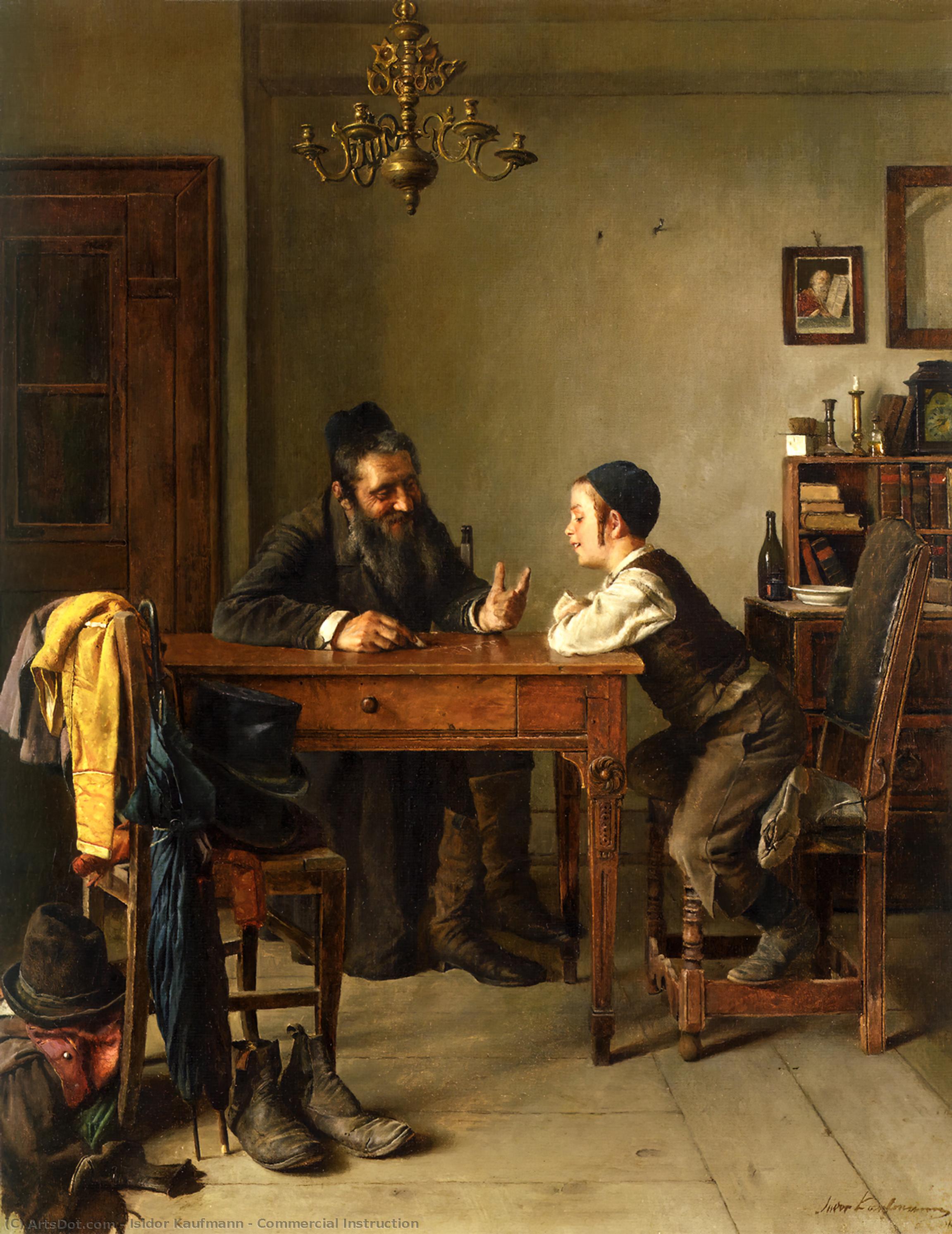
Commercial Instruction by Isidor Kaufmann

Commercial Instruction

Oil On Canvas

Commercial Instruction is a painting by Isidor Kaufmann. Born in Arad, Romania, in 1853, the artist followed a path quite different from the one that led to his career in fine art. Before entering the realm of painting, Kaufmann was destined for a commercial career. He spent time working as a bank clerk, a profession that stands in quiet contrast to the intimate genre scenes he would later produce.

Isidor Kaufmann's famous paintings, numbers 11 to 44

The subjects that held Isidor Kaufmann's eye

The four subjects that come back most often in these originals, each with its finest example.

The museums that keep Isidor Kaufmann's originals

The 4 museums that hold the most of the paintings on this page.

Museum City Works by Isidor Kaufmann Paintings from this list
Israel Museum, JerusalemIsrael Museum Jerusalem 3 Head of a Girl (Daughter of the Artist), Portrait Of A Young Jewish Man, Landscape with a Village
The Jewish Museum, New York CityThe Jewish Museum New York City 2 Portrait of a Young Man, The Cabbalist
Исторический музей Амстердама, AmsterdamИсторический музей Амстердама Amsterdam 1 Portrait of Eduard Kaufmann (1890-1965)
Museum of Fine Arts, BostonMuseum of Fine Arts Boston 1 Hannah

Isidor Kaufmann across the decades: one unique original for each

Works per decade

Pick a decade to see the original that defines it.

Isidor Kaufmann's paintings: questions for the gallery

What is the single most famous work of Isidor Kaufmann?Reveal the answer

Courthouse waiting room (1887). Portrait of Eduard Kaufmann (1890-1965) (1900) and Portrait of a Sephardic Jew (1900) come next.

At what age did Isidor Kaufmann create Courthouse waiting room?Reveal the answer

34 years old: Courthouse waiting room dates from 1887, and Isidor Kaufmann was born in 1853.

Which ten paintings by Isidor Kaufmann are the most famous?Reveal the answer

Courthouse waiting room, Portrait of Eduard Kaufmann (1890-1965), Portrait of a Sephardic Jew, The Son of the Miracle-Working Rabbi of Belz, Lady in an interior (The artist's wife), Portrait of Juliette Kaufmann, War Time Reminiscences, Child With Lulav, Rabbi With Young Student and Commercial Instruction. The ranking above gives each one's year and museum.

How many works by Isidor Kaufmann are known?Reveal the answer

Our catalog holds 45 works by Isidor Kaufmann, dated from 1887 to 1921.

Where can the most famous Isidor Kaufmann originals be seen?Reveal the answer

Mostly in Israel Museum (Jerusalem), The Jewish Museum (New York City) and Исторический музей Амстердама (Amsterdam). The museum table above lists them all.

During which period did Isidor Kaufmann create the best-known paintings?Reveal the answer

In 1900s: 4 of the 44 works on this page were made then, Portrait of Eduard Kaufmann (1890-1965) among them.

Which famous Isidor Kaufmann painting is the earliest, and which the latest?Reveal the answer

On this page, the earliest is Courthouse waiting room (1887) and the latest Lady in an interior (The artist's wife) (1921).

What subjects did Isidor Kaufmann favour?Reveal the answer

Portraits (10), Boys (5) and Chair (4), across the 44 works on this page.

What materials did Isidor Kaufmann paint with most?Reveal the answer

Oil, for 8 of the 44 works on this page.

Which movement does the work of Isidor Kaufmann belong to?Reveal the answer

Realism, judging by the originals on this page.

What Isidor Kaufmann originals can I see at the Israel Museum?Reveal the answer

Head of a Girl (Daughter of the Artist), Portrait Of A Young Jewish Man and Landscape with a Village: the Israel Museum, Jerusalem holds 3 of the works on this page.

Isidor Kaufmann: a portrait of the artist

The Chronicler of a Vanished World

Isidor Kaufmann stands as a singular figure in Austro-Hungarian art history, renowned for his poignant genre paintings depicting the daily lives and spiritual traditions of Hasidic communities across Poland and Romania. Born in Arad, Hungary—now part of Romania—to Hungarian Jewish parents in 1853, Kaufmann’s artistic journey was marked by serendipitous circumstances that ultimately propelled him to become one of the foremost chroniclers of Jewish culture during the late 19th century. While he initially pursued a commercial career, his true vocation emerged through a brief period of study at the Landes-Zeichenschule in Budapest. This early spark ignited a lifelong passion that would lead him to the prestigious Vienna Academy of Fine Arts, where, despite initial setbacks, he honed his skills under the rigorous tutelage of Professor Trenkwald.

Establishing himself as a skilled portrait painter in the vibrant atmosphere of Vienna, Kaufmann absorbed the stylistic influences of luminaries such as Joseph Matthäus Aigner. His work began to reflect a sophisticated blend of academic tradition and the burgeoning realism championed by Impressionism. This unique technical foundation allowed him to move beyond mere representation, enabling him to capture the profound psychological depth and spiritual weight of his subjects. His mastery of chiaroscuro—the dramatic interplay of light and shadow—became a hallmark of his style, lending an almost sacred atmosphere to his depictions of religious study and communal ritual.

A Masterpiece of Imperial Recognition

The turning point in Kaufmann’s career arrived with the monumental commission of “Der Besuch des Rabbi” (The Rabbi's Visit), a work so significant it was commissioned by Emperor Franz Joseph I for the Kunsthistorisches Museum. This painting serves as a definitive testament to his ability to weave meticulous detail with deep emotional resonance. Through this canvas, Kaufmann demonstrated that he was not merely an observer of tradition, but a master capable of capturing the very essence of human experience within specific cultural contexts. The success of this work solidified his reputation across Europe, marking him as an artist who could elevate ethnographic subject matter to the heights of high art.

His body of work is characterized by an intimate gaze into the heart of Eastern European Jewish life. Whether portraying the contemplative stillness of a scholar or the quiet intensity of youth, Kaufmann’s paintings function as windows into a world that was undergoing profound historical shifts. His notable works include:

Legacy and Historical Significance

The historical significance of Isidor Kaufmann lies in his role as a visual historian. His paintings serve as a vital, evocative record of Hasidic life and Jewish traditions during their final, vibrant years in Eastern Europe before the upheavals of the 20th century. Through his brush, the textures of heavy black coats, the glow of candlelight on ancient texts, and the solemnity of religious ritual are preserved with an almost tactile clarity. Kaufmann did not merely paint scenes; he captured the soul of a culture, ensuring that the dignity, intellect, and spiritual richness of these communities would remain etched in the annals of art history forever.