A Life Dedicated to the Unspoken
Irma Blank, who passed away in Milan on April 14, 2023, at the age of 88, was an artist whose singular vision relentlessly pursued the boundaries of language, communication, and the profound resonance of silence. Born in Celle, Germany, in 1934, her journey took a pivotal turn in 1955 when, inspired by Goethe’s *Italian Journey*, she traveled to Syracuse, Sicily. This wasn't merely a geographical relocation; it was an existential shift. The experience of being immersed in a culture where language itself became a barrier—a veil obscuring understanding—ignited a lifelong investigation into the very essence of expression and its limitations. She settled permanently in Italy, balancing her days teaching high school with a burgeoning artistic practice that unfolded during the quiet hours of the night. It was within this duality – educator by day, explorer of the unspoken by night – that Blank’s unique aesthetic began to take form.
The Language of Absence: Trascrizioni and Beyond
Blank's artistic development gained significant momentum through her encounter with the Concrete Poetry movement in Milan during the 1970s. This exposure proved transformative, encouraging her to integrate language directly into her work, moving beyond traditional representational forms. However, she didn’t seek to *use* language in a conventional sense; rather, she aimed to deconstruct it, to reveal its inherent ambiguities and limitations. The most celebrated cycle of her work, the ‘
Trascrizioni’ (1973-1979), embodies this pursuit perfectly. These weren't simple transcriptions but meticulous re-interpretations. Blank painstakingly copied texts – fragments from newspapers, philosophical treatises, poetry – in black ink onto sheets of transparent paper. But the act of copying was only part of the process. Crucially, as she transcribed, she would silently “read” the text with her mouth closed, simultaneously recording the resulting sounds—a breathy, almost imperceptible murmur. This performative element elevated the work beyond visual representation; it transformed written language into a purely sonic and visceral experience, emphasizing the physicality of writing and the inherent silence *within* communication. The ‘
Trascrizioni’ weren't about conveying meaning but about exploring the space between words, the unspoken thoughts and feelings that lie beneath the surface of language.
A Meditation on Form and Meaning
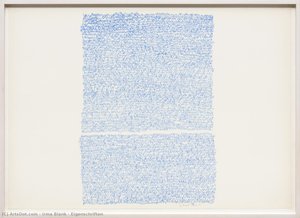
Blank’s artistic approach was deeply rooted in a meditative process. Her work wasn’t driven by grand narratives or overt political statements; instead, it delved into fundamental questions about perception, communication, and the relationship between the visible and the invisible. Later series, such as “Radical Writings” (1983-1986) and "Avant-testo" (1998–2006), continued this exploration, often focusing on the act of writing itself as a performative gesture. In “Radical Writings,” she explored color—pinks, purples, and blues—as emotional states linked to breath and bodily rhythm, while "Avant-testo" saw her employing a dual-handed drawing technique that mimicked the frenetic energy of digital processes, ironically using analog means to comment on the increasingly mediated nature of communication. Throughout her career, Blank consistently challenged conventional notions of authorship and originality, suggesting that true creativity lies not in inventing new forms but in reinterpreting existing ones, stripping them down to their essential elements.
Recognition and a Lasting Legacy
Despite early recognition – including exhibitions at Documenta 6 in Kassel (1977) and the Venice Biennale (1978) – Blank’s work experienced a period of relative obscurity for several decades. However, beginning in the 2010s, her contributions began to receive renewed attention, culminating in major retrospectives that toured institutions across Europe, including Culturgest in Lisbon, MAMCO in Geneva, and ICA Milan. This rediscovery was accompanied by critical acclaim and a growing appreciation for the depth and complexity of her artistic vision. Irma Blank’s influence extends far beyond the realm of Concrete Poetry or text-based art. Her work resonates with contemporary artists exploring themes of language, performance, and the poetics of silence. She leaves behind a body of work that is both intellectually rigorous and deeply moving—a testament to the power of art to illuminate the hidden dimensions of human experience. Her exploration of language as both a tool for connection and a potential barrier to understanding remains profoundly relevant in our increasingly fragmented world, urging us to listen not just to what is said, but also to what remains unspoken.
Key Exhibitions & Achievements
- 1977: Documenta 6, Kassel
- 1978: Venice Biennale (38th)
- 2017: Venice Biennale (57th)
- 2019-2022: Comprehensive retrospective toured Culturgest (Lisbon), MAMCO (Geneva), CAPC Musée d'art contemporain de Bordeaux, CCA Tel Aviv-Yafo, Bauhaus Foundation Tel Aviv, Museo Civico Villa dei Cedri (Bellinzona), Bombas Gens Centre d’Art (Valencia) and ICA Milan.


 Metropolitan Museum of Art
 Fondazione Hospice Seràgnoli Onlus


