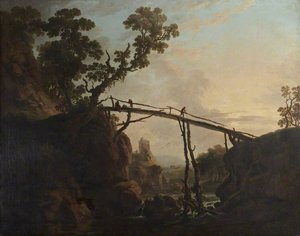
George Barret Sr.: Life & Legacy
Early Life and Training
- Born: Between 1728 and 1732 in Libertyville, Ireland, the son of a cloth merchant.
- Initially apprenticed as a staymaker before discovering his artistic talent.
- Began formal drawing training at Robert West’s Academy in Dublin around 1747, sponsored by the Royal Dublin Society.
- Subsequently taught drawing at the same academy, demonstrating early promise and skill.
- A formative friendship with Edmund Burke, formed during Burke's time at Trinity College, Dublin, would prove crucial later in life.
Early Artistic Development & Influences
- Barret’s early paintings often featured classical scenery and mythological figures.
- Influenced by: The philosophical writings of Edmund Burke, particularly *A Philosophical Enquiry into the Origin of Our Ideas of the Sublime and Beautiful*, which informed his artistic approach to landscape.
- He initially worked by reworking engravings of classical Italianate scenes by artists like Claude Lorrain, demonstrating a strong foundation in established styles.
- Despite depicting Italian landscapes, there’s no evidence he ever travelled to Italy himself.
Move to London and Rise to Prominence
- In 1762, Barret moved to London seeking greater artistic opportunities.
- Quickly gained recognition as a leading landscape artist of the period.
- Exhibited at the Society of Artists of Great Britain and attracted patronage from prominent art collectors.
- Key Achievement: In 1768, Barret was among the founding members who left the Society of Artists to establish the Royal Academy – a pivotal moment in British art history.
Artistic Style and Themes
- Barret’s style evolved from idealized Italianate landscapes to more naturalistic depictions of English and Irish scenery.
- He travelled extensively throughout England, Wales, Scotland, and Ireland, undertaking commissions and capturing the beauty of diverse landscapes.
- Common themes included idyllic views, picturesque countryside, waterfalls (like his famous *The Powerscourt Waterfall*), and topographical representations of estates and properties.
- His paintings often featured figures within the landscape, adding a sense of scale and narrative.
Later Life & Patronage
- Suffered from asthma, leading him to relocate to Westbourne Green in 1772 for health reasons.
- Despite earning substantial income, he was described as “feckless” with money and occasionally faced financial difficulties.
- Continued Support: Edmund Burke remained a loyal friend and assisted Barret financially and professionally.
- In 1782, Burke recommended Barret for the position of Master Painter of Chelsea Hospital, which he held until his death in 1784.
Legacy & Historical Significance
- Although his widow and children were left destitute upon his death, the Royal Academy provided a small pension.
- Barret’s work represents a significant transition in British landscape painting, moving from classical imitation to a more distinctly national style.
- His paintings provide valuable insights into 18th-century landscapes and aristocratic life.
- Many of his works are now held in prominent collections, including the National Gallery of Ireland and Yale Center for British Art.
Questions & Answers
What other names is George Barret the Elder known by?
George Barret the Elder is also known as George Barret Sr., George Barrett.
How did George Barret the Elder's art evolve over time?
The Chronicle of George Barret the Elder is a scroll-driven timeline that presents the artist's works in chronological order, grouped into career-period chapters.
Where are George Barret the Elder's artworks mapped by subject?
The Subject Atlas page maps George Barret the Elder's artworks by subject.