Portrait of Gene Davis

Gene Davis Paintings: The 100 Most Famous, Through a Gallery's Eye

Updated November 2026 · ranked by our popularity score (searches, visits and orders for each work) · 205 works by Gene Davis in our catalogue

In short

To the gallery's eye, Gene Davis's most famous painting is Hot Beat (1964). (Series I, portfolio) Jack in the Box (1969) and Bullet Proof, from the portfolio Series I (1969) complete the trio every eye recognises. Of the 205 works by Gene Davis in our catalog, the gallery presents the 100 most famous below, each original with its year, its museum and what makes it unique.

1920 – 1985, Washington, D.C. Color field Most works: The Phillips Collection

The gallery's top 10 Gene Davis paintings

1
Hot Beat (1964) by Gene Davis

Hot Beat

1964 · Acrylic On Canvas

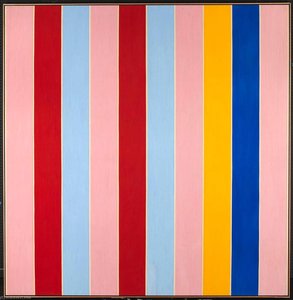
In 1964, Gene Davis applied acrylic to canvas to create Hot Beat. The work measures 116 x 128 cm. It exists as a rhythmic arrangement of color, a physical presence held within the walls of the Smithsonian American Art Museum in the United States.

5
Black Flowers (1952) by Gene Davis

Black Flowers

1952 · The Phillips Collection, Washington, D.C.

In this 1952 work, we encounter a side of Gene Davis that feels strikingly different from the rhythmic, colorful stripes for which he later became known. Black Flowers is a monochromatic exploration, a somber composition that relies on texture and high-contrast line work to suggest a presence rather than define it. The piece presents a central, stylized human figure, appearing as a nude female form, enveloped by large, wing-like shapes…

Gene Davis paintings, ranked 11 to 100

11Microhead (1982) by Gene DavisMicrohead1982 12Untitled (Four Heads) (1984) by Gene DavisUntitled (Four Heads)1984 13Peeping Wall (1960) by Gene DavisPeeping Wall1960 14Red Devil (1959) by Gene DavisRed Devil1959 · The Phillips Collection 15Bridge (1952) by Gene DavisBridge1952 16Homage to Dubuffet I (1952) by Gene DavisHomage to Dubuffet I1952 17Angel Vine (1952) by Gene DavisAngel Vine1952 18Mine Field (1952) by Gene DavisMine Field1952 19Inner Space (1952) by Gene DavisInner Space1952 20Leap Frog (1952) by Gene DavisLeap Frog1952 21Seascape (1952) by Gene DavisSeascape1952 22Bird Land (1952) by Gene DavisBird Land1952 23Saber Dance (1952) by Gene DavisSaber Dance1952 24Satan's Flag (1956) by Gene DavisSatan's Flag1956 25Autumn (1955) by Gene DavisAutumn1955 26Homage to Rembrandt (1957) by Gene DavisHomage to Rembrandt1957 27The Committee (1957) by Gene DavisThe Committee1957 28Dog and Flowers (1957) by Gene DavisDog and Flowers1957 29Man at the Pump (1955) by Gene DavisMan at the Pump1955 30Two Crosses (1956) by Gene DavisTwo Crosses1956 31Lemon Look (1960) by Gene DavisLemon Look1960 · Worcester Art Museum 32Half Hot (1959) by Gene DavisHalf Hot1959 · Metropolitan Museum of Art 33Peeping Wall (1960) by Gene DavisPeeping Wall1960 34Tom's Furnace (1961) by Gene DavisTom's Furnace1961 35Half Hot (1959) by Gene DavisHalf Hot1959 36Blue Broad Jump (1960) by Gene DavisBlue Broad Jump1960 37Untitled (1959) by Gene DavisUntitled1959 38Homage to Matisse (1960) by Gene DavisHomage to Matisse1960 39Sweet Score-Skylark (1960) by Gene DavisSweet Score-Skylark1960 40Red Dog (1961) by Gene DavisRed Dog1961 41Bay (1958) by Gene DavisBay1958 42Pink Stripe (1960) by Gene DavisPink Stripe1960 43Blue Rectangle II (1958) by Gene DavisBlue Rectangle II1958 44Blue Broadjump (1960) by Gene DavisBlue Broadjump1960 45Eyeglasses (1958) by Gene DavisEyeglasses1958 46Limelight Sounds of Grass (1960) by Gene DavisLimelight Sounds of Grass1960 47Untitled (1964) by Gene DavisUntitled1964 · John and Mable Ringling Museum of Art 48Ferris Wheel (1963) by Gene DavisFerris Wheel1963 49Edges/Solar Beat (1962) by Gene DavisEdges/Solar Beat1962 50Pepper Pot (1966) by Gene DavisPepper Pot1966 51Solar Skin (1964) by Gene DavisSolar Skin1964 52Untitled (1962) by Gene DavisUntitled1962 53Red Witch (1966) by Gene DavisRed Witch1966 54Black Grey Beat (1964) by Gene DavisBlack Grey Beat1964 55Boudoir Painting (1965) by Gene DavisBoudoir Painting1965 56Untitled (1964) by Gene DavisUntitled1964 57Flower Machine (1964) by Gene DavisFlower Machine1964 58Yankee Doodle (1966) by Gene DavisYankee Doodle1966 59Citadel (1962) by Gene DavisCitadel1962 60Anthracite Minuet (1966) by Gene DavisAnthracite Minuet1966 61Flower Machine (1964) by Gene DavisFlower Machine1964 62Wall Stripes No. 3 (1962) by Gene DavisWall Stripes No. 31962 63Red Witch (1966) by Gene DavisRed Witch1966 64Two Part Blue (1964) by Gene DavisTwo Part Blue1964 65Untitled #81A (1969) by Gene DavisUntitled #81A1969 · Dallas Museum of Art 66Raspberry Icicle (1967) by Gene DavisRaspberry Icicle1967 · Smithsonian American Art Museum 67Long John (1968) by Gene DavisLong John1968 · Smithsonian American Art Museum 68Tarzan (Series I) (1969) by Gene DavisTarzan (Series I)1969 · Statens Museum For Kunst 69Micro-Painting (1968) by Gene DavisMicro-Painting1968 70Barricades (1968) by Gene DavisBarricades1968 71Dr. Peppercorn (1967) by Gene DavisDr. Peppercorn1967 72Half Lemon (1969) by Gene DavisHalf Lemon1969 73(Series I, portfolio) Graf Zeppelin (1969) by Gene Davis(Series I, portfolio) Graf Zeppelin1969 74Jack in the Box, from the portfolio Series I (1969) by Gene DavisJack in the Box, from the portfolio Series I1969 75Sweet Carburetor, from the portfolio Series II (1969) by Gene DavisSweet Carburetor, from the portfolio Series II1969 76Graf Zeppelin, from the portfolio Series I (1969) by Gene DavisGraf Zeppelin, from the portfolio Series I1969 77Gothic Jab (1968) by Gene DavisGothic Jab1968 78John Barley Corn, from the portfolio Series I (1969) by Gene DavisJohn Barley Corn, from the portfolio Series I1969 79(Series I, portfolio) Bullet Proof (1969) by Gene Davis(Series I, portfolio) Bullet Proof1969 80Yo Yo, from the portfolio Series II (1969) by Gene DavisYo Yo, from the portfolio Series II1969 81Apricot Ripple (1968) by Gene DavisApricot Ripple1968 82Battle for Grown Ups, from the portfolio Series II (1969) by Gene DavisBattle for Grown Ups, from the portfolio Series II1969 83(Series I, portfolio) John Barley Corn (1969) by Gene Davis(Series I, portfolio) John Barley Corn1969 84Raspberry Icicle (1967) by Gene DavisRaspberry Icicle1967 85Powwow (1969) by Gene DavisPowwow1969 86Zebra, from the portfolio Series II (1969) by Gene DavisZebra, from the portfolio Series II1969 87Black Popcorn, from the portfolio Series II (1969) by Gene DavisBlack Popcorn, from the portfolio Series II1969 88Ianthe, from the portfolio Series II (1969) by Gene DavisIanthe, from the portfolio Series II1969 89Tarzan, from the portfolio Series I (1969) by Gene DavisTarzan, from the portfolio Series I1969 90(Series I, portfolio) King Kong (1969) by Gene Davis(Series I, portfolio) King Kong1969 91(Series I, portfolio) Tarzan (1969) by Gene Davis(Series I, portfolio) Tarzan1969 92King Kong, from the portfolio Series I (1969) by Gene DavisKing Kong, from the portfolio Series I1969 93Untitled (1971) by Gene DavisUntitled1971 · The Phillips Collection 94Solar Diary (Needle Park) (1972) by Gene DavisSolar Diary (Needle Park)1972 95Parachute (1972) by Gene DavisParachute1972 96Checkmate (1973) by Gene DavisCheckmate1973 97Untitled 1 (1971) by Gene DavisUntitled 11971 98Tight Rope (1973) by Gene DavisTight Rope1973 99Home Run (1973) by Gene DavisHome Run1973 100Ferris Wheel (1973) by Gene DavisFerris Wheel1973

Gene Davis's famous paintings, period by period

Mid-Career

1952 – 1962 · 3 works in this list

The subjects that held Gene Davis's eye

The four subjects that come back most often in these originals, each with its finest example.

The museums that keep Gene Davis's originals

The 7 museums that hold the most of the paintings on this page.

Museum City Works by Gene Davis Paintings from this list
The Phillips Collection, Washington, D.C.The Phillips Collection Washington, D.C. 4 Black Flowers, Rain Dance I, Red Devil
Smithsonian American Art Museum, Washington, D.C.Smithsonian American Art Museum Washington, D.C. 4 Raspberry Icicle, Long John
Metropolitan Museum of Art, New YorkMetropolitan Museum of Art New York 2 Half Hot
Worcester Art Museum, WorcesterWorcester Art Museum Worcester 1 Lemon Look
John and Mable Ringling Museum of Art, SarasotaJohn and Mable Ringling Museum of Art Sarasota 1 Untitled
Dallas Museum of Art, DallasDallas Museum of Art Dallas 1 Untitled #81A
Statens Museum For Kunst, CopenhagenStatens Museum For Kunst Copenhagen 1 Tarzan (Series I)

Gene Davis, one signature painting per decade

Works per decade

Pick a decade to see the original that defines it.

Gene Davis's paintings: the gallery answers

Which Gene Davis painting is the most famous of all?Reveal the answer

Hot Beat (1964). (Series I, portfolio) Jack in the Box (1969) and Bullet Proof, from the portfolio Series I (1969) come next.

How old was Gene Davis on completing Hot Beat?Reveal the answer

44 years old: Hot Beat dates from 1964, and Gene Davis was born in 1920.

Which are Gene Davis's top 10 paintings?Reveal the answer

Hot Beat, (Series I, portfolio) Jack in the Box, Bullet Proof, from the portfolio Series I, Mardi Gras, Black Flowers, Under Flowers, Rain Dance I, Untitled (The World Agrees), Leaping Horse and Self-Portrait. The ranking above gives each one's year and museum.

How many works did Gene Davis create?Reveal the answer

Our catalog holds 205 works by Gene Davis, dated from 1952 to 1984.

Where do Gene Davis's most famous originals hang?Reveal the answer

Mostly in The Phillips Collection (Washington, D.C.), Smithsonian American Art Museum (Washington, D.C.) and Metropolitan Museum of Art (New York). The museum table above lists them all.

When did Gene Davis create the most famous paintings?Reveal the answer

In 1960s: 61 of the 100 works on this page were made then, Hot Beat among them.

Which are Gene Davis's earliest and latest famous works?Reveal the answer

On this page, the earliest is Black Flowers (1952) and the latest Untitled (Four Heads) (1984).

Which subjects did Gene Davis return to most?Reveal the answer

Geometric design (7), Abstract art (6) and Stripes (5), across the 100 works on this page.

Which movement is Gene Davis associated with?Reveal the answer

Color field, judging by the originals on this page.

Which Gene Davis originals does the The Phillips Collection hold?Reveal the answer

Black Flowers, Rain Dance I and Red Devil: the The Phillips Collection, Washington, D.C. holds 4 of the works on this page.

Gene Davis: the artist

The Architect of Color: The Life and Legacy of Gene Davis

In the vibrant tapestry of mid-century American abstraction, few threads shine as brightly or as rhythmically as those woven by Gene Davis. A pioneer of the Color Field movement, Davis possessed a singular ability to transform the canvas into a rhythmic experience of light and motion. Born in Washington, D.C., in 1920, his journey toward becoming a central figure of the Washington Color School was not one of immediate abstraction, but rather a gradual evolution shaped by a keen observational eye. Before he ever commanded the brush to create his iconic stripes, Davis worked as a sportswriter, a profession that demanded a sharp focus on movement, energy, and the unfolding drama of live events—elements that would later find their way into the pulsating verticality of his paintings.

The seeds of his abstract language were sown through deep engagement with European modernism. During his formative years, Davis found profound inspiration in the works of Paul Klee and Arshile Gorky, artists who demonstrated how form could be distilled into pure emotion and symbolic weight. By immersing himself in the masterpieces held within the Phillips Collection, he began to understand that color did not merely serve a subject; color was the subject. This realization set him on a path away from traditional representation and toward a revolutionary way of seeing, where the boundaries between shape and hue began to dissolve into pure, chromatic energy.

The Rhythm of the Stripe: Innovation and Technique

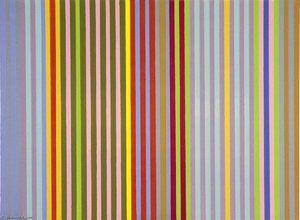
The year 1958 marked a seismic shift in Davis’s career and the broader trajectory of American art. It was during this period that he began producing his celebrated acrylic stripe paintings, a technique that would become his unmistakable signature. Moving away from the heavy, gestural textures of Abstract Expressionism, Davis embraced the flat, luminous qualities of acrylic paint. His compositions often featured monumental vertical bands of color that seemed to vibrate against one another, creating a sense of optical movement that drew the viewer into a hypnotic, rhythmic trance.

These works were far more than simple geometric exercises; they were explorations of space and perception. By utilizing the Washington Color School approach, Davis emphasized the primacy of color, allowing each stripe to interact with its neighbor through subtle shifts in value and saturation. His technique allowed for a unique kind of "breathing" within the painting, where the eye is encouraged to dance vertically across the canvas. This mastery of repetition and rhythm allowed him to capture the essence of urban energy and natural light, translating the chaos of the modern world into a structured, yet profoundly fluid, visual language.

A Lasting Impression on American Abstraction

As a cornerstone of the Washington Color School alongside contemporaries like Morris Louis and Kenneth Nurtland, Gene Davis helped redefine the boundaries of post-painterly abstraction. His work stood as a testament to the power of restraint and the infinite possibilities found within a limited palette. Even in his later works, such as the evocative Night Rider from 1983, one can see his ability to blend bold hues with complex imagery, proving that his mastery of color could support deep, symbolic narratives.

The historical significance of Gene Davis lies in his role as a bridge between the intense emotionality of early abstraction and the cool, calculated precision of later Color Field painting. His legacy is found in every canvas that prioritizes the sensory experience of color over the depiction of form. Through his rhythmic stripes, he left behind a visual symphony that continues to resonate with collectors and art enthusiasts worldwide, reminding us that art can be both profoundly simple and infinitely complex.