1982
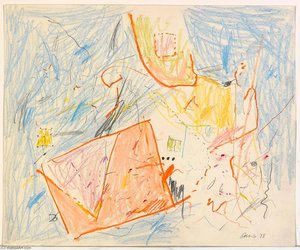
Microhead (Gene Davis, 1982)
Gene Davis (1920–1985) made Microhead. It dates from 1982. It measures 6 × 5 cm.
- 1982
- 6 × 5 cm

 Preview

 Hand Made Oil Painting
 Send
 Share
 Fact sheet


 Download
 Similars
 X-Ray
 Diaporama
 Q&A

 Stats
Microhead, in brief
- Title
- Microhead
- Artist
- Gene Davis (1920–1985)
- Artist born in
- Washington, D.C., United States
- Date
- 1982
- Dimensions
- 6 × 5 cm
High-resolution images of Microhead
Protected by copyright: these files are for personal reference, not a licence to republish.
Gene Davis, Microhead (1982).
Questions on Microhead, answered
What is the creation date of "Microhead" by Gene Davis?
"Microhead" by Gene Davis was created in 1982.
How big is the original "Microhead"?
The original "Microhead" by Gene Davis measures 6 x 5 cm.
Is "Microhead" by Gene Davis in the public domain?
"Microhead" by Gene Davis is still protected by copyright. This status governs how the image of the work may be reproduced.
Which artist is "Microhead" attributed to?
"Microhead" is attributed to Gene Davis.
What was Gene Davis's age when "Microhead" was created?
Gene Davis made "Microhead" at the age of 62. The artist was born in 1920 and the work is dated 1982.
What explains the copyright situation of "Microhead" by Gene Davis?
The copyright status of "Microhead" - still protected by copyright - follows from the artist's death in 1985.
About the artist, Gene Davis

1920–1985, United States
Gene Davis
The Architect of Color: The Life and Legacy of Gene Davis In the vibrant tapestry of mid-century American abstraction, few threads shine as brightly or as rhythmically as those woven by Gene Davis. A pioneer of the Color Field movement, Davis possessed a singular ability to transform the canvas into a rhythmic experience of light and motion. Born in Washington, D.C., in 1920, his journey toward becoming a central figure of the Washington Color School was not one of immediate abstraction, but rather a gradual evolution shaped by a keen observational eye. Before he ever commanded the brush to create his iconic stripes, Davis worked as a sportswriter, a profession that demanded a sharp focus on movement, energy, and the unfolding drama of live events—elements that would later find their way into the pulsating verticality of his paintings.
 Hot Beat1964
 (Series I, portfolio) Jack in the Box1969
 Bullet Proof, from the portfolio Series I1969
 Mardi Gras1978