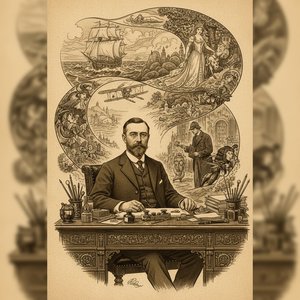
Frederick Richard Pickersgill: Life & Art
Early Life and Education
- Born: London, United Kingdom in 1820.
- Pickersgill came from a family of artists, fostering an early interest in the visual arts.
- He was admitted to the prestigious Royal Academy Schools in 1840, receiving formal training in artistic techniques and principles.
Artistic Career & Style
- Pickersgill exhibited consistently at the Royal Academy between 1839 and 1875, establishing his presence within the British art scene.
- Themes: His work frequently depicted scenes drawn from literature – including works by Edmund Spenser and John Milton – as well as religious narratives and historical events.
- Style: Pickersgill’s style is generally categorized as Romantic, with increasing influences from the Pre-Raphaelite movement.
- He was known for detailed compositions, dramatic lighting, and a focus on narrative storytelling within his paintings.
Major Achievements & Notable Works
- The Burial of Harold (1847): This work was accepted as a decoration for the Houses of Parliament, earning him significant recognition and a commission of £500.
- Other Notable Works: Include “Flight of the Pagan Deities,” “Britomart Unarming”, “Crowned By Cupid” and several paintings depicting scenes from Shakespeare’s plays.
- He also produced landscape paintings, demonstrating his versatility as an artist.
Influences & Artistic Development
- Pre-Raphaelite Influence: While not a core member of the Pre-Raphaelite Brotherhood, Pickersgill’s work shows clear influences from their emphasis on detail, vibrant color, and narrative complexity.
- His early training at the Royal Academy provided him with a strong foundation in academic painting techniques.
- Pickersgill experimented with photography, being photographed himself by Robert Howlett in 1856 and potentially engaging in photographic practice.
Later Life & Legacy
- Pickersgill was elected an Associate of the Royal Academy in 1847 and became a full Royal Academician in June 1857, signifying his standing within the art establishment.
- He served as Keeper of the Royal Academy Schools from 1873 to 1887, contributing to the education of future generations of artists.
- Pickersgill retired in 1888 and passed away in 1900.
- Historical Significance: Frederick Richard Pickersgill represents a transitional figure between Romanticism and the Pre-Raphaelite movement, contributing to the rich tapestry of Victorian art. His works offer valuable insights into the artistic tastes and cultural values of his time.
Questions & Answers
Can I study Frederick Richard Pickersgill's use of color across all works?
The Palette Genome of Frederick Richard Pickersgill is a page that presents the color profile of the artist's body of work.
How is Frederick Richard Pickersgill's career divided into periods?
The Chronicle of Frederick Richard Pickersgill is a scroll-driven timeline that presents the artist's works in chronological order, grouped into career-period chapters.
Where are Frederick Richard Pickersgill's artworks organized by color?
The Spectral Index of Frederick Richard Pickersgill is a page that organizes the artist's artworks by their colors.
In which historical period did Frederick Richard Pickersgill work?
Frederick Richard Pickersgill worked in the 19th-Century period. The period situates the artist's activity in history.