Portrait of Franz Roubaud

Franz Roubaud Paintings: The 75 Most Famous, Through a Gallery's Eye

Updated November 2026 · ranked by our popularity score (searches, visits and orders for each work) · 86 works by Franz Roubaud in our catalogue

In short

To the gallery's eye, Franz Roubaud's most famous painting is Caucasian Armed Horsemen On Patrol. The Death Of Major General Sleptsov In Chechnya and Playing Kokpar complete the trio every eye recognises. Of the 86 works by Franz Roubaud in our catalog, the gallery presents the 75 most famous below, each original with its year, its museum and what makes it unique.

1856 – 1928, Odesa Contemporary realism Most works: Bavarian State Painting Collections

The gallery's top 10 Franz Roubaud paintings

Franz Roubaud paintings, ranked 11 to 75

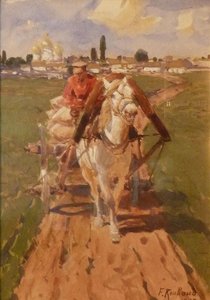
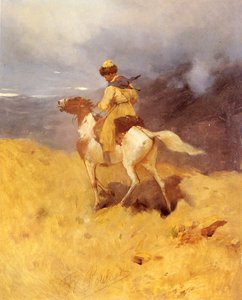
11Crossing The River by Franz RoubaudCrossing The River 12Caucasian Riders Signed by Franz RoubaudCaucasian Riders Signed 13Cavalier Tartre A L'entree D'une Ville by Franz RoubaudCavalier Tartre A L'entree D'une Ville 14Malakhov - by Franz RoubaudMalakhov - 15Fishermen On The Black Sea by Franz RoubaudFishermen On The Black Sea 16Malakhov1 by Franz RoubaudMalakhov1 17Dadon Shemakha by Franz RoubaudDadon Shemakha 18Passage Of Prince Argutinskiy Through The Caucasian Ridge by Franz RoubaudPassage Of Prince Argutinskiy Through The Caucasian Ridge 19A Steamboat On The Black Sea by Franz RoubaudA Steamboat On The Black Sea 20River Crossing by Franz RoubaudRiver Crossing 21Mountainous Landscape by Franz RoubaudMountainous Landscape 22Signed And Dated by Franz RoubaudSigned And Dated 23Circassian Charge by Franz RoubaudCircassian Charge 24The Siege Of Sevastopol Panorama by Franz RoubaudThe Siege Of Sevastopol Panorama 25The Siege Of Sevastopol Panorama by Franz RoubaudThe Siege Of Sevastopol Panorama 26The Capture Of Aul Gimry by Franz RoubaudThe Capture Of Aul Gimry 27Central Asian Horse Market by Franz RoubaudCentral Asian Horse Market 28Cossacks Crossing The River by Franz RoubaudCossacks Crossing The River 29Fahnentragender Tscherkesse Zu Pferd Vor Gebirgslandschaft by Franz RoubaudFahnentragender Tscherkesse Zu Pferd Vor Gebirgslandschaft 30Circassian Riders. by Franz RoubaudCircassian Riders. 31Circassian On A Veld In The Caucasus by Franz RoubaudCircassian On A Veld In The Caucasus 32Battle Of Borodino by Franz RoubaudBattle Of Borodino 33The Siege Of Sevastopol by Franz RoubaudThe Siege Of Sevastopol 34Two Cossack Men by Franz RoubaudTwo Cossack Men 35A Caucasian Rider by Franz RoubaudA Caucasian Rider 36Battle Of Borodino (detail) by Franz RoubaudBattle Of Borodino (detail) 37Tscherkessische Reiter In Steppenlandschaft by Franz RoubaudTscherkessische Reiter In Steppenlandschaft 38Cossacks Crossing A River by Franz RoubaudCossacks Crossing A River 39Tsar Alexander Iii Travelling Through The Caucasus by Franz RoubaudTsar Alexander Iii Travelling Through The Caucasus 40Cossacks Charging Into Battle by Franz RoubaudCossacks Charging Into Battle 41Caravanserai by Franz RoubaudCaravanserai 42Market Day by Franz RoubaudMarket Day 43A Caucasian Riding His Horse At Full Gallop by Franz RoubaudA Caucasian Riding His Horse At Full Gallop 44Duel by Franz RoubaudDuel 45Battle Of Borodino (detail) by Franz RoubaudBattle Of Borodino (detail) 46Königsee, Germany by Franz RoubaudKönigsee, Germany 47The Alexander Battery Attacking The English-french Fleet by Franz RoubaudThe Alexander Battery Attacking The English-french Fleet 48Tscherkessen Zu Pferd Überqueren Einen Fluss by Franz RoubaudTscherkessen Zu Pferd Überqueren Einen Fluss 49A Group Of Cossacks Returning Home In A Winter Landscape by Franz RoubaudA Group Of Cossacks Returning Home In A Winter Landscape 50View From A Cliff-top by Franz RoubaudView From A Cliff-top 51Sheikh Arabic by Franz RoubaudSheikh Arabic 52Capturing Of The Aul Akhtulga by Franz RoubaudCapturing Of The Aul Akhtulga 53Kurd's Flight With His Booty by Franz RoubaudKurd's Flight With His Booty 54Cavalier Tartare by Franz RoubaudCavalier Tartare 55The Living Bridge by Franz RoubaudThe Living Bridge 56Assault On Gimry by Franz RoubaudAssault On Gimry 57Charrette Dans Un Paysage by Franz RoubaudCharrette Dans Un Paysage 58Mountains In The Morning Light by Franz RoubaudMountains In The Morning Light 59Rue Marchande Près De La Place Du Régistan by Franz RoubaudRue Marchande Près De La Place Du Régistan 60Cosaque Sur Un Cheval Blanc by Franz RoubaudCosaque Sur Un Cheval Blanc 61In the Caucasus by Franz RoubaudIn the Caucasus 62Malakhov - by Franz RoubaudMalakhov - 63Cossacks In A Mountain River by Franz RoubaudCossacks In A Mountain River 64The Hay Cart by Franz RoubaudThe Hay Cart 65Surrendering the Caliph's Banner by Franz RoubaudSurrendering the Caliph's Banner 66Circassians Crossing A River At Sunset by Franz RoubaudCircassians Crossing A River At Sunset 67A Mountain Village In The Caucasus by Franz RoubaudA Mountain Village In The Caucasus 68Caucasian horseman by Franz RoubaudCaucasian horseman 69Falconer by Franz RoubaudFalconer 70Horseman In A Mountainous Landscape by Franz RoubaudHorseman In A Mountainous Landscape 71Champion by Franz RoubaudChampion 72Cossacks by Franz RoubaudCossacks 73Study Of Soldiers For The Panorama The Defence Of Sevastopol by Franz RoubaudStudy Of Soldiers For The Panorama The Defence Of Sevastopol 74Cossacks Crossing A Ford by Franz RoubaudCossacks Crossing A Ford 75Capture Of Imam Shamil by Franz RoubaudCapture Of Imam Shamil

Franz Roubaud's famous paintings, period by period

The subjects that held Franz Roubaud's eye

The four subjects that come back most often in these originals, each with its finest example.

The museums that keep Franz Roubaud's originals

The museum that holds the most of the paintings on this page.

Museum City Works by Franz Roubaud Paintings from this list
Bavarian State Painting Collections, MunichBavarian State Painting Collections Munich 3 Hunting Party in a Winter Landscape, Crossing the River (In the Caucasus), Battle Between Russian and Polish Cavalrymen

Franz Roubaud, the signature paintings of each year

Some ten years, from 1893 to 1900, were enough for Franz Roubaud: the gallery walks through them year by year, one famous original after another.

Works per year

Pick a year to see its originals.

Franz Roubaud's paintings: the gallery answers

Which Franz Roubaud painting is the most famous of all?Reveal the answer

Caucasian Armed Horsemen On Patrol. The Death Of Major General Sleptsov In Chechnya and Playing Kokpar come next.

Which are Franz Roubaud's top 10 paintings?Reveal the answer

Caucasian Armed Horsemen On Patrol, The Death Of Major General Sleptsov In Chechnya, Playing Kokpar, Hunting Party in a Winter Landscape, Crossing the River (In the Caucasus), Battle Between Russian and Polish Cavalrymen, The Siege Of Sevastopol (detail), The Siege Of Sevastopol Panorama, The Siege Of Sevastopol Panorama and The River Crossing. The ranking above gives each one's year and museum.

How many works did Franz Roubaud create?Reveal the answer

Our catalog holds 86 works by Franz Roubaud, dated from 1893 to 1900.

Where do Franz Roubaud's most famous originals hang?Reveal the answer

Mostly in Bavarian State Painting Collections (Munich). The museum table above lists them all.

Which are Franz Roubaud's earliest and latest famous works?Reveal the answer

On this page, the earliest is Crossing the River (In the Caucasus) (1893) and the latest Battle Between Russian and Polish Cavalrymen (1900).

Which subjects did Franz Roubaud return to most?Reveal the answer

Panoramic painting (5), Mountain landscape (5) and Wars (4), across the 75 works on this page.

Which movement is Franz Roubaud associated with?Reveal the answer

Contemporary realism, judging by the originals on this page.

Which Franz Roubaud originals does the Bavarian State Painting Collections hold?Reveal the answer

Hunting Party in a Winter Landscape, Crossing the River (In the Caucasus) and Battle Between Russian and Polish Cavalrymen: the Bavarian State Painting Collections, Munich holds 3 of the works on this page.

Franz Roubaud: the artist

Early Life and Artistic Foundations

Franz Alekseyevich Roubaud, born François Iwan Roubaud on June 15, 1856, in the bustling port city of Odessa, Russia, emerged from a family steeped in culture yet surprisingly distant from the world of fine art. His father, Honoré Fortuné Alexis Roubaud, was a French bookseller and stationer—a man of commerce rather than canvas—and his mother, Magdeleine Sénèque, completed a Catholic household that fostered intellectual curiosity but not necessarily artistic ambition. Young Franz, however, demonstrated an early inclination towards visual expression, entering the Odessa Drawing School at the age of nine. This initial foray into formal training laid the groundwork for a career that would ultimately redefine the landscape of Russian historical painting. The school provided him with fundamental skills, nurturing his talent and setting him on a path toward Munich, where in 1877 he enrolled in the prestigious Munich Academy of Fine Arts. It was here, amidst the vibrant artistic currents of Bavaria, that Roubaud truly began to hone his craft, absorbing techniques and styles that would later inform his monumental works.

The Rise of the Panorama: A New Vision for History

Roubaud’s destiny wasn't merely to paint history; it was to *immerse* audiences within it. After establishing himself in Saint Petersburg, he found his calling in the creation of panoramas—colossal, 360-degree paintings designed to envelop viewers in a convincingly realistic depiction of historical events. This burgeoning art form, patented by Robert Barker in 1787, was gaining immense popularity across Europe, offering a novel and thrilling way to experience the past. Roubaud quickly distinguished himself as a master of this medium, transforming historical battles into breathtaking spectacles. He worked within the Imperial Academy of Arts, dedicating years to meticulously researching and rendering scenes with unparalleled detail. His approach wasn't simply about recreating events; it was about constructing an illusion—a virtual reality that transported viewers directly onto the battlefield or into the heart of a dramatic moment. The viewer’s vantage point, elevated as if observing from a high place, further enhanced this sense of presence and immediacy.

Major Achievements: Sevastopol and Beyond

Roubaud's most celebrated achievement is undoubtedly his panoramic painting of the Siege of Sevastopol (1854-1855). Unveiled in 1905, this immense work became an instant sensation, drawing crowds eager to witness the drama and heroism of the Crimean War. The sheer scale of the painting—spanning hundreds of square meters—was astonishing, but it was Roubaud’s attention to detail that truly captivated audiences. He painstakingly recreated every aspect of the siege, from the fortifications and weaponry to the uniforms and faces of the soldiers. Beyond Sevastopol, Roubaud continued to produce a series of equally impressive panoramas, including The Battle of Borodino (1812) and Storm of Achulgo. These paintings weren’t merely artistic endeavors; they were national events, often commissioned by the government to foster patriotism and commemorate significant moments in Russian history. He also served as a professor at the St. Petersburg Academy of Arts from 1904-1912, passing on his expertise to a new generation of artists.

Technique and Artistic Style

Roubaud’s technique was characterized by meticulous realism and an unwavering commitment to historical accuracy. He wasn't interested in romanticizing the past; he sought to depict events as they truly happened, relying on extensive research, eyewitness accounts, and detailed sketches. His paintings are notable for their warm tones, dramatic lighting, and dynamic compositions. He skillfully employed perspective and atmospheric effects to create a sense of depth and immersion, drawing viewers into the heart of the scene. While his style is often described as realistic, it’s important to note that Roubaud wasn't simply a photographic recorder of events. He possessed a keen artistic sensibility, carefully selecting details and arranging compositions to maximize emotional impact. His works are imbued with a sense of grandeur and drama, reflecting his deep understanding of human psychology and the power of visual storytelling.

Legacy and Historical Significance

Franz Roubaud’s legacy extends far beyond the confines of the art world. He revolutionized the way history was experienced, transforming it from a subject of academic study into a visceral and immersive spectacle. His panoramic paintings weren't merely works of art; they were cultural landmarks—symbols of national pride and collective memory. Though many panoramas fell into disrepair during periods of conflict and upheaval, several of Roubaud’s masterpieces have been painstakingly restored, allowing future generations to experience the power and grandeur of his vision. Today, his works stand as a testament to the enduring appeal of historical painting and the transformative potential of art. He remains a pivotal figure in Russian art history, celebrated for his technical mastery, artistic innovation, and unwavering commitment to capturing the spirit of an era.