Portrait of Frances Benjamin Johnston

Frances Benjamin Johnston Paintings: The 73 Most Famous, Through a Gallery's Eye

Updated November 2026 · ranked by our popularity score (searches, visits and orders for each work) · 73 works by Frances Benjamin Johnston in our catalogue

In short

To the gallery's eye, Frances Benjamin Johnston's most famous painting is The Pappoose (1900). Log sawing (1900) and Fancy sawing (1900) complete the trio every eye recognises. Of the 73 works by Frances Benjamin Johnston in our catalog, the gallery presents the 73 most famous below, each original with its year, its museum and what makes it unique.

1866 – 1952, Grafton Documentary photography Most works: National Portrait Gallery

The gallery's top 10 Frances Benjamin Johnston paintings

1
The Pappoose (1900) by Frances Benjamin Johnston

The Pappoose

1900 · Black and White Photography

The Pappoose is a photograph by Frances Benjamin Johnston, dating to about 1900. This portrait captures a young Native American child dressed in traditional ceremonial attire. The image functions as a documentary record of indigenous life and customs at the turn of the twentieth century.

2
Log sawing (1900) by Frances Benjamin Johnston

Log sawing

1900 · Gelatin Silver Print · National Gallery of Armenia, Yerevan

is a silver gelatin print by Frances Benjamin Johnston. Created in 1900, the work captures a specific moment of industrial labor. The image focuses on the mechanical process of log sawing within a lumber mill. It records the intersection of heavy machinery and human effort.

3
Fancy sawing (1900) by Frances Benjamin Johnston

Fancy sawing

1900 · Gelatin Silver Print

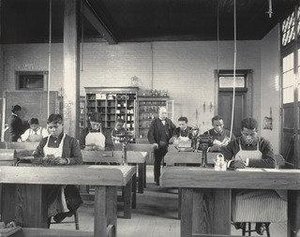
In Fancy sawing, Frances Benjamin Johnston turns her lens toward the quiet, rhythmic intensity of industrial labor. Created in 1900, this work captures a specific moment within an interior workshop or factory setting. The scene focuses on the specialized world of woodworking, where several men are engaged in their daily tasks. There is a sense of focused industry as they work around large machinery, their presence grounding the image in…

4
A Cooking Lesson (1900) by Frances Benjamin Johnston

A Cooking Lesson

1900 · Photography

A Cooking Lesson is a documentary photograph created by Frances Benjamin Johnston. The image was produced in 1900. This work captures a specific moment of instruction within a kitchen setting, documenting the activities of a group of women engaged in culinary tasks. The photograph provides a visual record of educational practices and social dynamics from the turn of the twentieth century.

5
A football team (1900) by Frances Benjamin Johnston

A football team

1900 · Gelatin Silver Print

A football team is a silver gelatin print by Frances Benjamin Johnston. Created in 1900, the photograph captures a group of players posed outdoors. The image functions as a formal group portrait, documenting a specific moment in early American sports culture.

6
Indian Orchestra (1900) by Frances Benjamin Johnston

Indian Orchestra

1900 · Gelatin Silver Print

The photograph presents a group of musicians arranged upon stone steps in front of a building facade. This assembly, identified as an Indian orchestra, is positioned across multiple levels of the staircase, creating a tiered arrangement of figures. The composition utilizes the architectural elements of the steps and the building to establish a sense of depth and structure. The musicians are grouped closely, their organic forms contrasting with the rigid,…

7
The School Choir (1900) by Frances Benjamin Johnston

The School Choir

1900 · Black and White Photography

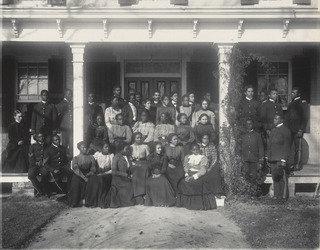
The artwork titled The School Choir is a photographic work by the artist Frances Benjamin Johnston. Created around 1900, this image functions as a formal group portrait. The subjects of the photograph consist of a large gathering of individuals, specifically the students and faculty of the Hampton Normal and Agricultural Institute. The scene is set in Hampton, Virginia, on the porch of a building that serves as the backdrop for…

8
Girls basket ball (1900) by Frances Benjamin Johnston

Girls basket ball

1900 · Photography

The scene unfolds in the photograph titled Girls basket ball, a moment captured by the lens of Frances Benjamin Johnston. In this image, a group of young girls engages in a game of basketball outdoors, their movements frozen in a lively scrimmage. The energy of the game feels immediate, as if the viewer has just stepped into the clearing to witness their spirited play. This work dates to about 1900,…

9
Tailor boys at work (1900) by Frances Benjamin Johnston

Tailor boys at work

1900 · Black and White Photography

In this photograph titled Tailor boys at work, we encounter a quiet, unvarnished moment from the turn of the century. Created by Frances Benjamin Johnston around 1900, the image captures a specific, somber reality of the era. It is a piece that moves away from the formal portraiture for which Johnston was often commissioned, opting instead to document the lived experiences of the working class.

10
The School Battalion (1900) by Frances Benjamin Johnston

The School Battalion

1900 · Gelatin Silver Print

The School Battalion is a photographic work by Frances Benjamin Johnston, produced in 1900. Commissioned by Hollis Burke Frissell, the image is part of a larger series documenting the Hampton Normal and Agricultural Institute in Hampton, Virginia. Johnston’s lens focused on the students of the institution, capturing the daily realities of their environment.

Frances Benjamin Johnston paintings, ranked 11 to 73

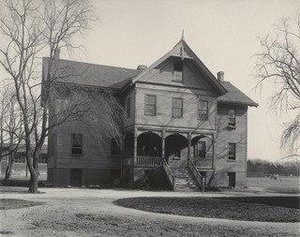
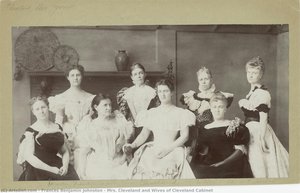
11The old folks at home (1900) by Frances Benjamin JohnstonThe old folks at home1900 12Trade School Shoe making (1900) by Frances Benjamin JohnstonTrade School Shoe making1900 13Trade School Plastering (1900) by Frances Benjamin JohnstonTrade School Plastering1900 14Carving and cabinet work (1900) by Frances Benjamin JohnstonCarving and cabinet work1900 15Agriculture Butter making (1900) by Frances Benjamin JohnstonAgriculture Butter making1900 16Agriculture Sampling milk (1900) by Frances Benjamin JohnstonAgriculture Sampling milk1900 17Trade School Brick laying (1900) by Frances Benjamin JohnstonTrade School Brick laying1900 18A guitar and mandolin club (1900) by Frances Benjamin JohnstonA guitar and mandolin club1900 19The School Band (1900) by Frances Benjamin JohnstonThe School Band1900 20Gymnastics at the Whittier (1900) by Frances Benjamin JohnstonGymnastics at the Whittier1900 21Trade School Harness making (1900) by Frances Benjamin JohnstonTrade School Harness making1900 22Arithmetic Measuring circles (1900) by Frances Benjamin JohnstonArithmetic Measuring circles1900 23English Study in the Library (1900) by Frances Benjamin JohnstonEnglish Study in the Library1900 24Physics Capillary phenomena (1900) by Frances Benjamin JohnstonPhysics Capillary phenomena1900 25Boys' wand drill (1900) by Frances Benjamin JohnstonBoys' wand drill1900 26Trade School A carpenter shop (1900) by Frances Benjamin JohnstonTrade School A carpenter shop1900 27Trade School The machine shop (1900) by Frances Benjamin JohnstonTrade School The machine shop1900 28Trade School Mechanical drawing (1900) by Frances Benjamin JohnstonTrade School Mechanical drawing1900 29Arithmetic Measuring and pacing (1900) by Frances Benjamin JohnstonArithmetic Measuring and pacing1900 30A sewing lesson at the Whittier (1900) by Frances Benjamin JohnstonA sewing lesson at the Whittier1900 31Manual training at the Whittier (1900) by Frances Benjamin JohnstonManual training at the Whittier1900 32The Post graduate Class of 1900 (1900) by Frances Benjamin JohnstonThe Post graduate Class of 19001900 33Trade School A black smith shop (1900) by Frances Benjamin JohnstonTrade School A black smith shop1900 34Physiology Class in Emergency Work (1900) by Frances Benjamin JohnstonPhysiology Class in Emergency Work1900 35Arithmetic Measuring for estimates (1900) by Frances Benjamin JohnstonArithmetic Measuring for estimates1900 36Agriculture Filling the silo by hand (1900) by Frances Benjamin JohnstonAgriculture Filling the silo by hand1900 · Museo Nacional Centro de Arte Reina Sofía 37Physiology Class studying the lungs (1900) by Frances Benjamin JohnstonPhysiology Class studying the lungs1900 38Physiology Class studying the heart (1900) by Frances Benjamin JohnstonPhysiology Class studying the heart1900 39An arithmetic lesson at the Whittier (1900) by Frances Benjamin JohnstonAn arithmetic lesson at the Whittier1900 40Physics Seniors studying osmose (sic) (1900) by Frances Benjamin JohnstonPhysics Seniors studying osmose (sic)1900 41Physiology Class studying the stomach (1900) by Frances Benjamin JohnstonPhysiology Class studying the stomach1900 42Arithmetic Lesson under a student mason (1900) by Frances Benjamin JohnstonArithmetic Lesson under a student mason1900 43English Studying the cone bearing trees (1900) by Frances Benjamin JohnstonEnglish Studying the cone bearing trees1900 44Thanksgiving Day Lesson at the Whittier (1900) by Frances Benjamin JohnstonThanksgiving Day Lesson at the Whittier1900 45Class in manual training Bent iron and tin (1900) by Frances Benjamin JohnstonClass in manual training Bent iron and tin1900 46Field work in sketching (Agriculture work) (1900) by Frances Benjamin JohnstonField work in sketching (Agriculture work)1900 47Printing Foot and steam power (1900) by Frances Benjamin JohnstonPrinting Foot and steam power1900 · Moravian Gallery in Brno 48Agriculture Studying commercial plant foods (1900) by Frances Benjamin JohnstonAgriculture Studying commercial plant foods1900 49Agriculture. Animal life Collecting specimens (1900) by Frances Benjamin JohnstonAgriculture. Animal life Collecting specimens1900 50Agriculture Study of plants or a plant society (1900) by Frances Benjamin JohnstonAgriculture Study of plants or a plant society1900 51Trade School A corner of the wheelwright shop (1900) by Frances Benjamin JohnstonTrade School A corner of the wheelwright shop1900 · Bratislava City Gallery 52Primary Class Studying Plants Whittier School (1900) by Frances Benjamin JohnstonPrimary Class Studying Plants Whittier School1900 53Physics The screw as applied to the cheese press (1900) by Frances Benjamin JohnstonPhysics The screw as applied to the cheese press1900 54The Improved Well (Three Hampton Grandchildren) (1900) by Frances Benjamin JohnstonThe Improved Well (Three Hampton Grandchildren)1900 55Agriculture Studying different methods of creamery (1900) by Frances Benjamin JohnstonAgriculture Studying different methods of creamery1900 56Drawing Simple work from the object (1900) by Frances Benjamin JohnstonDrawing Simple work from the object1900 57Physics Estimating the combined draught of horses (1900) by Frances Benjamin JohnstonPhysics Estimating the combined draught of horses1900 58Agriculture. Inspection of milk Use of the lactometer (1900) by Frances Benjamin JohnstonAgriculture. Inspection of milk Use of the lactometer1900 59Agriculture. Plant life Propagating (1900) by Frances Benjamin JohnstonAgriculture. Plant life Propagating1900 60Agriculture. Plant life Experiments with plants and soil (1900) by Frances Benjamin JohnstonAgriculture. Plant life Experiments with plants and soil1900 61Girls' Cottage Dormitory for colored girls and teachers (1900) by Frances Benjamin JohnstonGirls' Cottage Dormitory for colored girls and teachers1900 62The Treasurer's Residence Built and finished largely by students (1900) by Frances Benjamin JohnstonThe Treasurer's Residence Built and finished largely by students1900 63Geography Studying the Seasons from the Hampton Album (1900) by Frances Benjamin JohnstonGeography Studying the Seasons from the Hampton Album1900 64Andrew Carnegie and Booker T. Washington (1906) by Frances Benjamin JohnstonAndrew Carnegie and Booker T. Washington1906 · National Portrait Gallery 65Wood turning (1900) by Frances Benjamin JohnstonWood turning1900 66Agriculture Poultry (1900) by Frances Benjamin JohnstonAgriculture Poultry1900 67A sketch class at work (1900) by Frances Benjamin JohnstonA sketch class at work1900 68Barn on a one mule farm (1900) by Frances Benjamin JohnstonBarn on a one mule farm1900 · Art Gallery of New South Wales 69Graves Cottage Dormitory for colored boys (1900) by Frances Benjamin JohnstonGraves Cottage Dormitory for colored boys1900 · Museum of Fine Arts 70The Mansion House The Principal's residence (1900) by Frances Benjamin JohnstonThe Mansion House The Principal's residence1900 71Winona Dormitory for Indian girls and teachers (1900) by Frances Benjamin JohnstonWinona Dormitory for Indian girls and teachers1900 72The Armstrong Slater Memorial Trade School (1900) by Frances Benjamin JohnstonThe Armstrong Slater Memorial Trade School1900 73Mrs. Cleveland and Wives of Cleveland Cabinet (1897) by Frances Benjamin JohnstonMrs. Cleveland and Wives of Cleveland Cabinet1897 · National Portrait Gallery

The subjects that held Frances Benjamin Johnston's eye

The four subjects that come back most often in these originals, each with its finest example.

The museums that keep Frances Benjamin Johnston's originals

The 7 museums that hold the most of the paintings on this page.

Museum City Works by Frances Benjamin Johnston Paintings from this list
National Portrait Gallery, Washington, D.C.National Portrait Gallery Washington, D.C. 2 Andrew Carnegie and Booker T. Washington, Mrs. Cleveland and Wives of Cleveland Cabinet
National Gallery of Armenia, YerevanNational Gallery of Armenia Yerevan 1 Log sawing
Museo Nacional Centro de Arte Reina Sofía, MadridMuseo Nacional Centro de Arte Reina Sofía Madrid 1 Agriculture Filling the silo by hand
Moravian Gallery in Brno, BrnoMoravian Gallery in Brno Brno 1 Printing Foot and steam power
Bratislava City Gallery, BratislavaBratislava City Gallery Bratislava 1 Trade School A corner of the wheelwright shop
Art Gallery of New South Wales, SydneyArt Gallery of New South Wales Sydney 1 Barn on a one mule farm
Museum of Fine Arts, HoustonMuseum of Fine Arts Houston 1 Graves Cottage Dormitory for colored boys

Frances Benjamin Johnston, the signature paintings of each year

Some ten years, from 1897 to 1906, were enough for Frances Benjamin Johnston: the gallery walks through them year by year, one famous original after another.

Works per year

Pick a year to see its originals.

Frances Benjamin Johnston's paintings: the gallery answers

Which Frances Benjamin Johnston painting is the most famous of all?Reveal the answer

The Pappoose (1900). Log sawing (1900) and Fancy sawing (1900) come next.

How old was Frances Benjamin Johnston on completing The Pappoose?Reveal the answer

34 years old: The Pappoose dates from 1900, and Frances Benjamin Johnston was born in 1866.

Which are Frances Benjamin Johnston's top 10 paintings?Reveal the answer

The Pappoose, Log sawing, Fancy sawing, A Cooking Lesson, A football team, Indian Orchestra, The School Choir, Girls basket ball, Tailor boys at work and The School Battalion. The ranking above gives each one's year and museum.

How many works did Frances Benjamin Johnston create?Reveal the answer

Our catalog holds 73 works by Frances Benjamin Johnston, dated from 1897 to 1906.

Where do Frances Benjamin Johnston's most famous originals hang?Reveal the answer

Mostly in National Portrait Gallery (Washington, D.C.), National Gallery of Armenia (Yerevan) and Museo Nacional Centro de Arte Reina Sofía (Madrid). The museum table above lists them all.

When did Frances Benjamin Johnston create the most famous paintings?Reveal the answer

In 1900: 71 of the 73 works on this page were made then, The Pappoose among them.

Which are Frances Benjamin Johnston's earliest and latest famous works?Reveal the answer

On this page, the earliest is Mrs. Cleveland and Wives of Cleveland Cabinet (1897) and the latest Andrew Carnegie and Booker T. Washington (1906).

Which subjects did Frances Benjamin Johnston return to most?Reveal the answer

People (24), Students (18) and Monochrome (14), across the 73 works on this page.

Which medium did Frances Benjamin Johnston work in most?Reveal the answer

Black and White Photography, for 33 of the 73 works on this page.

Which movement is Frances Benjamin Johnston associated with?Reveal the answer

Documentary photography, judging by the originals on this page.

Which Frances Benjamin Johnston originals does the National Portrait Gallery hold?Reveal the answer

Andrew Carnegie and Booker T. Washington and Mrs. Cleveland and Wives of Cleveland Cabinet: the National Portrait Gallery, Washington, D.C. holds 2 of the works on this page.

Frances Benjamin Johnston: the artist

A Pioneer Behind the Lens: The Life and Legacy of Frances Benjamin Johnston

Born in 1864, amidst the tumultuous backdrop of post-Civil War America, Frances Benjamin Johnston emerged as a groundbreaking figure in the nascent field of photography. Her story is one of privilege tempered by ambition, societal expectations challenged by artistic drive, and a keen eye for documenting a nation undergoing profound transformation. Unlike many artists who struggled for recognition, Johnston benefited from a comfortable upbringing; her mother, Frances Antoinette Benjamin, was a respected journalist writing under the pen name “Ione” for *The Baltimore Sun*, while her father, Anderson Doniphan Johnston, held a position within the U.S. Treasury Department. This secure foundation allowed young Frances access to a quality education—graduating from Notre Dame of Maryland Collegiate Institute in 1883—and crucially, opportunities to pursue artistic training both at home and abroad, including studies at the Académie Julian in Paris and the Washington Art Students League. However, it was a gift from an unexpected source – George Eastman himself – that truly ignited her photographic journey: one of the very first Kodak cameras, ushering her into a world she would help redefine.

From Portraits to Social Commentary: A Developing Vision

Johnston’s early work centered on portraiture, initially capturing the likenesses of friends, family, and prominent figures within Washington D.C.’s social circles. She quickly gained recognition for her ability to portray character and nuance, securing commissions to photograph luminaries such as Susan B. Anthony, Mark Twain, and Booker T. Washington. This success led to an unprecedented role: becoming the official White House photographer under multiple presidential administrations – Harrison, Cleveland, McKinley, Theodore Roosevelt, and Taft. Yet, Johnston’s artistic vision extended far beyond the confines of political portraiture. She possessed a deep curiosity about American life in all its facets, and her lens began to turn towards documenting the experiences of ordinary people. This shift marked a pivotal moment in her career, transforming her from a skilled portraitist into a pioneering documentary photographer. She ventured into coal mines, iron works, textile mills, and even aboard ships, capturing images that offered a starkly realistic glimpse into the lives of working-class Americans – a demographic often overlooked by mainstream art and media. Her commitment to social commentary was particularly evident in her 1900 commission from Hollis Burke Frissell to photograph the Hampton Normal and Agricultural Institute. This series, documenting the successes and daily lives of African American students, stands as one of her most significant achievements, offering a powerful visual testament to their resilience and aspirations during an era of pervasive racial inequality.

Artistic Influences and Evolving Style

Johnston’s photographic style was not formed in isolation; she absorbed influences from the artistic currents of her time. Initially drawn to Pictorialism – a movement emphasizing artistic effect and evocative imagery – she gradually moved towards a more direct, documentary approach. The work of photographers like Peter Henry Emerson, who championed naturalistic photography and eschewed manipulation, resonated with Johnston’s growing desire for authenticity. Her portraits, even those of prominent figures, were characterized by their candidness and attention to detail, avoiding the stiff formality often associated with studio portraiture. She demonstrated an innovative use of lighting and composition, skillfully manipulating these elements to create images that were both aesthetically pleasing and emotionally resonant. Perhaps one of her most iconic self-portraits – depicting herself as a “New Woman” confidently holding a beer stein – encapsulates her spirit of independence and social change, challenging conventional gender roles and celebrating female empowerment. This image became a symbol of the evolving role of women in American society at the turn of the 20th century.

A Lasting Impact: Legacy and Historical Significance

Frances Benjamin Johnston’s contributions to American photography are immeasurable. She was not only one of the first women to achieve commercial success and widespread recognition as a photographer, but she also helped elevate documentary photography to an art form. Her extensive body of work provides an invaluable historical record of late 19th and early 20th century America, offering insights into its social, economic, and political landscape. Her photographs are now held in numerous prestigious museum collections, including the Library of Congress and the Smithsonian Institution, ensuring their preservation for future generations. Beyond her artistic achievements, Johnston paved the way for countless women photographers who followed in her footsteps, demonstrating that a career behind the lens was not only possible but could also be profoundly impactful. She proved that photography wasn’t merely about recording reality; it was about interpreting it, challenging perceptions, and ultimately, shaping our understanding of the world around us. Her legacy continues to inspire photographers today, reminding us of the power of visual storytelling and the importance of documenting the human experience with empathy, integrity, and artistic vision.

Further Exploration