Portrait of Emil Carlsen

The 93 Most Famous Emil Carlsen Paintings, a Gallery Selection

Updated November 2026 · ranked by our popularity score (searches, visits and orders for each work) · 95 works by Emil Carlsen in our catalogue

In short

Of all the originals Emil Carlsen left, the most famous is Ruby Reflection (1895). Close behind it come The Picture from Thibet (1920) and Mums in an Oriental Vase (1893). Our catalog holds 95 works by Emil Carlsen; the gallery has kept the 93 the world admires most, each shown with its date, its museum and its story.

1848 – 1932, Copenhagen Impressionism Most works: Museum of Fine Arts

Emil Carlsen's top 10 paintings: the gallery's choice

1
Ruby Reflection (1895) by Emil Carlsen

Ruby Reflection

1895 · Oil On Canvas

In 1895, Emil Carlsen captured a quiet moment in Ruby Reflection. This oil on canvas work emerges from the hand of an American Impressionist painter. The surface holds the weight of pigment and intent, a stillness caught in the grain of the fabric. It is a study of light and form, anchored by the artist's presence in the corner of the frame.

3
Mums in an Oriental Vase (1893) by Emil Carlsen

Mums in an Oriental Vase

1893 · Oil On Canvas

Mums in an Oriental Vase is a still life painting by Emil Carlsen. Created about 1893, the work captures a quiet arrangement of flowers held within a white vase accented with blue. This oil on canvas piece focuses on the delicate details of nature, presenting a harmonious display of botanical forms.

4
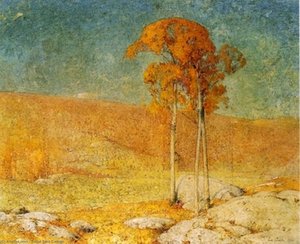
Old Sycamore by Emil Carlsen

Old Sycamore

Oil On Canvas

The painting presents a large, central tree with a thick, textured trunk and spreading branches. This primary subject occupies the center of the frame, rooted in a field of grass. Scattered rocks of varying sizes lie on the ground around the base of the tree, providing a coarse texture against the softer blades of grass. In the background, two smaller trees are positioned on opposite sides of the composition, one…

5
Blackfish and Clams (1880) by Emil Carlsen

Blackfish and Clams

1880 · Oil On Canvas · Metropolitan Museum of Art, New York

To gaze upon Blackfish and Clams is to be drawn into a moment suspended in time—a quiet tableau of sustenance and domestic grace. Søren Emil Carlsen, with his masterful hand, has captured not merely objects, but the very essence of a bountiful catch laid out for contemplation. The composition itself speaks volumes; it is structured around a gentle, almost unconscious triangle, drawing the eye from the central woven basket outward…

The Emil Carlsen selection continues, 11 to 93

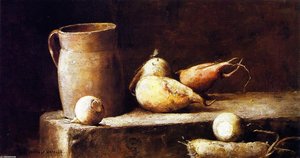
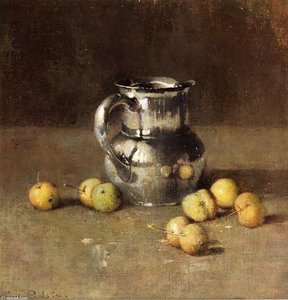
11A Young Girl Preparing Poultry (1885) by Emil CarlsenA Young Girl Preparing Poultry1885 12Still Life with Skate (1884) by Emil CarlsenStill Life with Skate1884 13The Root Cellar (1884) by Emil CarlsenThe Root Cellar1884 14Cape Ann Sands (1885) by Emil CarlsenCape Ann Sands1885 15Still Life with Fish (1882) by Emil CarlsenStill Life with Fish1882 · National Gallery of Art 16Still LIfe with Goose (1883) by Emil CarlsenStill LIfe with Goose1883 17Still LIfe with Flowers (1883) by Emil CarlsenStill LIfe with Flowers1883 18Haddock (1886) by Emil CarlsenHaddock1886 · Smithsonian American Art Museum 19Still Life with Bust and White Roses (1888) by Emil CarlsenStill Life with Bust and White Roses1888 20Still Life (1892) by Emil CarlsenStill Life1892 21White Asparagus (1891) by Emil CarlsenWhite Asparagus1891 22Still LIfe with Strawberries (1891) by Emil CarlsenStill LIfe with Strawberries1891 23Still Life with Fish (1893) by Emil CarlsenStill Life with Fish1893 24Chrysanthemums in a Canton Vase (1893) by Emil CarlsenChrysanthemums in a Canton Vase1893 25Vase of Roses (1895) by Emil CarlsenVase of Roses1895 26Still Life of Chrysanthemums in a Canton Vase (1893) by Emil CarlsenStill Life of Chrysanthemums in a Canton Vase1893 27Still Life with Dead Game (1895) by Emil CarlsenStill Life with Dead Game1895 28May (1895) by Emil CarlsenMay1895 29Still Life with Fish (1897) by Emil CarlsenStill Life with Fish1897 · Museum of Fine Arts 30Roses (1894) by Emil CarlsenRoses1894 31Still Life with Squash and PItcher (1893) by Emil CarlsenStill Life with Squash and PItcher1893 32Still Life with Fish and Copper Bowl (1894) by Emil CarlsenStill Life with Fish and Copper Bowl1894 33Orchard in Bloom (1904) by Emil CarlsenOrchard in Bloom1904 · Rhode Island School of Design Museum of Art 34Still Life with Oriental Works of Art (1901) by Emil CarlsenStill Life with Oriental Works of Art1901 35Study in Grey (1906) by Emil CarlsenStudy in Grey1906 · Dallas Museum of Art 36The South Strand (1909) by Emil CarlsenThe South Strand1909 · Smithsonian American Art Museum 37Wood Interior (1910) by Emil CarlsenWood Interior1910 · Cleveland Museum of Art 38Meeting of the Two Seas (1908) by Emil CarlsenMeeting of the Two Seas1908 39Moonlilt Seascape (1909) by Emil CarlsenMoonlilt Seascape1909 40Moonlight on the Kattegat (1910) by Emil CarlsenMoonlight on the Kattegat1910 41Still LIfe with Garlic (1906) by Emil CarlsenStill LIfe with Garlic1906 42The Open Sea (1910) by Emil CarlsenThe Open Sea1910 43Still Life with Kettle and Jug (1906) by Emil CarlsenStill Life with Kettle and Jug1906 44Oriental Jars (1914) by Emil CarlsenOriental Jars1914 · Saint Louis Art Museum 45Still Life (1914) by Emil CarlsenStill Life1914 46Entrance to the Harbor of St. Thomas (1915) by Emil CarlsenEntrance to the Harbor of St. Thomas1915 · Reading Public Museum 47Summer Light (1915) by Emil CarlsenSummer Light1915 48The Sky and the Ocean (1913) by Emil CarlsenThe Sky and the Ocean1913 49Moonlight Scene (1913) by Emil CarlsenMoonlight Scene1913 50The Fan (1919) by Emil CarlsenThe Fan1919 · Saint Louis Art Museum 51Landscape (1919) by Emil CarlsenLandscape1919 · Dayton Art Institute 52Still Life (1920) by Emil CarlsenStill Life1920 · Museum of Fine Arts 53The French Fan (1922) by Emil CarlsenThe French Fan1922 54Meeting of the Seas (1919) by Emil CarlsenMeeting of the Seas1919 55The Leeds Jug (1920) by Emil CarlsenThe Leeds Jug1920 56Iron Kettle and Clams (1926) by Emil CarlsenIron Kettle and Clams1926 57Connecticut Farmhouse (1928) by Emil CarlsenConnecticut Farmhouse1928 58A Cleaaring beyond the Trees (also known as Green Trees) (1928) by Emil CarlsenA Cleaaring beyond the Trees (also known as Green Trees)1928 59Wood Pasture (1930) by Emil CarlsenWood Pasture1930 60Evening Light (1930) by Emil CarlsenEvening Light1930 61Still Life with Self-Portrait Reflection (1931) by Emil CarlsenStill Life with Self-Portrait Reflection1931 62October Summer (1904) by Emil CarlsenOctober Summer1904 63The Open Sea (1909) by Emil CarlsenThe Open Sea1909 · Metropolitan Museum of Art 64Still Life with Yellow Roses by Emil CarlsenStill Life with Yellow RosesMuseum of Fine Arts 65Oriental Still Life by Emil CarlsenOriental Still Life 66Still Life with Teapot and Onion by Emil CarlsenStill Life with Teapot and Onion 67Cliff and Sea, Ogunquit by Emil CarlsenCliff and Sea, Ogunquit 68Surf Breaking on Rocks by Emil CarlsenSurf Breaking on Rocks 69Woods by Emil CarlsenWoods 70Through the Woods by Emil CarlsenThrough the Woods 71The Majestic Sea by Emil CarlsenThe Majestic Sea 72Trees in Forest by Emil CarlsenTrees in Forest 73The Market, Venice by Emil CarlsenThe Market, Venice 74Lakeside Landscape by Emil CarlsenLakeside Landscape 75Wooded Interior by Emil CarlsenWooded Interior 76Still Life with Teapot and Onion by Emil CarlsenStill Life with Teapot and Onion 77Still Life of Chrysanthemums by Emil CarlsenStill Life of Chrysanthemums 78Jade and Ancient Glass by Emil CarlsenJade and Ancient Glass 79Silver and Gray by Emil CarlsenSilver and Gray 80Misty Sea by Emil CarlsenMisty Sea 81Vase and Flowers by Emil CarlsenVase and Flowers 82Still Life with Mallards and Copper Pots by Emil CarlsenStill Life with Mallards and Copper Pots 83A Freshening Breeze by Emil CarlsenA Freshening Breeze 84Still LIfe with Pitcher and Pivar by Emil CarlsenStill LIfe with Pitcher and Pivar 85The Caribbean by Emil CarlsenThe Caribbean 86The Ocean at Sunrise by Emil CarlsenThe Ocean at Sunrise 87Landscape by Emil CarlsenLandscape 88Landscape, Orange Mountain by Emil CarlsenLandscape, Orange Mountain 89Still LIfe with Chinese Porcelain by Emil CarlsenStill LIfe with Chinese Porcelain 90The Valley, Moonlight by Emil CarlsenThe Valley, Moonlight 91The Samovar (1920) by Emil CarlsenThe Samovar1920 92The Canal by Emil CarlsenThe CanalReading Public Museum 93Still Life with Copper, Brass and Onions (1888) by Emil CarlsenStill Life with Copper, Brass and Onions1888

The subjects that held Emil Carlsen's eye

The four subjects that come back most often in these originals, each with its finest example.

The museums that keep Emil Carlsen's originals

The 8 museums that hold the most of the paintings on this page.

Museum City Works by Emil Carlsen Paintings from this list
Museum of Fine Arts, HoustonMuseum of Fine Arts Houston 3 Still Life with Fish, Still Life, Still Life with Yellow Roses
National Gallery of Art, WashingtonNational Gallery of Art Washington 2 The Picture from Thibet, Still Life with Fish
Metropolitan Museum of Art, New YorkMetropolitan Museum of Art New York 2 Blackfish and Clams, The Open Sea
Smithsonian American Art Museum, Washington, D.C.Smithsonian American Art Museum Washington, D.C. 2 Haddock, The South Strand
Saint Louis Art Museum, Saint LouisSaint Louis Art Museum Saint Louis 2 Oriental Jars, The Fan
Reading Public Museum, ReadingReading Public Museum Reading 2 Entrance to the Harbor of St. Thomas, The Canal
Art Institute of Chicago, ChicagoArt Institute of Chicago Chicago 1 Nantasket Beach
Rhode Island School of Design Museum of Art, ProvidenceRhode Island School of Design Museum of Art Providence 1 Orchard in Bloom

Emil Carlsen decade by decade: the original that defines each

Works per decade

Pick a decade to see the original that defines it.

Collectors' questions about Emil Carlsen's paintings

Which work is Emil Carlsen most famous for?Reveal the answer

Ruby Reflection (1895). The Picture from Thibet (1920) and Mums in an Oriental Vase (1893) come next.

What age was Emil Carlsen when Ruby Reflection was made?Reveal the answer

47 years old: Ruby Reflection dates from 1895, and Emil Carlsen was born in 1848.

What are the ten most famous Emil Carlsen paintings?Reveal the answer

Ruby Reflection, The Picture from Thibet, Mums in an Oriental Vase, Old Sycamore, Blackfish and Clams, Nantasket Beach, Sailor's Wife, Chrysanthemums, The River Bank and The Root Cellar. The ranking above gives each one's year and museum.

How many paintings did Emil Carlsen leave?Reveal the answer

Our catalog holds 95 works by Emil Carlsen, dated from 1876 to 1931.

In which museums do Emil Carlsen's masterpieces hang?Reveal the answer

Mostly in Museum of Fine Arts (Houston), National Gallery of Art (Washington) and Metropolitan Museum of Art (New York). The museum table above lists them all.

In which years did Emil Carlsen paint the most famous works?Reveal the answer

In 1890s: 15 of the 93 works on this page were made then, Ruby Reflection among them.

What are the first and the last famous originals of Emil Carlsen?Reveal the answer

On this page, the earliest is Nantasket Beach (1876) and the latest Still Life with Self-Portrait Reflection (1931).

Which subjects did Emil Carlsen choose most often?Reveal the answer

Life (17), Flowers (8) and Vase (7), across the 93 works on this page.

Which technique did Emil Carlsen use most?Reveal the answer

Oil On Canvas, for 6 of the 93 works on this page.

To which art movement does Emil Carlsen belong?Reveal the answer

Impressionism, judging by the originals on this page.

Which Emil Carlsen works hang at the Museum of Fine Arts?Reveal the answer

Still Life with Fish, Still Life and Still Life with Yellow Roses: the Museum of Fine Arts, Houston holds 3 of the works on this page.

Emil Carlsen: life and work

A Life Bridging Worlds: The Story of Søren Emil Carlsen

Born in Copenhagen, Denmark, on October 19, 1848 (though some records indicate 1853), Søren Emil Carlsen embarked on a journey that would see him become a pivotal figure in the evolution of American painting. His early life was steeped in artistic potential; he initially pursued architecture at the Royal Academy in Copenhagen for four years, a foundation that instilled within him a keen understanding of structure and form. However, the allure of pure artistry proved too strong to resist. He transitioned from architectural assistant to studying with Danish marine artist Lauritz Holst, absorbing techniques of depicting light and atmosphere on water – skills that would subtly influence his later landscapes. A transformative period followed in 1872 when Carlsen emigrated to the United States, settling in Chicago, a burgeoning center for artistic innovation. This move marked not just a geographical shift but a profound turning point in his artistic development. He sought further refinement of his craft with a sojourn to Paris in 1875, where he fell under the spell of Jean-Baptiste-Siméon Chardin, the celebrated French master of still life.

The American Chardin: A Mastery of Stillness

Upon returning from France, Carlsen quickly established a reputation as “The American Chardin,” a testament to his remarkable ability to imbue everyday objects with dignity and poetic resonance. His early works were deeply rooted in the tonalist aesthetic, characterized by muted palettes, subtle gradations of light, and an emphasis on mood and atmosphere. He found beauty in the commonplace – copper pans gleaming softly, game birds arranged with meticulous detail, delicate flowers poised in vases. These weren’t merely depictions of objects; they were meditations on texture, form, and the fleeting nature of time. He wasn't simply painting *what* he saw, but *how* he felt when observing it. This sensitivity to light and atmosphere became a hallmark of his style, setting him apart from many of his contemporaries. However, Carlsen was not content to remain solely within the confines of still life. As his career progressed, he began to expand his artistic horizons, venturing into landscapes and marine paintings, always retaining that signature tonalist sensibility. His exploration of these genres reveals a growing interest in capturing the broader effects of light and atmosphere on the natural world, influenced by encounters with American Impressionists like John Twachtman and Julian Alden Weir.

A Teacher and Innovator: Shaping the Next Generation

Carlsen’s influence extended far beyond his own canvases; he was a dedicated educator who profoundly impacted generations of artists. He began his teaching career as the first instructor of drawing and painting at the Chicago Academy of Design, laying the groundwork for countless aspiring artists. Later, he served as director of the California School of Design (now the San Francisco Art Institute) from 1887 to 1889, shaping the artistic landscape of the West Coast. He continued his commitment to teaching throughout his life, holding positions at the National Academy of Design, the Art Students League, and the Pennsylvania Academy of Fine Arts for over four decades. Among his most notable students was Guy Rose, who would go on to become a prominent figure in California Impressionism. Carlsen’s pedagogical approach emphasized observation, technique, and a deep understanding of artistic principles. He wasn't merely imparting skills; he was fostering a love of art and encouraging his students to find their own unique voices. His dedication to education earned him numerous accolades, including the Samuel T. Shaw Purchase Prize, a Gold Medal at the Louisiana Purchase Exposition, and the prestigious Medal of Honor at the Panama–Pacific International Exposition. He was also elected to membership in the National Academy of Design, solidifying his position as a leading figure in the American art world.

Legacy and Enduring Appeal

Søren Emil Carlsen’s artistic legacy is one of quiet brilliance and enduring influence. He skillfully bridged the gap between Tonalism and early Impressionism, demonstrating how these seemingly disparate styles could coexist and enrich each other. His work continues to resonate with audiences today because of its timeless quality – a masterful blend of technical skill, emotional depth, and poetic sensibility. He purchased a home in Falls Village, Connecticut in 1905, finding solace and inspiration in the Berkshire Mountains, where he painted many landscapes during his summers. His sales improved significantly after joining the Macbeth Gallery, allowing him to live comfortably and continue pursuing his artistic vision. Solo exhibitions at the gallery throughout the 1910s and 1920s further cemented his reputation as a leading American artist. Carlsen continued teaching until his death on January 2, 1932, in New York City, leaving behind a rich body of work that is now represented in prominent museums across the country, including the Art Institute of Chicago, the Metropolitan Museum of Art, and the San Diego Museum of Art. His paintings are not merely historical artifacts; they are windows into a world seen through the eyes of a master – a world where beauty resides in simplicity, and light holds the power to transform the ordinary into the extraordinary.

Key Characteristics of Carlsen’s Work

  • Tonalism & Impressionism: A unique blend of muted tones and atmospheric effects with a touch of impressionistic vibrancy.
  • Still Life Mastery: Renowned for his exquisite still lifes, often featuring copper, brass, and everyday objects imbued with poetic significance.
  • Subtle Light & Atmosphere: A remarkable ability to capture the nuances of light and atmosphere, creating a sense of mood and tranquility.
  • Influenced by Chardin: Deeply inspired by Jean-Baptiste-Siméon Chardin’s approach to still life painting.
  • Dedication to Teaching: A committed educator who shaped the next generation of American artists.