


1


Updated November 2026 · ranked by our popularity score (searches, visits and orders for each work) · 72 works by Edward William Stott in our catalogue
In short
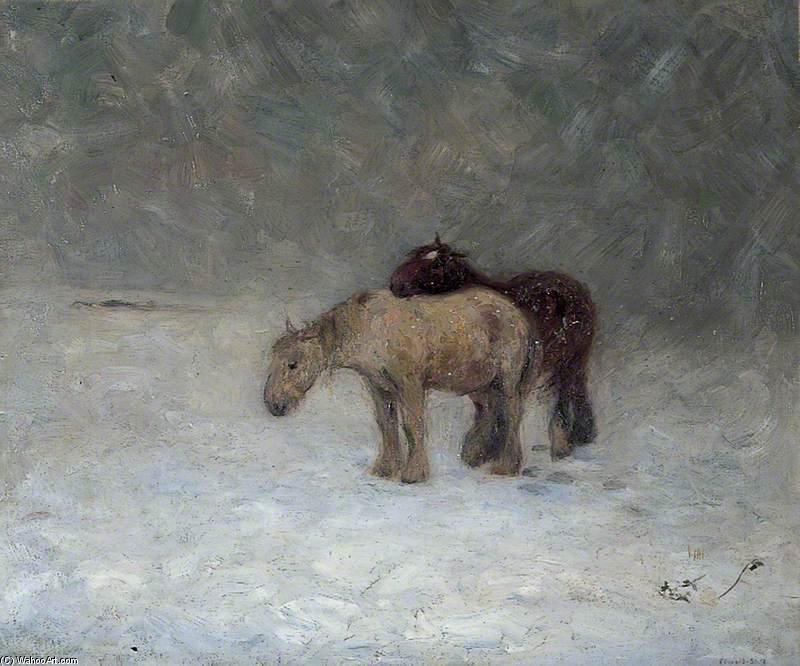
Of all the originals Edward William Stott left, the most famous is Black And White Cat. Close behind it come Where the dark earth sleeping lies (1908) and A Snow Storm. Our catalog holds 72 works by Edward William Stott; the gallery has kept the 48 the world admires most, each shown with its date, its museum and its story.



 The Harvesters' Return
12
 Lakeland landscape
13
 The Riverbank
14
 The Entombment
15
 Study Of A Calf In A Summer Meadow
16
 In The Fields, Anvers Sur Oise
17
 Study Of A Woman And Two Chil
18
 Chalk Pit Near Amberley
19
 The Stray Cat
20
 The Sacred Pool
21
 Sketch For The Wedding
22
 The Marshes
23
 The Turnip Field
24
 Sunrise In Winter
25
 The Bird Cage
26
 Springtime
27
 The Shepherd
28
 On A Summer Afternoon
29
 The Ferry
30
 The Horse Pond
31
 Portrait Of A Young Girl
32
 Portrait Of A Young Girl
33
 Milking Time, Early Morn
34
 Maternity
35
 A Village Street
36
 Alone - Early Spring Woodland
37
 Sunday Morning
38
 The Old Gate
39
 The Old Gate
40
 A Cottage Madonna
41
 The Flight
42
 A French Kitchen Garden
43
 The prodigal son
44
 The Carpenter's Shop
45
 Approaching Night -
46
 Motherhood
47
 The Fold
48
 Motherhood detail
The four subjects that come back most often in these originals, each with its finest example.
The museum that holds the most of the paintings on this page.
| Museum | City | Works by Edward William Stott | Paintings from this list |
|---|---|---|---|
 Art Gallery of New South Wales |
Sydney | 1 | Where the dark earth sleeping lies |
1908 is the year of every dated Edward William Stott work in this selection: here they are, ranked by fame.
Pick a year to see its originals.
Black And White Cat. Where the dark earth sleeping lies (1908) and A Snow Storm come next.
Black And White Cat, Where the dark earth sleeping lies, A Snow Storm, Ploughing, After Work, A Harvest Festival, Folding Time, Feeding The Ducks, The Labourer's Cottage and Hagar And Ishmael Beside A Well In The Desert. The ranking above gives each one's year and museum.
Our catalog holds 72 works by Edward William Stott.
Mostly in Art Gallery of New South Wales (Sydney). The museum table above lists them all.
Rural landscape (7), Landscape (5) and British countryside (3), across the 48 works on this page.
Barbizon school and Impressionism, judging by the originals on this page.
Edward William Stott remains a captivating figure in the tapestry of British art, a painter whose work breathes with the quiet, melancholic beauty of the late Victorian era. Born in 1855 amidst the industrial grit of Rochdale, Lancashire, Stott’s artistic sensibilities were far removed from the soot and iron of his birthplace. Instead, he sought a profound connection with the natural world, eventually finding his spiritual and creative home in the rolling, tranquil landscapes of rural Sussex. His journey was one of constant refinement, moving from the structured academic environments of Manchester and Paris to the spontaneous, light-drenched fields of the English countryside.
Stott’s early education provided him with a formidable technical foundation. His studies at the Manchester Academy of Fine Art and his subsequent immersion in the prestigious École Nationale Supérieure des Beaux-Arts in Paris placed him at the heart of a transformative period in art history. Under the guidance of masters such as Carolus-Duran and Cabanel, he mastered the nuances of form and light. However, it was the influence of the Barbizon School and the rustic Naturalism of Jules Bastien-Lepage that truly ignited his passion. He learned to marry the rigorous discipline of French academic training with a deep, emotive reverence for the English landscape tradition, echoing the poetic sensibilities of John Linnell and Samuel Palmer.
What distinguishes a Stott masterpiece is not merely the subject matter, but the palpable atmosphere that envelops every scene. He possessed an uncanny ability to capture the "fading light"—those fleeting, liminal moments of twilight when the world transitions from the clarity of day to the mystery of dusk. This preference for low-light settings allowed him to experiment with tonal variations and subtle color shifts, imbuing his canvases with a sense of profound contemplation and even a touch of nostalgia. His work often feels as though it is caught in a breath, suspended between the physical reality of the landscape and an internal, emotional response to it.
His technical repertoire was remarkably diverse, allowing him to express different facets of his vision through various media:
Despite achieving significant critical and commercial success during his lifetime—marked by his election as an Associate of the Royal Academy in 1906 and his role as a founding member of the New English Art Club—Stott’s reputation suffered a decline following the Great War. As the art world pivoted toward more radical, fragmented movements, his devotion to Naturalism and the quiet dignity of rural life began to be viewed as unfashionable. Much of his oeuvre fell into obscurity, overshadowed by the rapid evolution of modernism.
Yet, in recent years, a renewed appreciation for Stott has begun to emerge. Collectors and historians are rediscovering the profound emotional depth and technical brilliance that define his work. He is no longer seen merely as a Victorian painter of landscapes, but as a master of atmosphere who captured the very soul of a vanishing way of life. His legacy lives on in the evocative textures of The Fold and the poignant realism of Lambing Time, reminding us that there is immense power in the quiet, the rural, and the twilight.


