Portrait of Edward Wadsworth

Edward Wadsworth Paintings: The 50 Most Famous, Through a Gallery's Eye

Updated November 2026 · ranked by our popularity score (searches, visits and orders for each work) · 51 works by Edward Wadsworth in our catalogue

In short

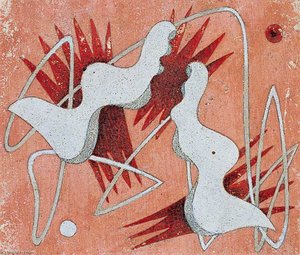
To the gallery's eye, Edward Wadsworth's most famous painting is Composition on a Pink Background (1934), whose original hangs in the Pallant House Gallery, Chichester. The First of the Ebb, the Sailor and the Sea (1938) and Coquillages (1926) complete the trio every eye recognises. Of the 51 works by Edward Wadsworth in our catalog, the gallery presents the 50 most famous below, each original with its year, its museum and what makes it unique.

1889 – 1949, Cleckheaton Vorticism Most works: Government Art Collection

The gallery's top 10 Edward Wadsworth paintings

1
Composition on a Pink Background (1934) by Edward Wadsworth

Composition on a Pink Background

1934 · Painting · Pallant House Gallery, Chichester

In the vibrant landscape of early twentieth-century abstraction, few works capture the playful yet structured essence of modernism quite like Edward Alexander Wadsworth’s Composition on a Pink Background. Created in 1934, this captivating piece serves as a window into a period where the boundaries between reality and geometry began to dissolve. At first glance, the viewer is greeted by a striking palette dominated by a warm, luminous pink backdrop that…

2
The First of the Ebb, the Sailor and the Sea (1938) by Edward Wadsworth

The First of the Ebb, the Sailor and the Sea

1938 · Oil · The Mercer Art Gallery, Harrogate

In the mesmerizing expanse of The First of the Ebb, the Sailor and the Sea, Edward Alexander Wadsworth invites us into a world where the boundaries between sky and sea dissolve into a singular, rhythmic motion. Painted in 1938, this evocative masterpiece captures a moment of profound vitality within the maritime landscape. The canvas is dominated by a breathtaking palette of blues, ranging from the deep, mysterious indigo of the…

3
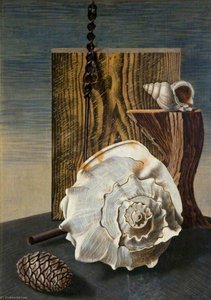
Coquillages (1926) by Edward Wadsworth

Coquillages

1926 · Tempera On Panel · The Whitworth, Manchester

In 1926, Edward Wadsworth completed Coquillages, a surrealist still life that captures a quiet, dreamlike arrangement. The work presents a collection of seashells scattered across a surface, a composition that moves beyond simple observation into the realm of the subconscious. It remains a quintessential example of British Surrealism, a movement seeking to liberate the mind from the constraints of logic.

6
Sussex Pastoral (1941) by Edward Wadsworth

Sussex Pastoral

1941 · Oil On Canvas · Art Gallery of Hamilton, Hamilton

Edward Alexander Wadsworth's Sussex Pastoral, painted in 1941, is not merely a still life; it’s a quietly profound meditation on the passage of time, the decline of industry, and perhaps even the melancholic beauty of obsolescence. This evocative work, dominated by a meticulously arranged collection of discarded industrial components – a locomotive wheel, weathered pipes, and fragmented barrels – presents a landscape both familiar and unsettling. The scene unfolds with…

Edward Wadsworth paintings, ranked 11 to 50

Edward Wadsworth's famous paintings, period by period

The subjects that held Edward Wadsworth's eye

The four subjects that come back most often in these originals, each with its finest example.

The museums that keep Edward Wadsworth's originals

The 8 museums that hold the most of the paintings on this page.

Museum City Works by Edward Wadsworth Paintings from this list
Government Art Collection, LondonGovernment Art Collection London 3 Still Life with Fruit and a Bottle, Floats and Afloat, Marseilles Harbour, Quai du Port
Leeds Art Gallery, LeedsLeeds Art Gallery Leeds 3 Faithful Servants (Marine), Composition on a Red Ground, Requiescat
Pallant House Gallery, ChichesterPallant House Gallery Chichester 2 Composition on a Pink Background, Conversation
Laing Art Gallery, Newcastle upon TyneLaing Art Gallery Newcastle upon Tyne 2 Marine Set, Le Havre, France
The Mercer Art Gallery, HarrogateThe Mercer Art Gallery Harrogate 1 The First of the Ebb, the Sailor and the Sea
The Whitworth, ManchesterThe Whitworth Manchester 1 Coquillages
Art Gallery of Hamilton, HamiltonArt Gallery of Hamilton Hamilton 1 Sussex Pastoral
New Walk Museum - Art Gallery, LeicesterNew Walk Museum - Art Gallery Leicester 1 Rue Fontaine de Caylus, Marseilles, France

Edward Wadsworth, one signature painting per decade

Works per decade

Pick a decade to see the original that defines it.

Edward Wadsworth's paintings: the gallery answers

Which Edward Wadsworth painting is the most famous of all?Reveal the answer

Composition on a Pink Background (1934), Pallant House Gallery, Chichester. The First of the Ebb, the Sailor and the Sea (1938) and Coquillages (1926) come next.

How old was Edward Wadsworth on completing Composition on a Pink Background?Reveal the answer

45 years old: Composition on a Pink Background dates from 1934, and Edward Wadsworth was born in 1889.

Which are Edward Wadsworth's top 10 paintings?Reveal the answer

Composition on a Pink Background, The First of the Ebb, the Sailor and the Sea, Coquillages, Cuthbert Kelly, Male Figure Standing, Sussex Pastoral, Still Life with Fruit and a Bottle, Broadbottom, near Glossop, Seaport and Dunkerque. The ranking above gives each one's year and museum.

How many works did Edward Wadsworth create?Reveal the answer

Our catalog holds 51 works by Edward Wadsworth, dated from 1910 to 1943.

Where do Edward Wadsworth's most famous originals hang?Reveal the answer

Mostly in Government Art Collection (London), Leeds Art Gallery (Leeds) and Pallant House Gallery (Chichester). The museum table above lists them all.

When did Edward Wadsworth create the most famous paintings?Reveal the answer

In 1930s: 19 of the 50 works on this page were made then, Composition on a Pink Background among them.

Which are Edward Wadsworth's earliest and latest famous works?Reveal the answer

On this page, the earliest is Cuthbert Kelly (1910) and the latest Top of the World (1943).

Which subjects did Edward Wadsworth return to most?Reveal the answer

Geometric shapes (4), Maritime (4) and Maritime art (4), across the 50 works on this page.

Which medium did Edward Wadsworth work in most?Reveal the answer

Oil On Canvas, for 3 of the 50 works on this page.

Which movement is Edward Wadsworth associated with?Reveal the answer

Vorticism, judging by the originals on this page.

Which Edward Wadsworth originals does the Government Art Collection hold?Reveal the answer

Still Life with Fruit and a Bottle, Floats and Afloat and Marseilles Harbour, Quai du Port: the Government Art Collection, London holds 3 of the works on this page.

Edward Wadsworth: the artist

Early Life and Artistic Awakening

Edward Alexander Wadsworth, born in Cleckheaton, West Yorkshire, in 1889, entered a world shadowed by early loss. The death of his mother shortly after his birth profoundly shaped his upbringing, leaving him largely raised by an aunt while his father managed the family’s wool-spinning business. This somewhat solitary childhood fostered a contemplative nature, perhaps laying the groundwork for the introspective quality that would later characterize his art. His formal education began at Fettes College in Edinburgh, but it was a sojourn to Munich in 1906 that proved pivotal. Initially enrolled to study engineering – a path dictated by paternal expectations – Wadsworth found himself irresistibly drawn to the artistic currents swirling within the city. At the Knirr School, he discovered a passion for drawing and woodcut printing, igniting a creative spark that would ultimately lead him away from the world of mechanics and towards a life dedicated to visual expression. This marked not merely a change in academic pursuit but a fundamental shift in his identity, a turning toward the realm of aesthetic exploration. Further honing his skills at Bradford School of Art and then the prestigious Slade School of Art in London, Wadsworth found himself amongst a remarkable cohort of future luminaries – Stanley Spencer, Mark Gertler, and others who would define British art for generations to come.

The Vortex and Wartime Innovation

Wadsworth’s artistic trajectory took a dramatic turn with his introduction to Wyndham Lewis and the burgeoning Vorticist movement. Initially influenced by Roger Fry's groundbreaking Post-Impressionist exhibitions, he quickly embraced the radical energy of Vorticism, an avant-garde aesthetic that sought to capture the dynamism of the modern age through abstraction and geometric forms. He became a key contributor to the movement, signing the Vorticist Manifesto in 1914 and exhibiting works that embodied its bold, fragmented style. However, Wadsworth’s engagement with modernity wasn't confined to the canvas. The outbreak of World War I saw him enlist in the Royal Naval Volunteer Reserve, where he put his artistic principles to an unexpectedly practical use. Tasked with designing dazzle camouflage – also known as razzle dazzle – for Allied ships, he applied Vorticist concepts of abstraction and disruption to confuse enemy submarines. These striking patterns, a fusion of art and naval strategy, weren’t intended to render vessels invisible but rather to make it difficult to determine their course and speed, thereby hindering accurate targeting. This period demonstrated Wadsworth's unique ability to bridge the gap between artistic innovation and real-world application, showcasing the power of abstract thought in a time of conflict.

Post-War Transformations and Maritime Visions

The aftermath of the war brought about a significant shift in Wadsworth’s artistic style. While he had been at the forefront of abstraction with Vorticism, he gradually moved towards a more representational approach, though one still imbued with a distinctive sensibility. His wartime experiences profoundly influenced his subject matter, leading to an enduring fascination with maritime themes. Ships – symbols of both conflict and exploration – became recurring motifs in his work, often depicted with a haunting stillness or set within dreamlike, surreal landscapes. He explored still life compositions and landscapes as well, frequently incorporating elements of the uncanny and employing muted color palettes that evoked a sense of melancholy and introspection. In 1934, Wadsworth joined Unit One, a group dedicated to promoting modern British art, further solidifying his position within the evolving artistic landscape of the time. This association reflected his commitment to pushing boundaries while remaining rooted in a distinctly British aesthetic tradition.

Surreal Echoes and Lasting Legacy

In his later years, Wadsworth’s work became increasingly infused with surrealist undertones, though he never formally aligned himself with the Surrealist movement. His paintings from this period often feature enigmatic juxtapositions of objects and spaces, creating a sense of unease and mystery. Works like Dazzle-ships in Drydock at Liverpool (1919), The Perspective of Idleness II (1942), and Sussex Pastoral (1941) exemplify his evolving style, showcasing a unique blend of abstraction, realism, and surrealism. He died in 1949, leaving behind a body of work that continues to captivate and intrigue. Wadsworth’s legacy extends beyond his paintings; his dazzle camouflage designs have experienced a resurgence of interest in contemporary graphic design, demonstrating the enduring relevance of his innovative visual language. He remains a pivotal figure in the development of modern British art, celebrated for his pioneering role in Vorticism, his wartime contributions, and his distinctive artistic vision that seamlessly blended abstraction with evocative realism. His ability to find beauty and meaning in both the mechanical world and the natural landscape ensures his place as one of the most compelling artists of his generation.