Edward Arthur Fellowes Prynne: A Pre-Raphaelite Visionary of Faith and Form
The world of Victorian art often presents a dazzling array of styles, yet within that landscape, Edward Arthur Fellowes Prynne carved out a distinctive niche—one deeply rooted in religious devotion and exquisitely rendered Pre-Raphaelite aesthetics. Born in Plymouth in 1854 into a family steeped in artistic and ecclesiastical tradition, Prynne’s life was inextricably linked to both the beauty of visual representation and the profound significance of faith. His story is not one of immediate fame, yet his legacy endures through the enduring power of his paintings—particularly his monumental ‘Stations of the Cross’ and his contributions to the sacred spaces of churches across England.
Prynne's artistic lineage was remarkable. His father, George Rundle Prynne, was a prominent Tractarian clergyman and ritualist, deeply involved in restoring traditional Catholic practices within the Church of England. This environment instilled in young Edward a reverence for beauty, tradition, and spiritual contemplation—qualities that would profoundly shape his artistic vision. His elder brother, George Fellowes Prynne, followed a path as an architect, specializing in ecclesiastical design, further cementing the family’s connection to sacred spaces and their aesthetic enhancement. This familial influence created a unique synergy, with Edward drawing inspiration from his brother's architectural projects while simultaneously exploring the expressive potential of painting.
Early training provided Prynne with a solid foundation in artistic technique. He began his formal education at Eastman’s Royal Naval Academy in Southsea, initially intending to pursue a career in the navy. However, recognizing his true calling, he was encouraged by Frederic Leighton—a leading figure of the Pre-Raphaelite Brotherhood—to embrace painting as his vocation. This pivotal decision led him to travel extensively throughout Europe, immersing himself in the artistic traditions of Antwerp, Florence, Paris, and Rome. These formative years exposed him to the works of masters like Charles Verlat, whose influence is readily apparent in Prynne’s early paintings, characterized by a rich palette and meticulous detail.
The Stations of the Cross: A Dramatic Narrative
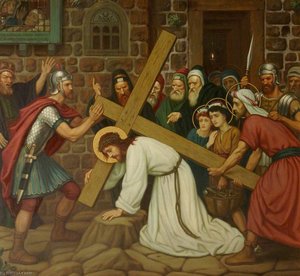
Prynne's most celebrated achievement undoubtedly lies in his series of ‘Stations of the Cross,’ monumental depictions of Christ’s journey to Calvary. These works are not merely devotional images; they are dramatic narratives rendered with a palpable sense of pathos and spiritual intensity. Each station is meticulously composed, employing vibrant colors, intricate details, and carefully chosen symbolism to convey the suffering and sacrifice of Christ. The series demonstrates Prynne's ability to seamlessly blend Pre-Raphaelite aesthetics—characterized by lush textures, luminous light, and idealized beauty—with a deeply felt religious sensibility.
The ‘Stations’ were commissioned for various churches throughout England, including St John Evangelist in Iffley Road, Oxford. These paintings are not simply decorative; they serve as visual meditations on the central tenets of Christian faith. The depiction of Christ's arrest, for example, is particularly arresting—a moment of profound vulnerability and defiance captured with remarkable sensitivity. The series’ impact extended beyond their aesthetic qualities; they transformed churches into spaces of contemplation and spiritual engagement.
Beyond the Stations: Portraits and Church Decoration
While the ‘Stations of the Cross’ secured Prynne's reputation, his artistic output encompassed a broader range of subjects. He was a highly skilled portrait painter, creating dignified and evocative portraits of prominent figures from Victorian society—including members of the Royal Family and notable politicians. His portraits are distinguished by their psychological depth and subtle nuances of expression. He skillfully captured not only physical likeness but also the inner character and personality of his subjects.
Furthermore, Prynne’s artistic talents extended to the realm of church decoration. He designed and executed a multitude of altar panels, reredos, and stained-glass windows for churches across Cornwall and Devon—regions where he maintained strong ties to his family heritage. These decorative works are integral components of the churches' architectural fabric, enhancing their spiritual atmosphere and providing visual narratives that complement the liturgical services. His work at Ladock Church in Cornwall is a particularly notable example of this facet of his career.
A Legacy of Faith and Beauty
Edward Arthur Fellowes Prynne’s artistic legacy is one of quiet distinction—a testament to the power of faith, beauty, and meticulous craftsmanship. Despite not achieving widespread fame during his lifetime, his paintings continue to resonate with viewers today, offering a glimpse into the spiritual and aesthetic sensibilities of Victorian England. His ‘Stations of the Cross,’ in particular, stand as enduring monuments to his artistic vision—powerful depictions of suffering, sacrifice, and redemption that speak across generations.
Prynne’s work reflects a deep engagement with both religious iconography and Pre-Raphaelite aesthetics, creating a unique visual language that is both profoundly moving and exquisitely beautiful. His contributions to the sacred spaces of churches—through his paintings, altar panels, and stained-glass windows—have left an indelible mark on the architectural landscape of England, reminding us of the enduring power of art to inspire contemplation and deepen our understanding of faith.