A Life Etched in Detail: The World of Chuck Close
Charles Thomas Close, born July 5, 1940, in Monroe, Washington, and who passed away on August 19, 2021, in Oceanside,
New York, was a monumental figure in the landscape of
contemporary art. His journey, marked by both profound artistic innovation and personal adversity, redefined portraiture for generations. From an early age, Close faced significant challenges – a neuromuscular condition coupled with dyslexia created obstacles that shaped his unique perspective. These difficulties fostered a deep observation of the world around him, a quality that would become central to his artistic practice. His childhood was further impacted by family tragedy; the loss of his father and his mother’s illness instilled in him a resilience that mirrored the meticulous dedication he later brought to his art. Early exposure to
Jackson Pollock's drip paintings at the Seattle Art Museum proved pivotal, igniting within him a passion for pushing artistic boundaries. He pursued formal education at the University of Washington, earning a B.A. in 1962, and continued honing his skills at Yale University, receiving both a BFA (1963) and an MFA (1964). A Fulbright scholarship then propelled him to Vienna’s Akademie der Bildenden Künste, broadening his artistic horizons before he returned to the United States.
From Abstraction to Hyperrealism: The Evolution of a Style
Close's artistic trajectory began with explorations in
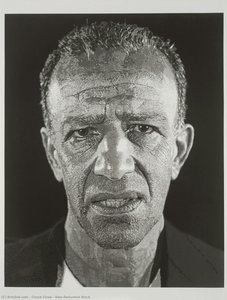
Abstract Expressionism, but it was during the late 1960s that he embarked on the path that would define his career – photorealism. Rejecting the gestural freedom of abstraction, Close turned to photography as his primary source material. He didn’t aim to merely copy a photograph; instead, he developed an intricate process of translation. Utilizing a grid system, he meticulously transferred photographic images onto enormous canvases, breaking down the image into manageable squares and replicating each detail with painstaking accuracy using
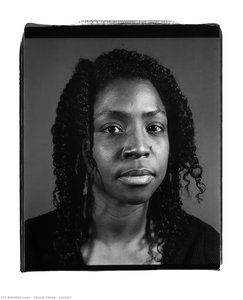
acrylic paints and airbrush techniques. This method wasn't about flawless reproduction but rather about revealing the underlying structure of perception itself. His early portraits were monumental in scale, confronting viewers with an almost overwhelming level of detail. He didn’t shy away from imperfections – bloodshot eyes, broken capillaries, pores, and wrinkles were all rendered with unflinching honesty. This emphasis on the flaws of human features wasn't a critique of beauty standards but rather an exploration of the inherent limitations of both photography and representation. He explored various media throughout his career, including fingerprint patterns and color printing processes, always seeking new ways to deconstruct and rebuild the image.
Innovation in the Face of Adversity: A Legacy Forged Through Resilience
The 1970s witnessed Close’s ascent to prominence as a leading figure in photorealism. His large-scale portraits garnered widespread recognition, establishing him as an artist who dared to challenge conventional notions of portraiture. His “fingerprint series” demonstrated a remarkable innovative approach to texture and abstraction; using his own fingerprints to create subtle gradations of gray, he transformed the personal into the universal. However, in 1988, Close’s life took another dramatic turn when he suffered a spinal artery occlusion, resulting in paralysis from the neck down. This devastating event could have ended his career, but instead, it spurred him to adapt and innovate further. He continued to paint, developing new techniques that allowed him to work with limited mobility – even painting with his mouth. This unwavering dedication to his craft is a testament to his artistic spirit and resilience. His work has been exhibited extensively worldwide and resides in prestigious museum collections such as the Art Institute of Chicago, the Museum of
Modern Art (
New York), and the
Tate Gallery (London).
Influences and Lasting Impact: A Transformation of Portraiture
Chuck Close’s artistic lineage is complex. While initially inspired by
Pollock's expressive freedom, he ultimately forged his own path, influenced by a desire to objectively observe and meticulously recreate reality. He challenged the traditional understanding of portraiture, moving away from idealized representations towards a more analytical and objective approach. His work questioned the very nature of seeing and representation, forcing viewers to confront the mechanics of perception. Close’s exploration of scale, detail, and process profoundly impacted the development of photorealism and
contemporary art as a whole. He demonstrated that photography wasn't simply a tool for capturing reality but also a medium for artistic interpretation and transformation. His influence extends beyond painting; his techniques have resonated with artists working in various disciplines, from sculpture to digital media. Notable works like the striking
black-and-white diptych of Barack Obama, the monumental self-portrait *
Big Self-Portrait*, the pixelated detail of *
Self-Portrait Spitbite White on Black*, and powerful portraits such as *
Mark* (
Richard Serra) and *Nat* stand as enduring testaments to his artistic vision.
Chuck Close’s legacy is not merely one of technical mastery but also of unwavering perseverance, demonstrating that art can flourish even in the face of profound adversity.
A Continuing Dialogue: Chuck Close's Enduring Relevance
- Photorealism Pioneer: Close remains a central figure in the history of photorealism, inspiring generations of artists to explore the boundaries between photography and painting.
- Technical Innovation: His grid system and innovative use of materials continue to be studied and emulated by artists today.
- Resilience and Adaptation: His ability to overcome physical challenges and continue creating art serves as a powerful example of the human spirit’s capacity for adaptation.
- Exploration of Identity & Perception: His portraits delve into themes of identity, perception, and representation, prompting viewers to question their own understanding of reality.
Despite controversies surrounding allegations of harassment later in his life, Chuck Close’s artistic contributions remain undeniable. He leaves behind a body of work that continues to challenge, provoke, and inspire, solidifying his place as one of the most important artists of the 20th and 21st centuries. His art invites us to look closer, not just at the images he created but also at ourselves and the world around us.