Portrait of Cedric Morris

The 67 Most Famous Cedric Morris Paintings, Each One of a Kind

Updated November 2026 · ranked by our popularity score (searches, visits and orders for each work) · 71 works by Cedric Morris in our catalogue

In short

Italian Wild Flowers (1922) is the Cedric Morris painting that draws the most eyes. After it, the eye goes to Caeharris Post Office from Gwernlwyn House (1935) and Self Portrait (1919). Among the 71 works of Cedric Morris in our catalog, these 67 are the most famous, each a unique original presented with its year, its museum and the reason it endures.

1889 – 1982, Sketty Impressionism Most works: Norwich Castle Museum And Art Gallery

Top 10 paintings by Cedric Morris, through the gallery's eye

1
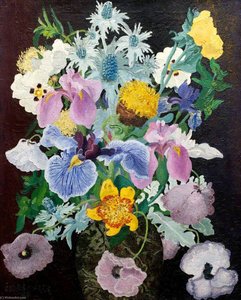
Italian Wild Flowers (1922) by Cedric Morris

Italian Wild Flowers

1922 · Oil

In the quietude of a studio, a bouquet of flowers rests within a dark vase, captured in the 1922 work Italian Wild Flowers. The artist, Cedric Morris, gathers a lively collection of blooms that seem to pulse with life against a muted greenish-blue backdrop. Red poppies, blue forget-me-nots, and purple hyacinths emerge from the arrangement, their colors meeting in a spirited dance of light and shadow. The scene feels immediate,…

8
Atelier Tapisseries, Djerba, Tunisia (1926) by Cedric Morris

Atelier Tapisseries, Djerba, Tunisia

1926 · Acrylic On Canvas · Government Art Collection, London

Cedric Lockwood Morris’s “Atelier Tapisseries, Djerba, Tunisia,” painted in 1926, offers more than just a picturesque scene; it's a vibrant snapshot of daily life within the ancient trading post of Djerba, an island off the coast of North Africa. The painting immediately draws the eye with its sun-drenched palette – ochre yellows, terracotta reds, and deep blues – evoking the intense heat and rich colors characteristic of the Tunisian landscape.…

9
Halcyon (1927) by Cedric Morris

Halcyon

1927 · Oil On Canvas · Norwich Castle Museum And Art Gallery, Norwich

Cedric Lockwood Morris's Halcyon, painted in 1927, isn’t merely a depiction of a beach scene; it’s an arresting meditation on the delicate balance between beauty and danger, tranquility and predation. This oil-on-canvas masterpiece, currently residing within the Norwich Castle Museum & Art Gallery, immediately draws the viewer into its dreamlike atmosphere – a hazy expanse of sand, sea, and sky rendered with a remarkable sensitivity to light and texture. The…

10
Herstmonceux Church, Hailsham, East Sussex (1928) by Cedric Morris

Herstmonceux Church, Hailsham, East Sussex

1928 · Oil · Towner, Eastbourne

In the gentle light of 1928, Sir Cedric Lockwood Morris captured a moment of profound stillness with his painting, Herstmonceux Church, Hailsham, East Sussex. This evocative work serves as more than just a topographical record of a religious landmark; it is an intimate window into the soul of the English countryside. The composition is anchored by the commanding presence of the church’s tall steeple, which rises with a quiet authority…

Cedric Morris's famous paintings, numbers 11 to 67

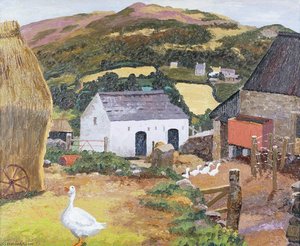
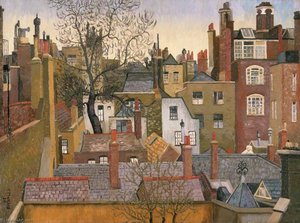
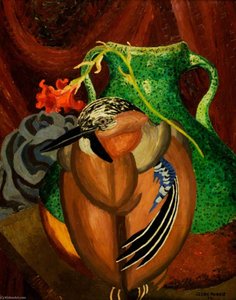
11Rhossili Down (1928) by Cedric MorrisRhossili Down1928 · Llyfrgell Genedlaethol Cymru / The National Library of Wales 12The Farmyard, Dorset (1928) by Cedric MorrisThe Farmyard, Dorset1928 · Harris Museum - Art Gallery 13Mary Butts (1924) by Cedric MorrisMary Butts1924 · Norwich Castle Museum And Art Gallery 14Nancy Morris (1929) by Cedric MorrisNancy Morris1929 · Norwich Castle Museum And Art Gallery 15Jeanette Horowitz (1921) by Cedric MorrisJeanette Horowitz1921 16Patisseries and a Croissant (1922) by Cedric MorrisPatisseries and a Croissant1922 17Birds (1928) by Cedric MorrisBirds1928 18Paul Odo Cross (1925) by Cedric MorrisPaul Odo Cross1925 19Les Ponts de Ceret (1923) by Cedric MorrisLes Ponts de Ceret1923 20From a Window at 45 Brook Street, London, W1 (1926) by Cedric MorrisFrom a Window at 45 Brook Street, London, W11926 21Breton Landscape (1927) by Cedric MorrisBreton Landscape1927 22Landscape Vallée de L'Ouvéze (1925) by Cedric MorrisLandscape Vallée de L'Ouvéze1925 23Heritage of the Desert (1925) by Cedric MorrisHeritage of the Desert1925 24Golden Auntie (1923) by Cedric MorrisGolden Auntie1923 25Summer Flowers (1928) by Cedric MorrisSummer Flowers1928 26Harding Down, Llangynwyd, Bridgend (1928) by Cedric MorrisHarding Down, Llangynwyd, Bridgend1928 27Llanmadoc Hill, Gower (1928) by Cedric MorrisLlanmadoc Hill, Gower1928 28Experiment in Textures (1923) by Cedric MorrisExperiment in Textures1923 29The Jay (1924) by Cedric MorrisThe Jay1924 30The Sparrow Hawks (1929) by Cedric MorrisThe Sparrow Hawks1929 31Crickhowell (1933) by Cedric MorrisCrickhowell1933 32Portinho da Arrábida (1930) by Cedric MorrisPortinho da Arrábida1930 33Llangennith Church, Swansea (1930) by Cedric MorrisLlangennith Church, Swansea1930 34Floreat (1933) by Cedric MorrisFloreat1933 35Drakes (1930) by Cedric MorrisDrakes1930 36Proud Lilies (1931) by Cedric MorrisProud Lilies1931 · Towner 37Cedric Morris (1930) by Cedric MorrisCedric Morris1930 38Polstead, Suffolk (1933) by Cedric MorrisPolstead, Suffolk1933 39Helen's Pot (1936) by Cedric MorrisHelen's Pot1936 40Shags (1938) by Cedric MorrisShags1938 41(George) Loraine Conran (1912–1986) (1934) by Cedric Morris(George) Loraine Conran (1912–1986)1934 42Lougher from Penclawdd (1936) by Cedric MorrisLougher from Penclawdd1936 43Gladys Hynes (1888–1958) (1936) by Cedric MorrisGladys Hynes (1888–1958)1936 44Dowlais from the Cinder Tips, Caeharris (1935) by Cedric MorrisDowlais from the Cinder Tips, Caeharris1935 45Two Sisters (1935) by Cedric MorrisTwo Sisters1935 46Solva, Pembrokeshire (1934) by Cedric MorrisSolva, Pembrokeshire1934 47The Serpentine Pot (1938) by Cedric MorrisThe Serpentine Pot1938 · Aberystwyth University School of Art Museum And Galleries 48David and Barbara Carr (1940) by Cedric MorrisDavid and Barbara Carr1940 49Heron (1941) by Cedric MorrisHeron1941 50Iris Seedlings (1943) by Cedric MorrisIris Seedlings1943 51Lucian Freud (1941) by Cedric MorrisLucian Freud1941 52Stoke by Nayland Church (1940) by Cedric MorrisStoke by Nayland Church1940 53Peregrine Falcons (1942) by Cedric MorrisPeregrine Falcons1942 54Connemara Landscape, Ireland (1940) by Cedric MorrisConnemara Landscape, Ireland1940 · Shrewsbury College of Arts - Technology 55Pontypridd (1945) by Cedric MorrisPontypridd1945 56Belle of Bloomsbury (1948) by Cedric MorrisBelle of Bloomsbury1948 57The Eggs (1944) by Cedric MorrisThe Eggs1944 58River Zezere, Portugal (1950) by Cedric MorrisRiver Zezere, Portugal1950 59French Partridge (1934) by Cedric MorrisFrench Partridge1934 · Pallant House Gallery 60Monchique Foothills, Algarve by Cedric MorrisMonchique Foothills, AlgarveThe New Art Gallery Walsall 61Flowers by Cedric MorrisFlowers 62Lake Pátzcuaro, Mexico by Cedric MorrisLake Pátzcuaro, Mexico 63Lake Pátzcuaro by Cedric MorrisLake Pátzcuaro 64Near Cagnes by Cedric MorrisNear Cagnes 65Ducks by Cedric MorrisDucks 66Mottled Iris by Cedric MorrisMottled Iris 67The Scilly Packet Boat by Cedric MorrisThe Scilly Packet BoatThe New Art Gallery Walsall

Cedric Morris's famous paintings, period by period

The subjects that held Cedric Morris's eye

The four subjects that come back most often in these originals, each with its finest example.

The museums that keep Cedric Morris's originals

The 8 museums that hold the most of the paintings on this page.

Museum City Works by Cedric Morris Paintings from this list
Norwich Castle Museum And Art Gallery, NorwichNorwich Castle Museum And Art Gallery Norwich 3 Halcyon, Mary Butts, Nancy Morris
Government Art Collection, LondonGovernment Art Collection London 2 Angus Davidson (1898–1980), Writer and Publisher, Atelier Tapisseries, Djerba, Tunisia
Towner, EastbourneTowner Eastbourne 2 Herstmonceux Church, Hailsham, East Sussex, Proud Lilies
The New Art Gallery Walsall, WalsallThe New Art Gallery Walsall Walsall 2 Monchique Foothills, Algarve, The Scilly Packet Boat
Llyfrgell Genedlaethol Cymru / The National Library of Wales, AberystwythLlyfrgell Genedlaethol Cymru / The National Library of Wales Aberystwyth 1 Rhossili Down
Harris Museum - Art Gallery, PrestonHarris Museum - Art Gallery Preston 1 The Farmyard, Dorset
Aberystwyth University School of Art Museum And Galleries, AberystwythAberystwyth University School of Art Museum And Galleries Aberystwyth 1 The Serpentine Pot
Shrewsbury College of Arts - Technology, ShropshireShrewsbury College of Arts - Technology Shropshire 1 Connemara Landscape, Ireland

Cedric Morris across the decades: one unique original for each

Works per decade

Pick a decade to see the original that defines it.

Cedric Morris's paintings: questions for the gallery

What is the single most famous work of Cedric Morris?Reveal the answer

Italian Wild Flowers (1922). Caeharris Post Office from Gwernlwyn House (1935) and Self Portrait (1919) come next.

At what age did Cedric Morris create Italian Wild Flowers?Reveal the answer

33 years old: Italian Wild Flowers dates from 1922, and Cedric Morris was born in 1889.

Which ten paintings by Cedric Morris are the most famous?Reveal the answer

Italian Wild Flowers, Caeharris Post Office from Gwernlwyn House, Self Portrait, The Swiss Visitor, Brocas Harris, Angus Davidson (1898–1980), Writer and Publisher, Antonia White, Atelier Tapisseries, Djerba, Tunisia, Halcyon and Herstmonceux Church, Hailsham, East Sussex. The ranking above gives each one's year and museum.

How many works by Cedric Morris are known?Reveal the answer

Our catalog holds 71 works by Cedric Morris, dated from 1919 to 1950.

Where can the most famous Cedric Morris originals be seen?Reveal the answer

Mostly in Norwich Castle Museum And Art Gallery (Norwich), Government Art Collection (London) and Towner (Eastbourne). The museum table above lists them all.

During which period did Cedric Morris create the best-known paintings?Reveal the answer

In 1920s: 27 of the 67 works on this page were made then, Italian Wild Flowers among them.

Which famous Cedric Morris painting is the earliest, and which the latest?Reveal the answer

On this page, the earliest is Self Portrait (1919) and the latest River Zezere, Portugal (1950).

What subjects did Cedric Morris favour?Reveal the answer

Landscape (8), British art (6) and Rural scene (5), across the 67 works on this page.

What materials did Cedric Morris paint with most?Reveal the answer

Oil On Canvas, for 6 of the 67 works on this page.

Which movement does the work of Cedric Morris belong to?Reveal the answer

Impressionism, judging by the originals on this page.

What Cedric Morris originals can I see at the Norwich Castle Museum And Art Gallery?Reveal the answer

Halcyon, Mary Butts and Nancy Morris: the Norwich Castle Museum And Art Gallery, Norwich holds 3 of the works on this page.

Cedric Morris: a portrait of the artist

A Life Rooted in Colour: The World of Cedric Lockwood Morris

Sir Cedric Lockwood Morris, born December 11, 1889, in Sketty, Swansea, was a figure who defied easy categorization. Descended from a lineage connected to the founders of the Dulwich Picture Gallery, his early life hinted at privilege and tradition, yet he embarked on a path that led him far from conventional expectations. The son of George Lockwood Morris, an industrialist and celebrated rugby international, and Wilhelmina Cory, Cedric’s upbringing was steeped in both physical prowess and artistic sensibility – a duality that would profoundly shape his creative journey. Initial attempts at a military commission proved unsuccessful, leading to periods of wandering and work across Canada and New York City before he ultimately found himself drawn towards the burgeoning art scene of early 20th-century Paris. A brief foray into musical studies at the Royal College of Music in London was quickly superseded by an undeniable calling to paint, marking a pivotal shift in his life’s direction.

From Parisian Studios to East Anglian Landscapes

Morris's formal artistic training began at the Académie Delécluse in Montparnasse in 1914, a period of intense creative ferment. The outbreak of World War I interrupted this study; deemed unfit for combat due to a childhood operation, he served with the Artists’ Rifles before being assigned to train horses – an experience that undoubtedly honed his keen observation of animal form and movement. It was in 1918 that a defining relationship blossomed: his partnership with Arthur Lett-Haines. This artistic and personal alliance would prove central to Morris's life and work, fostering a collaborative spirit that extended beyond their individual canvases. Early influences were drawn from Impressionism and Post-Impressionism, visible in his initial landscapes and portraits, but these foundations soon gave way to a uniquely expressive style. The vibrant hues and bold brushwork that would become his signature began to emerge as he increasingly focused on the natural world around him, particularly the East Anglian countryside after settling there with Lett-Haines. He wasn’t merely depicting what he saw; he was conveying its *feeling*, its essence.

A Celebration of Flora and a Legacy of Teaching

Cedric Lockwood Morris is perhaps best remembered for his captivating flower paintings. These weren't botanical illustrations in the traditional sense, but rather intensely personal interpretations of blooms – explosions of colour and texture that captured their fleeting beauty with remarkable vitality. Critics often likened his work to that of Van Gogh or Utrillo, but accessible to a wider audience— “a Van Gogh or Utrillo for those of modest means,” as one commentator noted. Beyond flowers, Morris produced numerous portraits, revealing a talent for capturing the character and personality of his sitters, and landscapes imbued with an expressive energy. A significant chapter in his career unfolded in 1935 when he was commissioned to paint large-scale flower murals aboard the luxurious ocean liner Queen Mary, bringing his vibrant vision to a wider public. However, perhaps his most enduring legacy lies in co-founding the East Anglian School of Painting and Drawing at Benton End, Suffolk, with Lett-Haines in 1937. This school became a haven for aspiring artists, including luminaries such as Lucian Freud and Maggi Hambling, emphasizing feeling and personal expression over strict academic representation – a philosophy that profoundly influenced a generation of British artists.

Later Years and Rediscovered Recognition

Despite his earlier successes, Morris experienced a period of relative obscurity following World War II. However, in the later years of his life, a renewed appreciation for his work began to emerge. His political activism with the Hadleigh Labour Party in the late 1930s reflected a broader engagement with social issues, adding another layer to his complex persona. He died on February 8, 1982, in Hadleigh, Suffolk, leaving behind a body of work that continues to captivate and inspire. Today, Cedric Lockwood Morris is recognized as a significant figure in British art of the 20th century – a unique blend of observation, expression, and an unwavering commitment to his artistic vision. His influence extends beyond his paintings; through the East Anglian School, he fostered a spirit of experimentation and individuality that continues to resonate within the British art world.

Key Facts & Enduring Influence

Morris’s legacy is not simply about the beauty of his paintings; it's about a philosophy of art-making that prioritized personal expression and connection to nature. He was a plantsman as much as an artist, cultivating both his garden and his creative vision with equal dedication. His work serves as a reminder that true artistry lies in seeing the world not just as it is, but as it feels.