1


Updated November 2026 · ranked by our popularity score (searches, visits and orders for each work) · 62 works by Benjamin Barker in our catalogue
In short
To the gallery's eye, Benjamin Barker's most famous painting is The Eagle Tower, Carnarvon Castle (1802), whose original hangs in the The Holburne Museum, Bath. Mr Howell Gwynne and Mr Chas Price at the Meet of Fox Hounds, Garth Bank near Builth Wells (1760) and Huntsman and Hounds (1760) complete the trio every eye recognises. Of the 62 works by Benjamin Barker in our catalog, the gallery presents the 54 most famous below, each original with its year, its museum and what makes it unique.


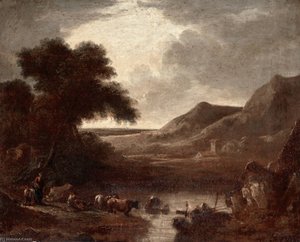
In the quietude of the early nineteenth century, few artists captured the gentle pulse of rural life with as much sincerity as Benjamin Barker II. His masterpiece, A Tarn with Peasants and Cattle, serves as a breathtaking window into a bygone era, where the rhythm of human existence was inextricably linked to the seasonal movements of livestock and the stillness of the natural world. The painting presents a serene mountain…


 Chippenham Mill, Wiltshire1809 · The Holburne Museum
12
 Wooded Landscape with Cattle, Sheep and Peasant Figures by a River1811 · National Trust
13
 Mountain Landscape with View of Snowdon1815 · Bristol Museum - Art Gallery
14
 Fishermen by a Stream in a Rocky Landscape1816 · Government Art Collection
15
 View of a River with Rocks and Trees1815 · National Trust
16
 A Landscape at Wick, Gloucestershire, 'Below the Rocks'1824 · Yale Center for British Art
17
 Landscape with a Bridge1830 · Victoria Art Gallery
18
 Landscape1830 · Government Art Collection
19
 Landscape with a Bridge1830 · Victoria Art Gallery
20
 Town Mills, Totnes, Devon1827
21
 Seascape with a Rocky Coast and a Lighthouse1827 · The Holburne Museum
22
 Pony Cart Crossing a Woodland BrookIndianapolis Museum of Art
23
 River Landscape with a WaterfallThe Holburne Museum
24
 Alpine Scene1803 · Mercer Art Gallery
25
 Landscape with a Bridge and a Winding RiverHolburne Museum
26
 Landscape with a WatermillHolburne Museum
27
 Coast Scene
28
 Landscape with a Cottage and a StreamVictoria Art Gallery
29
 Landscape with FiguresAmgueddfa Cymru
30
 Mountain Valley with a BridgeVictoria Art Gallery
31
 Landscape with a WaterfallHolburne Museum
32
 Mountainous Landscape
33
 Mountain Valley with a BridgeVictoria Art Gallery
34
 Landscape with Figures
35
 River Landscape with Ruined CastleVictoria Art Gallery
36
 Scene in North Wales
37
 Landscape with a Bridge and a Winding RiverThe Holburne Museum
38
 Landscape with Quarries
39
 Self PortraitVictoria Art Gallery
40
 Landscape with CattleVictoria Art Gallery
41
 Italianate Landscape with a Herdsman and Three Sheep and Two Cows under a Rock ArchNational Trust
42
 LandscapeColchester And Ipswich Museum
43
 Landscape with CattleBristol Museum And Art Gallery
44
 Italianate Landscape with a Herdsman and Three Sheep and Two Cows under a Rock ArchHartwell House
45
 View of Snowdon from Capel Curig
46
 Landscape in North WalesBristol Museum - Art Gallery
47
 Landscape with a WatermillThe Holburne Museum
48
 View of Llandysilio Vale, near Llangollen
49
 Landscape with a Waterfall (also known as Richly Clouded Landscape with Waterfall)
50
 Landscape (style of Nicolaes Berchem)The Holburne Museum
51
 SunsetThe Stanley - Audrey Burton Gallery
52
 A Wooded River Landscape with a BridgeThe National Trust For Scotland
53
 View of Weston Church and LansdownThe Holburne Museum
54
 Landscape with a WaterfallThe Holburne Museum
The four subjects that come back most often in these originals, each with its finest example.
The 8 museums that hold the most of the paintings on this page.
| Museum | City | Works by Benjamin Barker | Paintings from this list |
|---|---|---|---|
 Victoria Art Gallery |
Bath | 11 | Joseph Barker (1782–1809), Pevensey Bay and Battle Abbey, Sussex, Country Landscape with Fisherman beside a Lake |
 The Holburne Museum |
Bath | 10 | The Eagle Tower, Carnarvon Castle, A Tarn with Peasants and Cattle, Chippenham Mill, Wiltshire |
 Government Art Collection |
London | 3 | Welsh Landscape with a Bridge, Fishermen by a Stream in a Rocky Landscape, Landscape |
 Holburne Museum |
Bath | 3 | Landscape with a Bridge and a Winding River, Landscape with a Watermill, Landscape with a Waterfall |
 Yale Center for British Art |
New Haven | 2 | View of the River Severn, near King's Weston, Seat of Lord de Clifford, A Landscape at Wick, Gloucestershire, 'Below the Rocks' |
 Bristol Museum - Art Gallery |
Bristol | 2 | Mountain Landscape with View of Snowdon, Landscape in North Wales |
 National Trust |
Aylesbury | 2 | View of a River with Rocks and Trees, Italianate Landscape with a Herdsman and Three Sheep and Two Cows under a Rock Arch |
 National Trust |
Bodmin | 1 | Wooded Landscape with Cattle, Sheep and Peasant Figures by a River |
Pick a decade to see the original that defines it.

In the quietude of the early nineteenth century, few artists captured the gentle pulse of rural life with as much sincerity as Benjamin Barker II. His masterpiece, A Tarn with Peasants and Cattle, serves as a breathtaking window into a bygone era, where the rhythm of human existence was inextricably linked to the seasonal movements of livestock and the stillness of the natural world. The painting presents a serene mountain…
The Eagle Tower, Carnarvon Castle (1802), The Holburne Museum, Bath. Mr Howell Gwynne and Mr Chas Price at the Meet of Fox Hounds, Garth Bank near Builth Wells (1760) and Huntsman and Hounds (1760) come next.
26 years old: The Eagle Tower, Carnarvon Castle dates from 1802, and Benjamin Barker was born in 1776.
The Eagle Tower, Carnarvon Castle, Mr Howell Gwynne and Mr Chas Price at the Meet of Fox Hounds, Garth Bank near Builth Wells, Huntsman and Hounds, A Tarn with Peasants and Cattle, Joseph Barker (1782–1809), Welsh Landscape with a Bridge, View of the River Severn, near King's Weston, Seat of Lord de Clifford, Pevensey Bay and Battle Abbey, Sussex, Travellers Attacked by Robbers and Country Landscape with Fisherman beside a Lake. The ranking above gives each one's year and museum.
Our catalog holds 62 works by Benjamin Barker, dated from 1800 to 1833.
Mostly in Victoria Art Gallery (Bath), The Holburne Museum (Bath) and Government Art Collection (London). The museum table above lists them all.
In 1810s: 7 of the 54 works on this page were made then, Pevensey Bay and Battle Abbey, Sussex among them.
On this page, the earliest is Joseph Barker (1782–1809) (1800) and the latest A Tarn with Peasants and Cattle (1833).
Landscape (5), Mountains (4) and River (3), across the 54 works on this page.
Oil On Canvas, for 2 of the 54 works on this page.
Romanticism, judging by the originals on this page.
Joseph Barker (1782–1809), Pevensey Bay and Battle Abbey, Sussex and Country Landscape with Fisherman beside a Lake: the Victoria Art Gallery, Bath holds 11 of the works on this page.