Portrait of Baldassare Peruzzi

The 18 Most Famous Baldassare Peruzzi Paintings, a Gallery Selection

Updated November 2026 · ranked by our popularity score (searches, visits and orders for each work) · 18 works by Baldassare Peruzzi in our catalogue

In short

Of all the originals Baldassare Peruzzi left, the most famous is Ceiling decoration (Volta Dorata) (1519), in the collection of the Palazzo della Cancellaria, Rome. Close behind it come Apollo and the Muses (1514) and Palazzo Massimo alle Colonne (1532). Our catalog holds 18 works by Baldassare Peruzzi; the gallery has kept the 18 the world admires most, each shown with its date, its museum and its story.

1481 – 1536, Siena High renaissance Most works: Villa Farnesina

Baldassare Peruzzi's top 10 paintings: the gallery's choice

1
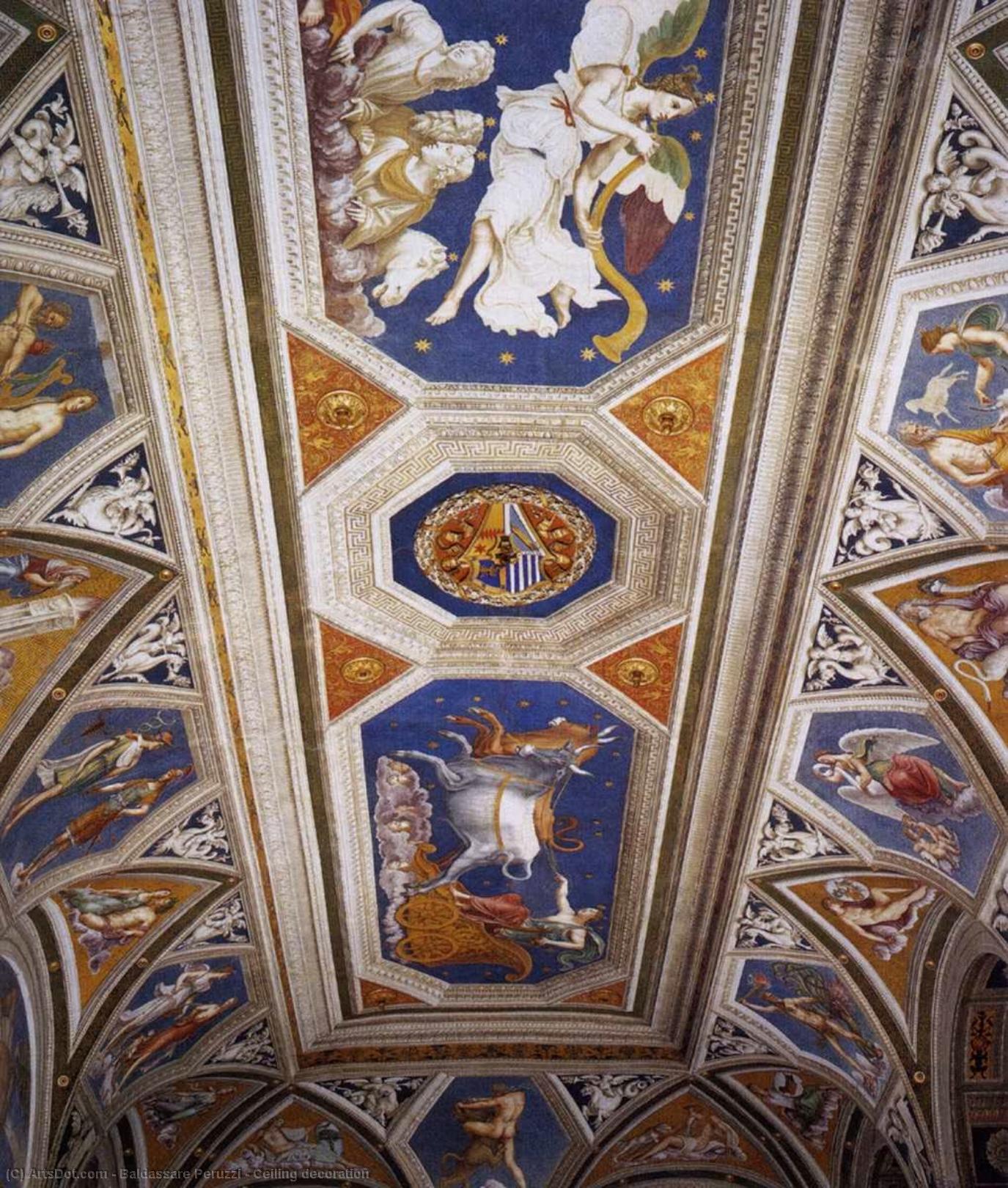
Ceiling decoration (Volta Dorata) (1519) by Baldassare Peruzzi

Ceiling decoration (Volta Dorata)

1519 · Acrylic On Canvas · Palazzo della Cancellaria, Rome

Baldassare Peruzzi (1481-1536), a Florentine architect and painter, stands as an emblem of the High Renaissance's ambition to transcend mere representation, achieving instead a breathtaking illusion of grandeur. His magnum opus, ‘Ceiling Decoration’ – more commonly known as Volta Dorata – commissioned for Villa Farnesina in Rome around 1519, exemplifies this masterful approach, cementing his place amongst the titans of artistic innovation.

2
Apollo and the Muses (1514) by Baldassare Peruzzi

Apollo and the Muses

1514 · Oil

The artwork presents a group of nude figures arranged in a circular formation, engaged in a rhythmic dance. These figures are tightly packed, creating a dense and energetic composition that fills the frame. The scene is set outdoors upon a textured surface, possibly a stone terrace or a pathway, which provides a rugged backdrop to the smooth contours of the human forms. The figures are rendered with a focus on…

3
Palazzo Massimo alle Colonne (1532) by Baldassare Peruzzi

Palazzo Massimo alle Colonne

1532 · Photography

The Palazzo Massimo alle Colonne is a significant architectural work by Baldassare Peruzzi. Commissioned by Pietro Massimo, the structure rose from the site of an earlier palace destroyed during the Sack of Rome in 1527. It occupies a prominent position on the 19th-century Corso Vittorio Emanuele. The building serves as the principal residence for the Massimo family.

4
Decoration of the Sala delle Prospettive (1515) by Baldassare Peruzzi

Decoration of the Sala delle Prospettive

1515 · Fresco · Villa Farnesina, Rome

The walls of the Sala delle Prospettive do not merely enclose a room; they dissolve. Within the Villa Farnesina in Rome, Baldassare Peruzzi orchestrates a grand deception that pulls the viewer through solid stone and into an imagined world. One feels the sudden, startling expansion of space as the eye travels past painted marble columns and through soaring arches. This is the art of trompe l'oeil, where color and shadow…

5
Perspective view of the Sala delle Prospettive (1515) by Baldassare Peruzzi

Perspective view of the Sala delle Prospettive

1515 · Fresco · Villa Farnesina, Rome

The walls of the Sala delle Prospettive do not merely enclose a room; they dissolve. Within the Villa Farnesina in Rome, Baldassare Peruzzi orchestrates a grand deception that pulls the viewer through solid stone and into an imagined world. One feels a sudden expansion of space as the eye travels past painted marble columns and through soaring arches. This is the art of trompe l'oeil, where color and shadow conspire…

6
Perseus and Pegasus (1510) by Baldassare Peruzzi

Perseus and Pegasus

1510 · Fresco · Villa Farnesina, Rome

The fresco painting titled Perseus and Pegasus emerged from the brush of Baldassare Peruzzi. It was executed around 1510, a moment when the walls of the Villa Farnesina in Rome, Italy, were receiving their first layers of color and intent. This residence was built for Agostino Chigi, a Sienese banker and treasurer to the Pope. The structure itself rose between 1506 and 1510, a period of intense creation within the…

7
Ceiling decoration (1511) by Baldassare Peruzzi

Ceiling decoration

1511 · Fresco · Villa Farnesina, Rome

The artwork titled Ceiling decoration, also known as Volta Dorata, is a fresco by the artist Baldassare Peruzzi. Peruzzi, who was born in 1481 and died in 1536, executed this work around 1519. The piece was originally commissioned for the Villa Farnesina in Rome. It is currently located at the Palazzo della Cancellaria in Rome, Italy.

8
Wall paintings (1504) by Baldassare Peruzzi

Wall paintings

1504 · Fresco · Sant'Onofrio, Rome

To step into this space is to witness the intersection of structural geometry and spiritual narrative. The frescoes, dating from 1504, wrap around the interior of the church, transforming the stone and plaster into a celestial vision. The central dome commands the eye, its base adorned with intricate patterns and figures that seem to support the heavens themselves. Light enters from the side, washing over the walls and creating a…

9
Perspective view of the Sala delle Prospettive (1515) by Baldassare Peruzzi

Perspective view of the Sala delle Prospettive

1515 · Fresco · Villa Farnesina, Rome

The Perspective view of the Sala delle Prospettive by Baldassare Peruzzi invites the eye into a space where the boundaries of architecture begin to dissolve. Created about 1515, this work transforms a physical room into a grand illusion of depth and light. The artist, Baldassare Peruzzi, uses his mastery of perspective to craft a scene that feels as though it extends far beyond the actual walls of the structure.

10
View of the Loggia di Galatea (1510) by Baldassare Peruzzi

View of the Loggia di Galatea

1510 · Fresco · Villa Farnesina, Rome

View of the Loggia di Galatea is a work by Baldassare Peruzzi, created about 1510. This architectural view is part of the decorative program of the Villa Farnesina in Rome, Italy. The structure, also known as Villa Chigi, was commissioned by Agostino Chigi.

The Baldassare Peruzzi selection continues, 11 to 18

Baldassare Peruzzi's famous paintings, period by period

The subjects that held Baldassare Peruzzi's eye

The four subjects that come back most often in these originals, each with its finest example.

The museums that keep Baldassare Peruzzi's originals

The 5 museums that hold the most of the paintings on this page.

Museum City Works by Baldassare Peruzzi Paintings from this list
Villa Farnesina, RomeVilla Farnesina Rome 8 Decoration of the Sala delle Prospettive, Perspective view of the Sala delle Prospettive, Perseus and Pegasus
Palazzo della Cancellaria, RomePalazzo della Cancellaria Rome 1 Ceiling decoration (Volta Dorata)
Sant'Onofrio, RomeSant'Onofrio Rome 1 Wall paintings
Santa Maria dell'Anima, RomeSanta Maria dell'Anima Rome 1 Tomb of Pope Hadrian VI
Metropolitan Museum of Art, New YorkMetropolitan Museum of Art New York 1 Frescoes from the Villa Stati-Mattei

Baldassare Peruzzi decade by decade: the original that defines each

Works per decade

Pick a decade to see the original that defines it.

Collectors' questions about Baldassare Peruzzi's paintings

Which work is Baldassare Peruzzi most famous for?Reveal the answer

Ceiling decoration (Volta Dorata) (1519), Palazzo della Cancellaria, Rome. Apollo and the Muses (1514) and Palazzo Massimo alle Colonne (1532) come next.

What age was Baldassare Peruzzi when Ceiling decoration (Volta Dorata) was made?Reveal the answer

38 years old: Ceiling decoration (Volta Dorata) dates from 1519, and Baldassare Peruzzi was born in 1481.

What are the ten most famous Baldassare Peruzzi paintings?Reveal the answer

Ceiling decoration (Volta Dorata), Apollo and the Muses, Palazzo Massimo alle Colonne, Decoration of the Sala delle Prospettive, Perspective view of the Sala delle Prospettive, Perseus and Pegasus, Ceiling decoration, Wall paintings, Perspective view of the Sala delle Prospettive and View of the Loggia di Galatea. The ranking above gives each one's year and museum.

How many paintings did Baldassare Peruzzi leave?Reveal the answer

Our catalog holds 18 works by Baldassare Peruzzi, dated from 1504 to 1532.

In which museums do Baldassare Peruzzi's masterpieces hang?Reveal the answer

Mostly in Villa Farnesina (Rome), Palazzo della Cancellaria (Rome) and Sant'Onofrio (Rome). The museum table above lists them all.

In which years did Baldassare Peruzzi paint the most famous works?Reveal the answer

In 1510s: 9 of the 18 works on this page were made then, Ceiling decoration (Volta Dorata) among them.

What are the first and the last famous originals of Baldassare Peruzzi?Reveal the answer

On this page, the earliest is Wall paintings (1504) and the latest Palazzo Massimo alle Colonne (1532).

Which subjects did Baldassare Peruzzi choose most often?Reveal the answer

Architecture (7), Columns (4) and Figures (3), across the 18 works on this page.

Which technique did Baldassare Peruzzi use most?Reveal the answer

Fresco, for 8 of the 18 works on this page.

To which art movement does Baldassare Peruzzi belong?Reveal the answer

High renaissance, judging by the originals on this page.

Which Baldassare Peruzzi works hang at the Villa Farnesina?Reveal the answer

Decoration of the Sala delle Prospettive, Perspective view of the Sala delle Prospettive and Perseus and Pegasus: the Villa Farnesina, Rome holds 8 of the works on this page.

Baldassare Peruzzi: life and work

Baldassare Peruzzi: Architect of Illusion and Renaissance Grandeur

Baldassare Tommaso Peruzzi, born in the small town of Ancaiano near Siena in 1481 and tragically dying in Rome in 1536, stands as a pivotal figure bridging the High Renaissance and the burgeoning Mannerist style. More than simply an architect or painter, Peruzzi was a master of illusion, a visionary who sought to blur the boundaries between reality and artifice, creating spaces that seemed to breathe with life and grandeur. His legacy is inextricably linked to the Villa Farnesina in Rome, but his influence extended far beyond this single commission, shaping the aesthetic landscape of his time. Peruzzi’s early career was rooted in Siena, a city renowned for its artistic tradition. He began as a painter, honing his skills within the established workshops and traditions of the region. However, it was his fascination with perspective and architectural design that truly set him apart. He wasn't content to merely depict buildings; he aimed to *transform* them, to create an illusion of limitless space and breathtaking scale. This ambition led him to Rome in the early 1500s, where he quickly gained recognition for his innovative approach. He initially worked under the tutelage of established masters like Bramante, absorbing their techniques while simultaneously forging his own distinctive style. His association with Raphael proved particularly fruitful, as Peruzzi learned from the great painter’s mastery of color and composition, further informing his architectural designs.

The Villa Farnesina: A Masterpiece of Illusion

Peruzzi's most celebrated achievement is undoubtedly the design and decoration of the Villa Farnesina, a lavish residence commissioned by Cardinal Agostino Chigi in 1506. This villa represents a radical departure from traditional Renaissance architecture, showcasing Peruzzi’s pioneering use of *quadratura*, or illusionistic painting. The exterior walls are adorned with intricate frescoes that extend seamlessly into the surrounding landscape, creating an astonishing sense of depth and perspective. The façade itself appears to flow outwards, defying conventional architectural constraints. Within the villa, the Sala delle Prospettive is a testament to Peruzzi’s genius – a meticulously crafted illusion of an open-air terrace overlooking a vast, idealized countryside. The use of vanishing points, carefully calculated angles, and subtle shifts in color create a remarkably convincing effect, transporting the viewer beyond the confines of the room. This wasn't simply decoration; it was a fundamental rethinking of how architecture could engage with space and perception. The influence of Melozzo da Forlì and Mantegna is evident here, but Peruzzi masterfully integrated these influences into his own unique vision.

Architectural Innovations and the St. Peter’s Project

Beyond the Villa Farnesina, Peruzzi played a crucial role in the ambitious construction of St. Peter's Basilica. Following Raphael’s death, he was appointed as one of the architects responsible for overseeing the project, working closely with Antonio da Sangallo the Younger. Peruzzi contributed significantly to the basilica’s design, particularly in the development of its complex plan and the intricate detailing of its façade. He also experimented with innovative techniques for creating illusionistic effects within the vast interior spaces. His work on the Belvedere Court, a courtyard adjacent to St. Peter's, demonstrates his ability to adapt architectural principles to unusual sites, curving the facade to seamlessly integrate with the surrounding road. This showcased his understanding of urban planning and his willingness to challenge conventional design norms.

Beyond Rome: Siena and the Defense of the City

Following the Sack of Rome in 1527, Peruzzi returned to his native Siena, where he was tasked with strengthening the city’s defenses against potential invaders. This period marked a shift in his architectural focus, as he designed a series of impressive bastions – fortified structures strategically positioned along Siena's walls. These bastions were not merely defensive installations; they were works of art in their own right, incorporating intricate decorative elements and showcasing Peruzzi’s mastery of perspective and illusionistic painting. The bastions near San Viene and Camollia stand as enduring testaments to his ingenuity and skill.

Legacy and Influence

Baldassare Peruzzi's legacy extends far beyond the specific buildings he designed. He was a pioneer in the field of *quadratura*, fundamentally altering the way architects approached space and illusion. His innovative use of perspective, axonometry, and illusionistic painting influenced generations of artists and architects who followed. His meticulous drawings, particularly those related to St. Peter’s Basilica, provide invaluable insights into his design process and demonstrate his remarkable attention to detail. While often overshadowed by the brilliance of Raphael and Bramante, Baldassare Peruzzi deserves recognition as a key figure in the development of Renaissance art and architecture—a master who dared to transform reality through the power of illusion.