Portrait of Aurèle Robert

Aurèle Robert Paintings: The 17 Most Famous, Through a Gallery's Eye

Updated November 2026 · ranked by our popularity score (searches, visits and orders for each work) · 18 works by Aurèle Robert in our catalogue

In short

To the gallery's eye, Aurèle Robert's most famous painting is The pifferari in front of the Madonna (1829). The Origin of Music (1845) and The Triumph of Music (1845) complete the trio every eye recognises. Of the 18 works by Aurèle Robert in our catalog, the gallery presents the 17 most famous below, each original with its year, its museum and what makes it unique.

1805 – 1871, Les Éplatures Most works: Wimpole Hall

The gallery's top 10 Aurèle Robert paintings

1
The pifferari in front of the Madonna (1829) by Aurèle Robert

The pifferari in front of the Madonna

1829 · Oil

The pifferari in front of the Madonna emerges from the brush of Aurèle Robert, a painter whose hand captures a quiet, devotional moment. This oil on canvas work, created about 1829, holds a vertical presence that draws the eye upward. The scene feels suspended in time, as if the musicians have just paused their melody to look toward something unseen.

2
The Origin of Music (1845) by Aurèle Robert

The Origin of Music

1845 · Oil On Canvas · Wimpole Hall

The scene unfolds within a gentle arc, an arched composition that frames a lush and idyllic landscape. At the heart of this gathering, a group of cherubic figures clusters around a young figure. This central figure holds a lyre or a similar musical instrument, anchoring the movement of the surrounding crowd. The arrangement follows a soft, panoramic curve, drawing the eye through a gathering of celestial beings caught in a…

3
The Triumph of Music (1845) by Aurèle Robert

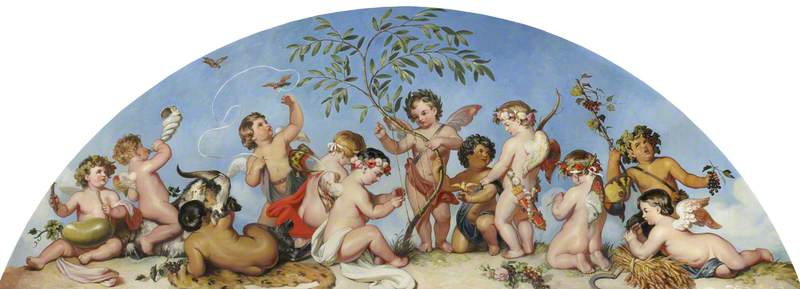
The Triumph of Music

1845 · Oil On Canvas · Wimpole Hall

The composition unfolds in a sweeping arc, designed to inhabit a curved space such as a lunette or ceiling. Within this semi-circular arrangement, a multitude of cherubic figures interact with symbolic animals and musical instruments. The scene is one of movement and celebration, where draped figures in shades of red, blue, and yellow engage in various musical activities. A lion rests on the left, adorned with floral garlands, while a…

4
Masters Boydell Sidney Graves (1844) by Aurèle Robert

Masters Boydell Sidney Graves

1844 · Oil On Canvas

In the vintage oil painting Masters Boydell Sidney Graves by Aurèle Robert, a quiet moment unfolds within an interior setting. The scene centers on two young children, a girl and a boy, who inhabit the space with a sense of stillness. The girl is positioned slightly to the left, her presence anchoring one side of the frame, while the boy sits upon a chair to the right. This arrangement creates…

5
A Funeral Bearer (1840) by Aurèle Robert

A Funeral Bearer

1840 · Oil On Canvas

In A Funeral Bearer by Aurèle Robert, the viewer is met with a quiet, centered portrait of a gentleman. The composition focuses entirely on the figure, which is presented within an oval frame that lends a sense of formality and isolation to the subject. He is dressed in full formal attire, including a black top hat, a tailcoat, a waistcoat, trousers, and boots. To complete his ensemble, he carries a…

6
Benjamin Webster as Apollo Belvi in 'Killing No Murder' by Theodore Hook (1831) by Aurèle Robert

Benjamin Webster as Apollo Belvi in 'Killing No Murder' by Theodore Hook

1831 · Oil · Theatre Royal, Bath

In the vibrant tapestry of nineteenth-century performance art, few images capture the electric atmosphere of the stage as vividly as Robert William Buss’s 1831 masterpiece, Benjamin Webster as Apollo Belvi in 'Killing No Murder' by Theodore Hook. This captivating portrait serves as a window into the golden age of the British theatre, transporting the viewer directly to the Theatre Royal in Bath. The painting centers on the charismatic Benjamin Webster,…

7
John Cooper as Captain Mouth in 'The Bride of Ludgate' by Aurèle Robert

John Cooper as Captain Mouth in 'The Bride of Ludgate'

Acrylic On Canvas · University of Bristol, Бристоль

Robert William Buss’s “John Cooper as Captain Mouth in ‘The Bride of Ludgate’” is a captivating portrait that transcends mere representation, embodying the grandeur and theatricality characteristic of Baroque art. Executed around 1927, this piece hails from the University of Bristol Theatre Collection, offering a glimpse into the artistic sensibilities of the early 20th century amidst a fascination with operatic performance.

Aurèle Robert paintings, ranked 11 to 17

Aurèle Robert's famous paintings, period by period

The subjects that held Aurèle Robert's eye

The four subjects that come back most often in these originals, each with its finest example.

The museums that keep Aurèle Robert's originals

The 8 museums that hold the most of the paintings on this page.

Museum City Works by Aurèle Robert Paintings from this list
Wimpole HallWimpole Hall 2 The Origin of Music, The Triumph of Music
Theatre Royal, BathTheatre Royal Bath 1 Benjamin Webster as Apollo Belvi in 'Killing No Murder' by Theodore Hook
University of Bristol, БристольUniversity of Bristol Бристоль 1 John Cooper as Captain Mouth in 'The Bride of Ludgate'
Holburne Museum, BathHolburne Museum Bath 1 J. B. Buckstone as Spado in 'The Castle of Andalusia' by John O'Keefe, Haymarket Theatre, 1833
The Holburne Museum, BathThe Holburne Museum Bath 1 J. B. Buckstone as Spado in 'The Castle of Andalusia' by John O'Keefe, Haymarket Theatre, 1833
Guildhall Art Gallery, LondonGuildhall Art Gallery London 1 The Crowd
Borough Museum - Art Gallery, New South WalesBorough Museum - Art Gallery New South Wales 1 The Mock Mayor
Walker Art Gallery, LiverpoolWalker Art Gallery Liverpool 1 Scene from 'Don Juan'

Aurèle Robert, one signature painting per decade

Works per decade

Pick a decade to see the original that defines it.

Aurèle Robert's paintings: the gallery answers

Which Aurèle Robert painting is the most famous of all?Reveal the answer

The pifferari in front of the Madonna (1829). The Origin of Music (1845) and The Triumph of Music (1845) come next.

How old was Aurèle Robert on completing The pifferari in front of the Madonna?Reveal the answer

24 years old: The pifferari in front of the Madonna dates from 1829, and Aurèle Robert was born in 1805.

Which are Aurèle Robert's top 10 paintings?Reveal the answer

The pifferari in front of the Madonna, The Origin of Music, The Triumph of Music, Masters Boydell Sidney Graves, A Funeral Bearer, Benjamin Webster as Apollo Belvi in 'Killing No Murder' by Theodore Hook, John Cooper as Captain Mouth in 'The Bride of Ludgate', J. B. Buckstone as Spado in 'The Castle of Andalusia' by John O'Keefe, Haymarket Theatre, 1833, J. B. Buckstone as Spado in 'The Castle of Andalusia' by John O'Keefe, Haymarket Theatre, 1833 and A Funeral Bearer. The ranking above gives each one's year and museum.

How many works did Aurèle Robert create?Reveal the answer

Our catalog holds 18 works by Aurèle Robert, dated from 1829 to 1847.

Where do Aurèle Robert's most famous originals hang?Reveal the answer

Mostly in Wimpole Hall, Theatre Royal (Bath) and University of Bristol (Бристоль). The museum table above lists them all.

When did Aurèle Robert create the most famous paintings?Reveal the answer

In 1840s: 7 of the 17 works on this page were made then, The Origin of Music among them.

Which are Aurèle Robert's earliest and latest famous works?Reveal the answer

On this page, the earliest is The pifferari in front of the Madonna (1829) and the latest The Crowd (1847).

Which subjects did Aurèle Robert return to most?Reveal the answer

Sky (2), Cherubs (2) and Foliage (2), across the 17 works on this page.

Which medium did Aurèle Robert work in most?Reveal the answer

Oil On Canvas, for 4 of the 17 works on this page.

Which Aurèle Robert originals does the Wimpole Hall hold?Reveal the answer

The Origin of Music and The Triumph of Music: the Wimpole Hall holds 2 of the works on this page.

Aurèle Robert: the artist

A Victorian Life in Art: The World of Robert William Buss

Robert William Buss, born in the bustling heart of London in 1804, was a quintessential product of his era – a versatile artist navigating the shifting currents of Victorian taste and ambition. His life story is one woven with threads of artistic dedication, familial support, and a touch of poignant regret. From his earliest days amidst the tools of his father’s engraving workshop to his later explorations of literary illustration, Buss embodied the industrious spirit and diverse skillset valued in 19th-century Britain. He wasn't merely a painter; he was an etcher, a portraitist, a historical scene-setter, and a devoted family man whose legacy extends beyond the canvas into the realm of educational reform.

Early Training and Theatrical Beginnings

Buss’s artistic journey began within the family trade. His father, a master engraver and enameller, provided an initial immersion in craftsmanship that would inform his later work. This practical foundation was then augmented by formal training under George Clint, a respected figure known for his miniatures, watercolours, and mezzotint engravings. Clint’s influence instilled in Buss a command of diverse techniques – a crucial asset in a period where artists were expected to be proficient across multiple mediums. Initially, Buss found success capturing the likenesses of prominent actors. The theatre world provided both subject matter and patronage; his portraits of William Charles Macready, John Pritt Harley, and John Baldwin Buckstone demonstrate a keen eye for character and an ability to translate stage presence onto canvas. These early works weren’t simply representations but rather celebrations of Victorian theatrical culture, capturing the glamour and drama of the era's most celebrated performers.

The *Pickwick Papers* and Literary Aspirations

A pivotal moment – and a source of lifelong disappointment – arrived with the commission to illustrate Charles Dickens’ *The Pickwick Papers*. Following the untimely death of the original illustrator, Robert Seymour, Buss was approached by Chapman & Hall. While his preliminary sketches were deemed adequate, he lacked expertise in steel plate etching, necessitating the hiring of an external etcher. The resulting printed images failed to meet expectations, leading to his dismissal from the project. This setback deeply affected Buss, yet it didn’t diminish his admiration for Dickens. Instead, it fueled a desire to visually interpret Dickens's work on his own terms. This culminated in *Dickens’ Dream*, an unfinished watercolour now housed at the Charles Dickens Museum. The painting is a remarkable testament to Buss’s literary devotion – a dreamscape populated by characters from Dickens’ novels surrounding the author as he dozes in his study at Gad’s Hill Place. It's not merely an illustration, but a heartfelt tribute, capturing the imaginative power and enduring appeal of Dickens’ storytelling. Beyond *Pickwick Papers*, Buss also lent his illustrative talents to works by Frederick Marryat (*Peter Simple*) and Frances Trollope (*The Widow Married*), showcasing his versatility and adaptability as an artist. He further contributed designs for wood engravings in Charles Knight’s editions of *London*, Shakespeare, and *Old England*.

Family, Education, and a Lasting Legacy

Robert William Buss's life wasn't solely defined by artistic pursuits. In 1826, he married Frances Fleetwood, and together they established a home in Camden Town, London, raising ten children – six of whom survived infancy. Their daughter, Frances Mary Buss, would become a pioneering figure in girls’ education, and Robert William actively supported her endeavors. Driven by financial concerns, his wife founded a school for boys and girls in 1845, with Frances Mary subsequently establishing a morning school offering a liberal education to young ladies within the same premises. Robert William contributed to this educational venture, teaching drawing, science, literature, and elocution. He was also an active scholar, researching earlier British printmakers and delivering lectures accompanied by visual examples. In 1874, he published *English Graphic Satire*, a testament to his scholarly interests and a celebration of the artistic predecessors who paved the way for his own work.

A Versatile Talent Remembered

Robert William Buss passed away in 1875, leaving behind a legacy as a versatile artist – a skilled portraitist, illustrator, and engraver whose career spanned several decades of Victorian artistic life. While the *Pickwick Papers* incident cast a shadow over his professional path, it ultimately underscored his deep admiration for Dickens and inspired one of his most poignant works. His contributions to girls’ education through his unwavering support of his daughter Frances Mary Buss further solidify his place in history. Today, *Dickens’ Dream* stands as a powerful reminder of his talent, dedication, and the enduring connection between art and literature – a fitting tribute to an artist who embraced the multifaceted nature of Victorian creativity.
  • Born: Aldersgate, United Kingdom (1804)
  • Died: 1875