Portrait of Alfred Philippe Roll

The 50 Most Famous Alfred Philippe Roll Paintings, a Gallery Selection

Updated November 2026 · ranked by our popularity score (searches, visits and orders for each work) · 50 works by Alfred Philippe Roll in our catalogue

In short

Of all the originals Alfred Philippe Roll left, the most famous is Portrait de Mme Roll. Close behind it come Retour du bal and The feast of Silenus (1871). Our catalog holds 50 works by Alfred Philippe Roll; the gallery has kept the 50 the world admires most, each shown with its date, its museum and its story.

1845 – 1919, former 8th arrondissement of Paris Most works: Petit Palais

Alfred Philippe Roll's top 10 paintings: the gallery's choice

1
Portrait de Mme Roll by Alfred Philippe Roll

Portrait de Mme Roll

Oil On Canvas

The portrait depicts a woman, identified as Madame Roll, positioned in a vertical orientation. She is situated slightly off-center within a domestic interior, appearing to stand near a window. The figure is rendered with a muted color palette, primarily composed of blacks, grays, and browns. Subtle ochre and muted red tones appear in the highlights and the background. Her attire is formal, and her expression remains serene with a slight…

2
Retour du bal by Alfred Philippe Roll

Retour du bal

Oil On Canvas · Musée d'Arts de Nantes, Nantes

The air in the room feels heavy with the scent of perfume and the soft rustle of silk as two women move through an opulent interior. We watch them from behind, catching only the graceful curve of their backs and the sweeping lines of their attire. They are poised, perhaps caught in a moment of transition between the excitement of a social gathering and the quietude of their private quarters.…

3
The feast of Silenus (1871) by Alfred Philippe Roll

The feast of Silenus

1871 · Oil On Canvas · Museum of Fine Arts Ghent (MSK), Ghent

The feast of Silenus emerges from the brush of Alfred Philippe Roll, a painter whose life spanned the transformative decades of the late nineteenth century. Born in the former 8th arrondissement of Paris, France, in 1845, Roll carries the weight of a changing era within his lineage. He remains a figure of the French tradition, having departed this world in 1919. This specific work, The feast of Silenus, captures a…

4
Marianne Orfrey, Green Crier (1880) by Alfred Philippe Roll

Marianne Orfrey, Green Crier

1880 · Oil On Canvas · Musée des Beaux-Arts de Pau, Pau

In this 1880 oil on canvas, we find ourselves standing at eye-level with a solitary woman, a street vendor whose presence commands a quiet, stoic dignity. She is positioned slightly off-center, a choice that lends a sense of naturalism to the vertical composition. There is a certain weight to her figure, anchored by the heavy folds of her skirt and the rounded, organic form of the basket she carries. The…

5
July 14, 1880, Inauguration of the Monument to the République (1882) by Alfred Philippe Roll

July 14, 1880, Inauguration of the Monument to the République

1882 · Oil · Petit Palais, Paris

The canvas depicts a dense, wide-angle view of a Parisian square during a large-scale public celebration. In the center of the composition, a monument rises toward a sky filled with fluttering flags. The scene is populated by a vast, diverse crowd of figures that extend from the immediate foreground into the distance. These people are rendered with varied postures, some standing in groups and others moving through the space. The…

6
Henri Rochefort (Victor-Henri, marquis de Rochefort-Luçay, 1831-1913), journalist, politician and writer (1879) by Alfred Philippe Roll

Henri Rochefort (Victor-Henri, marquis de Rochefort-Luçay, 1831-1913), journalist, politician and writer

1879 · Oil On Canvas · Carnavalet Museum, Paris

The portrait emerges from a period of transition in French art, moving away from the rigid constraints of academic tradition toward a more grounded, empathetic realism. The visible layering of paint suggests a preoccupation with the authentic human form rather than an idealized version of it. There is a palpable sense of the man's internal life, a quiet intensity that lingers in the way the light interacts with his features.…

7
Woman and bull (1885) by Alfred Philippe Roll

Woman and bull

1885 · Oil · National Museum of Fine Arts, Buenos Aires

The air feels heavy and still within this shadowed woodland, where the light filters through a dense canopy in soft, dappled patches. A nude woman rests in an intimate, quiet moment, her pale skin glowing against the deep, earthy tones of the surrounding meadow. Beside her, the muscular form of a bull emerges from the darkness, its presence a powerful counterpoint to her vulnerability. There is a profound sense of…

8
Alsatian and Lorrainer (1891) by Alfred Philippe Roll

Alsatian and Lorrainer

1891 · Oil · Museum of the French Revolution, Vizille

In the work Alsatian and Lorrainer by Alfred Philippe Roll, the composition is structured as a tight, intimate close-up of two female figures. The primary subject is positioned in the foreground, presented in a sharp profile facing toward the left side of the frame. Behind her, a second woman is partially visible, also oriented toward the left. This overlapping arrangement creates a sense of depth within the narrow field of…

9
Portrait of Thaulow and His Wife (1890) by Alfred Philippe Roll

Portrait of Thaulow and His Wife

1890 · Oil On Canvas · Petit Palais, Paris

In this intimate oil on canvas, Alfred Philippe Roll presents Portrait of Thaulow and His Wife. Painted about 1890, the work captures a quiet moment between a man and a woman. The subjects are likely the artist's acquaintances, Thaulow and his wife, rendered with a sense of naturalism that suggests a close proximity to the figures. There is a palpable sense of companionship in the way they are positioned together.

10
Portrait of Jane Hading (1890) by Alfred Philippe Roll

Portrait of Jane Hading

1890 · Oil On Canvas · Petit Palais, Paris

The portrait presents a woman seated centrally within a luxurious interior. She is positioned in a vertical orientation, wearing a sleeveless black gown that features shimmering, light-colored patterns suggestive of sequins or embroidery. A large, dark, textured element, resembling a fur mantle or heavy drapery, surrounds the upper portion of her chair. Her skin is rendered with smooth, luminous textures, and her reddish-brown hair is styled softly around her face.…

The Alfred Philippe Roll selection continues, 11 to 50

11André Manaut (1890) by Alfred Philippe RollAndré Manaut1890 · Municipal museum (Saverne) 12Au trot (1888) by Alfred Philippe RollAu trot1888 · Municipal museum (Saverne) 13Adolphe Alphand (1888) by Alfred Philippe RollAdolphe Alphand1888 · Petit Palais 14Centenary of the Estates General at the Neptune Basin (May 3, 1889) (1889) by Alfred Philippe RollCentenary of the Estates General at the Neptune Basin (May 3, 1889)1889 15Exodus (1893) by Alfred Philippe RollExodus1893 · Petit Palais 16Louise Cattel, wet nurse (1894) by Alfred Philippe RollLouise Cattel, wet nurse1894 · Palais des Beaux-Arts de Lille 17Alexandre Dumas fils (1895) by Alfred Philippe RollAlexandre Dumas fils1895 · Musee des Beaux-Arts 18Roll Painting (1900) by Alfred Philippe RollRoll Painting1900 · Petit Palais 19Portrait de Mme Henriette Roll (1900) by Alfred Philippe RollPortrait de Mme Henriette Roll1900 · Municipal museum (Saverne) 20Nu couché (1900) by Alfred Philippe RollNu couché1900 · Musée d'Art Moderne et Contemporain de Strasbourg 21In Summer, Woman with Dog (1909) by Alfred Philippe RollIn Summer, Woman with Dog1909 · Petit Palais 22Sketch for the Petit Palais, south gallery: Apotheosis (central ceiling) (1909) by Alfred Philippe RollSketch for the Petit Palais, south gallery: Apotheosis (central ceiling)1909 · Petit Palais 23Sketch for the Petit Palais, south gallery: Poetry - Drama (1910) by Alfred Philippe RollSketch for the Petit Palais, south gallery: Poetry - Drama1910 · Petit Palais 24Sketch for the Petit Palais, south gallery: Fantastic Music (1911) by Alfred Philippe RollSketch for the Petit Palais, south gallery: Fantastic Music1911 · Petit Palais 25Sketch for the South Gallery of the Petit Palais: Apotheosis (central ceiling) (1913) by Alfred Philippe RollSketch for the South Gallery of the Petit Palais: Apotheosis (central ceiling)1913 · Petit Palais 26The Big Bed (1912) by Alfred Philippe RollThe Big Bed1912 · Municipal museum (Saverne) 27Bourgeoisie (1913) by Alfred Philippe RollBourgeoisie1913 · Municipal museum (Saverne) 28Portrait of Miss Amélie Diéterle, in 1913. Title : In June, Amélie Diéterle. (1913) by Alfred Philippe RollPortrait of Miss Amélie Diéterle, in 1913. Title : In June, Amélie Diéterle.1913 · Petit Palais 29The Tea Cup (1918) by Alfred Philippe RollThe Tea Cup1918 · Municipal museum (Saverne) 30CHEMIN SOUS BOIS by Alfred Philippe RollCHEMIN SOUS BOIS 31July 14, 1880, Inauguration of the Monument to the Republic (1881) by Alfred Philippe RollJuly 14, 1880, Inauguration of the Monument to the Republic1881 · Petit Palais 32Esquisse pour La fête nationale du 14 juillet 1880 (1881) by Alfred Philippe RollEsquisse pour La fête nationale du 14 juillet 18801881 · Municipal museum (Saverne) 33Sketch for the Hôtel de Ville de Paris: Art, Movement, Work, Lights (1897) by Alfred Philippe RollSketch for the Hôtel de Ville de Paris: Art, Movement, Work, Lights1897 · Petit Palais 34The Vigil under the Arc de Triomphe (1903) by Alfred Philippe RollThe Vigil under the Arc de Triomphe1903 · Musée Victor Hugo 35The Wave (1911) by Alfred Philippe RollThe Wave1911 · Petit Palais 36Sketch for the Petit Palais, south gallery: Fantastic Music (1911) by Alfred Philippe RollSketch for the Petit Palais, south gallery: Fantastic Music1911 · Petit Palais 37Peder Severin Kröyer (1851-1909) by Alfred Philippe RollPeder Severin Kröyer (1851-1909)Nationalmuseum 38Female nude sitting by Alfred Philippe RollFemale nude sitting 39Petite République (1907) by Alfred Philippe RollPetite République1907 · Municipal museum (Saverne) 40La grève de mineurs by Alfred Philippe RollLa grève de mineurs 41Portrait de Léon Bourgeois by Alfred Philippe RollPortrait de Léon Bourgeois 42PORTRAIT DE JEUNE FILLE by Alfred Philippe RollPORTRAIT DE JEUNE FILLE 43Portrait de jeune femme by Alfred Philippe RollPortrait de jeune femme 44L'Exécution d'un trompette sous la Commune by Alfred Philippe RollL'Exécution d'un trompette sous la CommuneCarnavalet Museum 45Les baigneuses Panneau décoratif (Ancien titre) by Alfred Philippe RollLes baigneuses Panneau décoratif (Ancien titre) 46Bathers by Alfred Philippe RollBathersMusée des Beaux-Arts de Dijon 47Chevaux à l'écurie by Alfred Philippe RollChevaux à l'écurie 48Manda Lamétrie, fermière (1887) by Alfred Philippe RollManda Lamétrie, fermière1887 · Musée d'Orsay 49The Young Republic (1908) by Alfred Philippe RollThe Young Republic1908 · Musée d'Orsay 50The Striker's Wife by Alfred Philippe RollThe Striker's WifeMusee Baron Martin

Alfred Philippe Roll's famous paintings, period by period

The subjects that held Alfred Philippe Roll's eye

The four subjects that come back most often in these originals, each with its finest example.

The museums that keep Alfred Philippe Roll's originals

The 8 museums that hold the most of the paintings on this page.

Museum City Works by Alfred Philippe Roll Paintings from this list
Petit Palais, ParisPetit Palais Paris 16 July 14, 1880, Inauguration of the Monument to the République, Portrait of Thaulow and His Wife, Portrait of Jane Hading
Municipal museum (Saverne), SaverneMunicipal museum (Saverne) Saverne 8 André Manaut, Au trot, Portrait de Mme Henriette Roll
Carnavalet Museum, ParisCarnavalet Museum Paris 2 Henri Rochefort (Victor-Henri, marquis de Rochefort-Luçay, 1831-1913), journalist, politician and writer, L'Exécution d'un trompette sous la Commune
Musée d'Orsay, ParisMusée d'Orsay Paris 2 Manda Lamétrie, fermière, The Young Republic
Musée d'Arts de Nantes, NantesMusée d'Arts de Nantes Nantes 1 Retour du bal
Museum of Fine Arts Ghent (MSK), GhentMuseum of Fine Arts Ghent (MSK) Ghent 1 The feast of Silenus
Musée des Beaux-Arts de Pau, PauMusée des Beaux-Arts de Pau Pau 1 Marianne Orfrey, Green Crier
National Museum of Fine Arts, Buenos AiresNational Museum of Fine Arts Buenos Aires 1 Woman and bull

Alfred Philippe Roll decade by decade: the original that defines each

Works per decade

Pick a decade to see the original that defines it.

Collectors' questions about Alfred Philippe Roll's paintings

Which work is Alfred Philippe Roll most famous for?Reveal the answer

Portrait de Mme Roll. Retour du bal and The feast of Silenus (1871) come next.

What are the ten most famous Alfred Philippe Roll paintings?Reveal the answer

Portrait de Mme Roll, Retour du bal, The feast of Silenus, Marianne Orfrey, Green Crier, July 14, 1880, Inauguration of the Monument to the République, Henri Rochefort (Victor-Henri, marquis de Rochefort-Luçay, 1831-1913), journalist, politician and writer, Woman and bull, Alsatian and Lorrainer, Portrait of Thaulow and His Wife and Portrait of Jane Hading. The ranking above gives each one's year and museum.

How many paintings did Alfred Philippe Roll leave?Reveal the answer

Our catalog holds 50 works by Alfred Philippe Roll, dated from 1871 to 1918.

In which museums do Alfred Philippe Roll's masterpieces hang?Reveal the answer

Mostly in Petit Palais (Paris), Municipal museum (Saverne) (Saverne) and Carnavalet Museum (Paris). The museum table above lists them all.

In which years did Alfred Philippe Roll paint the most famous works?Reveal the answer

In 1880s: 9 of the 50 works on this page were made then, Marianne Orfrey, Green Crier among them.

What are the first and the last famous originals of Alfred Philippe Roll?Reveal the answer

On this page, the earliest is The feast of Silenus (1871) and the latest The Tea Cup (1918).

Which subjects did Alfred Philippe Roll choose most often?Reveal the answer

Woman (19), Man (8) and Skin tones (5), across the 50 works on this page.

Which technique did Alfred Philippe Roll use most?Reveal the answer

Oil On Canvas, for 17 of the 50 works on this page.

Which Alfred Philippe Roll works hang at the Petit Palais?Reveal the answer

July 14, 1880, Inauguration of the Monument to the République, Portrait of Thaulow and His Wife and Portrait of Jane Hading: the Petit Palais, Paris holds 16 of the works on this page.

Alfred Philippe Roll: life and work

The Soul of the Third Republic: The Artistic Journey of Alfred Philippe Roll

In the vibrant, shifting landscape of late 19th-century France, few artists captured the pulse of a changing nation as poignantly as Alfred Philippe Roll. Born in Paris in 1846, Roll emerged from the prestigious halls of the École des Beaux-Arts, a student shaped by the rigorous academic traditions of masters such as Jean-Léon Gérôme, Léon Bonnat, and Charles-François Daubigny. His early years were marked by a romantic sensibility, a stylistic period where his canvases breathed with the grandeur and picturesque charm characteristic of the era. During this formative stage, his work often echoed the sweeping emotionality of the Bolognese tradition and the burgeoning realism of Gustave Courbet, creating a delicate tension between classical beauty and raw observation.

The trajectory of Roll’s career was irrevocably altered by the turbulent winds of history. The Franco-Prussian War, which saw him serving as a lieutenant of militia, infused his perspective with a profound understanding of human resilience and societal upheaval. This period of conflict acted as a crucible, refining his gaze from the purely romantic toward a more grounded, empathetic realism. His 1s75 masterpiece, The Flood at Toulouse, stands as a haunting testament to this transition; by capturing the immediate suffering and the fragility of life during a natural disaster, he moved beyond mere decoration to engage with the collective psyche of the French people. This work, which now resides in the Musée Malraux, signaled his arrival as an artist capable of profound visual storytelling.

From Romanticism to the Rawness of Realism

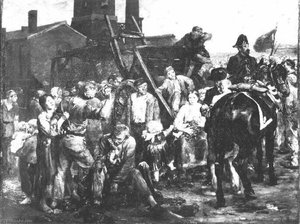
As the decades progressed, Roll’s brushwork began to shed its romanticized edges, embracing instead the grit and truth of the Naturalist movement. He became a painter of the people, turning his attention toward the socio-political dynamics of the Third Republic. This evolution was not merely stylistic but deeply ideological. He sought to document the authentic human experience, particularly the struggles and triumphs of the working class. His landmark painting, Miners’ Strike (1880), remains one of his most significant achievements, catapulting him into the upper echelons of the French art world. In this work, he did not merely depict labor unrest; he humanized the struggle, imbuing the figures with a dignity that resonated far beyond the gallery walls.

This commitment to social realism allowed Roll to navigate the complexities of his era with remarkable dexterity. His repertoire expanded to include:

  • Urban Landscapes: Meticulous depictions of Parisian life and the changing face of the city.
  • Intimate Portraits: Studies that reflected the nuances of bourgeois and working-class identities.
  • Social Narratives: Large-scale compositions that addressed contemporary political and social issues.

His ability to blend the technical precision learned from his academic mentors with a progressive, almost documentary-like approach to subject matter made him a vital voice in French art. He was not just an observer of life but a chronicler of its most pressing transformations.

Legacy and Historical Significance

Alfred Philippe Roll’s legacy is defined by his role as a bridge between the old world of academic tradition and the new world of social engagement. As a co-founder of the Société Nationale des Beaux-Arts, he played a crucial part in reshaping the institutional landscape of French art, advocating for a space where diverse styles could coexist. His work remains a vital historical record, capturing the essence of a France caught between the echoes of romanticism and the stark realities of industrialization and social reform.

Through his mastery of light, texture, and composition, Roll ensured that the struggles and the beauty of everyday life were immortalized. Whether through the sweeping vistas of the Champagne region or the somber tones of a labor strike, his art continues to invite viewers into a profound dialogue with the past. He remains a significant figure for anyone seeking to understand the heartbeat of 19th-century France—an artist who looked at the world not just as it appeared, but as it was felt.