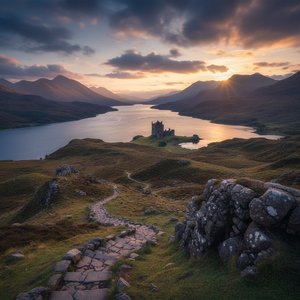
Introduction There is a profound, almost spiritual silence that resides within the peaks of our world. To look upon a mountain is to confront the eternal; it is to witness the earth’s most ambitious reach toward the heavens. Throughout history, artis...
To look upon a mountain range is to witness something eternal, a silent sentinel that has watched the passage of centuries with unshakeable grace. In the rugged expanse of the Scottish Highlands, this encounter becomes particularly profound. Here, the earth reaches upward with an ambition that feels both heavy and spiritual. For much of art history, the depiction of such terrain was not merely about recording topography or marking the location of a peak like Ben Nevis; it was an attempt to capture the sublime—that specific, unsettling intersection where beauty meets a sense of overwhelming grandeur.
This pursuit of the infinite finds a historical echo in the ancient Chinese shan shui tradition. In those East Asian landscapes, mountains were not viewed as mere geological formations but as the very breath of the universe, often inhabited by spirits and shrouded in philosophical depth. While the Western approach eventually moved toward the dramatic tension of the Romantic era, the fundamental impulse remains the same: to use the scale of the landscape to reflect the scale of the human soul. When we stand before a painting of a Highland glen, we are not just looking at stone and water; we are confronting our own smallness within the vastness of the natural world.
Shadows of Romanticism: The Dramatic Visions of Paul Gustave Doré
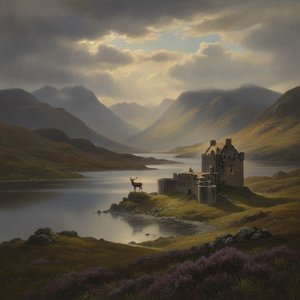
A Dramatic Vision of the Scottish Highlands This magnificent oil painting, “Scottish Highlands,” transports the viewer directly into the heart of a landscape forged by both raw power and serene beauty. Executed in 1875 by the renowned artist Paul Gus...
The late eighteenth and nineteenth centuries brought a shift in how we perceive the wild. As the Industrial Revolution began to reshape the lowlands, the Romantic movement sought refuge in the untamed and the mysterious. Artists like Paul Gustave Doré captured this tension with remarkable intensity. In his 1875 work, Scottish Highlands, the landscape is far from a passive subject. Instead, it is a dramatic vision where a brooding sky and a vast, reflective lake command the viewer's attention.
This era of painting finds its roots in the earlier fascination with the exotic and the unknown. Just as the Romantics looked back to an idealized past of chivalry and organic connection to nature, Doré used his mastery of light and shadow to create a sense of movement and dynamism. His technique, characterized by strong diagonal perspectives, draws the eye deep into the mountains, emphasizing a scale that feels almost overwhelming. It is a deliberate departure from mere documentation, moving instead toward an exploration of humanity's relationship with forces far beyond our control.
Atmospheric Truths: The Art of Mist, Light, and Shadow
A Scottish Visionary: The Life and Art of Horatio McCulloch Horatio McCulloch, born in Glasgow in 1805, stands as Scotland’s most celebrated landscape painter—a figure who eloquently captured the nation's wild beauty during a period of profound chang...
The true character of the Highlands is found not in the solid granite of its peaks, but in the ephemeral qualities that drift between them. The mist that clings to a lonely glen or the way light filters through a heavy cloud defines the region's emotional weight. Painters such as Horatio McCulloch, born in Glasgow, dedicated their lives to translating these fleeting atmospheric effects onto canvas. His work does not simply show what the Highlands look like; it conveys how they feel during a moment of profound stillness or approaching storm.
This focus on atmosphere finds a parallel in the meticulous studies of light seen in the works of later masters. Much like the way Samuel Bough embraced the raw, often melancholic power of the Scottish landscape to capture the golden glow of autumn or the damp chill of a misty morning, the great Romantic painters understood that weather is an essential element of composition. By building up layers of pigment, these artists created luminous surfaces that mimic the very texture of the air. The use of light and shadow becomes a tool for depth, allowing the viewer to sense the distance between a foregrounded rock and a far-off, shrouded summit.
Echoes of the Glens: Landscape as a Vessel for History
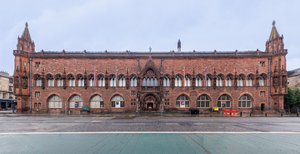
Scottish National Portrait Gallery Edinburgh’s skyline is punctuated by architectural statements, but few possess the narrative weight and sheer romantic presence of the Scottish National Portrait Gallery. More than just a repository for painted face...
Every valley in the Highlands carries the weight of its own narrative. Places like Glencoe, often referred to as the "Weeping Glen," are etched with histories of clan struggles and profound loss. To paint these landscapes is to engage with a living chronicle of Scotland. The landscape serves as a repository for memory, where the ruins of old structures or the very shape of a mountain range whisper tales of the Jacobite risings and the subsequent shifts in Highland life.
This layering of history onto geography mirrors the way portrait galleries, such as the Scottish National Portrait Gallery in Edinburgh, function as chronicles of a nation. Just as a portrait captures the essence of an individual within their era, a landscape painting captures the spirit of a place through its historical scars and triumphs. The mountains are not silent; they are witnesses. When we observe the subtle variations in color and texture in a well-executed oil painting, we are seeing more than just earth; we are seeing the enduring presence of a culture that has survived through centuries of change.
The Enduring Presence: Bringing Highland Majesty into the Modern Home
In our contemporary, fast-paced world, the stillness found within these painted landscapes offers a necessary sanctuary. As our lives become increasingly defined by digital abstraction and urban density, the rugged textures of a mountain scene provide a window into a more permanent reality. Bringing such works into a living space is an act of intentionality—a way to anchor a room with the strength and peace of the natural world.
This desire for connection to the earth is not new; it is a continuation of the long-standing human need for stability. Just as the builders of Gothic Revival structures used stone to evoke medieval grandeur, we use art to create environments of depth and contemplation. Whether through a large-scale oil reproduction that captures the heavy impasto of a mountain ridge or a delicate study of light on a loch, these pieces allow us to invite the restorative power of the outdoors into our private sanctuaries. At OriginalUniqueArt.com, we believe that every home deserves a piece of this enduring majesty, providing a sense of calm and a connection to the eternal.
Explore the captivating world of Horatio McCulloch, Scotland’s premier landscape painter. Discover his Romantic masterpieces, spiritual themes & lasting impact on Scottish art history at OriginalUniqueArt.
Explore the profound beauty of the Scottish Highlands through the lens of Romanticism. Discover the history, technique, and atmospheric mastery behind iconic landscape paintings from the Old Masters to museum-quality oil reproductions for collectors.

 Peak Inspiration: 10 Breathtaking Artworks That Capture the Majesty of Mountains
 Scottish Highlands
 Horatio McCulloch
 Scottish National Portrait Gallery