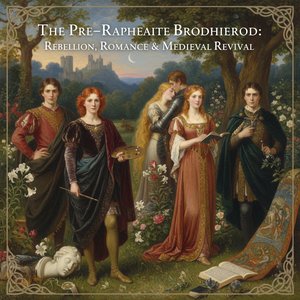
The Soul of Romanticism: A Rebellion of Emotion and Individualism
Romanticism championed emotion, imagination, individualism, and the subjective experience.
To understand the profound allure of Romantic illustration, one must first look back to the late 18th century, an era when the rigid, clinical logic of the Enlightenment began to falter under the weight of its own rationalism. As the Industrial Revolution cast its soot-stained shadows across Europe, a new intellectual and artistic movement emerged—not as a mere stylistic shift, but as a profound rebellion of the human spirit. Romanticism was born from a desperate, beautiful necessity to reclaim the primacy of subjectivity, imagination, and the raw, unadulterated power of emotion.
Where the previous age sought to categorize and control the world through science and empirical observation, the Romantics sought to feel it. They rejected the cold didacticism of their predecessors in favor of a moral outlook rooted in individualism. For the Romantic artist, truth was not found in a mathematical formula, but in the intuitive pulse of passion and the haunting depths of the human psyche. This era championed the idea that beauty is far more than an affair of form; it is a visceral experience that evokes a strong, often overwhelming, emotional response from the observer.
This movement fundamentally altered the trajectory of Western art, moving away from the pursuit of visible reality toward the exploration of the invisible. It embraced the irrational, the dreamlike, and the intensely personal, creating a sanctuary for those who found the encroaching mechanical world too sterile. In doing so, it laid the groundwork for a visual language that celebrates the intensity of human feeling, ensuring that art would forever remain a vessel for the soul's most profound mysteries.
The Sublime and the Natural World: Capturing Grandeur through Landscape
Along with plumbing emotional and behavioral extremes, Romantic artists expanded the repertoire of subject matter, rejecting the didacticism of ...
At the heart of the Romantic aesthetic lies an almost spiritual reverence for the natural world. To the Romanticist, nature was not merely a backdrop or a resource to be harnessed; it was a living, breathing entity, often possessing a terrifying and magnificent power known as the sublime. This concept—the intersection of awe and terror—became the quintessential subject of the era's most evocative landscapes. Artists sought to capture those moments when the human presence is dwarfed by the infinite scale of mountains, the churning fury of oceans, or the ethereal mystery of a fog-drenched valley.
Consider the works that define this period, where the landscape serves as a mirror for the internal human condition. The interplay of light and shadow, the dramatic tension of a storm brewing on the horizon, and the quiet, haunting stillness of a twilight forest all serve to evoke a sense of cosmic grandeur. These illustrations did not merely depict scenery; they invited the viewer to contemplate their own place within the vast, uncontrollable machinery of the universe. The natural world became a stage for the drama of existence, where every jagged peak and swirling cloud whispered of the eternal and the divine.
This fascination with nature was also a poignant response to the environmental degradation brought about by rapid industrialization. As cities expanded and forests receded, the Romantic landscape functioned as a nostalgic refuge—a longing for an organic, untamed world that felt increasingly out of reach. Through their brushes, artists preserved a vision of a wilder, more primordial earth, imbuing their works with a sense of sanctity that continues to resonate with those who seek solace in the beauty of the natural landscape.
Technological Renaissance: The Golden Age of Victorian Narrative Illustration
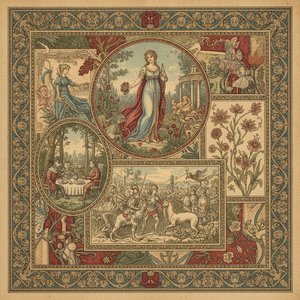 Victorian Illustration: The Golden Age of Narrative Art and Intricate Detail
The Rise of the Golden Age: Technological Innovation and the Printing Revolution To understand the breathtaking complexity of Victorian illustration, one must first look toward the industrial heartbeat of the nineteenth century. This was an era defin...
As we transition into the mid-19th century, the Romantic spirit found a new and powerful medium through the advancements of the Victorian era. This period witnessed a breathtaking paradox: while the rhythmic, relentless pulse of the Industrial Revolution accelerated technological progress, it simultaneously fueled a profound yearning for the organic and the whimsical. The advent of sophisticated printing technologies, particularly improvements in wood engraving and the development of color lithography, acted as the catalyst for what historians now celebrate as the Golden Age of Illustration.
This was an era of unprecedented accessibility. Art, once the exclusive domain of the wealthy and confined to private galleries, began to permeate the everyday lives of a burgeoning middle class. The rise of periodicals like The Illustrated London News and The Graphic transformed how history was documented and perceived. These publications were not merely conveyors of information; they were masters of visual storytelling, bringing the drama of battlefields, the splendor of royal ceremonies, and the intimate details of daily life directly into the homes of millions. The ability to reproduce intricate, high-quality imagery at scale meant that a single illustration could shape the public consciousness of an entire empire.
The technological revolution also birtated a new market for narrative art, from beautifully illustrated "toy books" for children to lavishly decorated gift books for adults. This era saw the birth of a sophisticated visual culture where the precision of new mechanical capabilities met a deep, nostalgic reverence for detail. The result was a shimmering contradiction—a period where the machine enabled the most delicate and soulful expressions of human imagination, creating a legacy of narrative art that remains unparalleled in its complexity and charm.
Masters of the Line: Exploring Intricate Detail and Pre-Raphaelite Influence
 emma florence harrison
A Life Unveiled: The Art of Florence Harrison For decades, the name Florence Harrison graced the pages of beloved children’s books and illuminated collections of classic poetry, her delicate watercolors evoking a world steeped in Pre-Raphaelite roman...
Within this Golden Age, certain artistic lineages emerged that would redefine the boundaries of illustrative beauty. The Pre-Raphaelite Brotherhood, founded in 1848, stood as a rebellious vanguard, rejecting the academic conventions of their time in favor of a return to the intense detail and luminous color found in Italian art prior to Raphael. Their influence on illustration was profound, infusing it with a sense of medieval romance, botanical accuracy, and an almost ethereal grace.
The work of illustrators like Florence Harrison exemplifies this exquisite aesthetic. Her delicate watercolors, often adorning the pages of classic poetry, evoked a world steeped in Pre-Raphaelite elegance and Art Nouveau fluidity. Such artists did not merely accompany a text; they became its visual embodiment. Every floral motif, every meticulously rendered figure, and every soft, light-drenched scene was designed to deepen the emotional resonance of the written word. This commitment to meticulous detail and symbolic depth turned the act of reading into a multi-sensaturated experience of beauty.
Furthermore, the era's illustrators mastered the art of the "intricate line," using the medium of engraving to create textures that felt almost tactile. Whether it was the whimsical charm of Kate Greenaway’s seasonal scenes or the vibrant, storytelling power of Walter Crane’s works, there was a shared dedication to craftsmanship. These artists understood that in an age of increasing mass production, the value of the hand-drawn, the carefully composed, and the deeply personal was more vital than ever. They provided a visual anchor of refinement and virtue in a rapidly changing world.
Legacy of the Illustrators: From Periodicals to the Modern Collector's Eye
 The Illustrated London News Company
The Chronicle in Pictures: The Illustrated London News Company The story of the Illustrated London News Company isn't simply a tale of an art publisher; it’s a reflection of Victorian England itself, a period defined by rapid technological advancemen...
The enduring power of Romantic and Victorian illustration lies in its ability to transcend time, offering a window into an era of profound psychological and social complexity. The themes established by these masters—the celebration of individualism, the reverence for nature, and the pursuit of emotional truth—remain as relevant today as they were in the 19th century. We see their legacy in the continued fascination with narrative art and the modern collector's desire for pieces that possess a "soul"—works that offer more than mere decoration.
Today, the appreciation for this era has found a new home in the world of fine art reproductions and bespoke commissions. For the discerning connoisseur, owning a piece that captures the essence of the Romantic spirit is an act of preserving history. Whether it is a large-scale oil reproduction of a sweeping landscape or a custom portrait reimagined in a classical style, these works bring the grandeur and emotional depth of the past into contemporary living spaces. The craftsmanship required to replicate the visible brushstrokes and rich tonal ranges of the masters ensures that the tactile magic of the original era is never lost.
At OriginalUniqueArt.com, we honor this magnificent heritage by bridging the gap between historical mastery and modern luxury. We specialize in the creation of museum-quality, hand-painted oil reproductions that capture the very essence of the Romantic and Victorian eras. Our artists, trained in the finest academic traditions, work meticulously on 100% cotton canvas to ensure every stroke reflects the passion and precision of the masters. From custom "period shifts" to large-format architectural murals, we provide a service for those who seek to surround themselves with art that does not merely occupy a wall, but tells a story of eternal beauty and profound emotion.