--- title: The Hudson River School - The Metropolitan Museum of Art author: Kevin J Avery url: https://www.metmuseum.org/essays/the-hudson-river-school hostname: metmuseum.org description: Though the earliest references to the term “Hudson River Scho...
The story of American landscape painting finds its true beginning not in a studio, but on the banks of the Hudson River. In 1825, an artist named Thomas Cole arrived in New York City from the western territories of Ohio and Pennsylvania. Before he became the central figure of a movement, Cole worked as an itinerant portrait painter, a job that required him to move frequently through the rugged landscapes of the American frontier. His arrival coincided with a moment of profound change in the region, as new tourist hotels began opening in the Catskill Mountains, just 100 miles upriver from the city.
This shift toward organized exploration allowed Cole to undertake sketching expeditions that would change the course of American art. He did not merely observe the scenery; he looked for a way to translate the raw, uncultivated terrain into a visual language that could command respect on the global stage. His early success was almost accidental, occurring when his sketches were spotted in a bookstore window by influential artists, leading to commissions that brought him instant recognition.
This period of discovery mirrors the broader expansion of the American frontier during the nineteenth century. Just as Cole moved from the settled areas of Pennsylvania into the wilder Catskills to find his subject, the United States was simultaneously pushing its borders westward. The act of sketching these unknown territories was a precursor to the larger cultural project of mapping and claiming the continent through art.
The Aesthetic of Awe: Translating the Sublime to American Soil
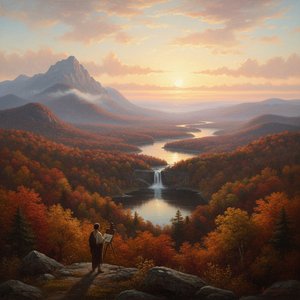
To understand the impact of this group of painters, one must understand the concept of the Sublime. This British aesthetic theory focused on the feeling of awe mixed with a certain level of fear when confronted by the overwhelming power of nature. While European artists had used the Sublime to depict ancient ruins or mythological storms, Cole and his followers applied it to the American wilderness. They sought to capture the scale of mountains and the ferocity of storms to show that the New World possessed a spiritual intensity equal to any Old World site.
The technique required for such works was vigorous and dramatic. Painters like Frederic Edwin Church, a student of Cole, pushed these boundaries even further, using light and massive compositions to document far-reaching landscapes. They utilized detailed naturalism—a precise way of painting plants and geological formations—to ground their more dramatic, idealized visions in reality. This balance allowed the viewer to believe in the physical truth of the scene while feeling its spiritual weight.
We see a similar tension today in how we interact with the natural world through photography and film. We use high-definition technology to capture the immense scale of glaciers or volcanic eruptions, seeking that same sense of smallness in the face of something much larger than ourselves. The desire to witness the overwhelming power of nature remains a constant human impulse, even as our tools for viewing it have changed.
Forging a National Identity through the Wilderness
By the mid-nineteenth century, landscape painting had become more than an aesthetic choice; it was a tool for nation-building. As the United States sought to establish its own cultural identity apart from Europe, the landscape provided the perfect subject. There were no ancient cathedrals or Roman ruins in the American West to provide a sense of history, so artists looked to the forests and rivers instead. They presented the wilderness as a source of spiritual renewal and a symbol of the nation's potential.
This vision was supported by contemporary literature, most notably the "Leatherstocking Tales" by James Fenimore Cooper. His stories of frontiersmen like Natty Bumppo provided a narrative framework that matched the visual grandeur of the paintings. The landscape became a character in its own right, representing a pure, untouched past that could define the American spirit. This was a period where the physical environment and the concept of national destiny were viewed as inseparable.
This connection between land and identity echoes the political rhetoric of the era, such as the speeches of DeWitt Clinton, who championed the Erie Canal. He argued that a Republican government provided the ideal soil for the cultivation of fine arts because nature had conducted her operations on such a magnificent scale in America. The expansion of the landscape was, quite literally, the expansion of the nation's soul.
Beyond the River: Expanding the American Horizon
As the mid-century approached, the focus of these artists began to shift outward from the Hudson River Valley. While the Catskills and the Adirondacks remained foundational subjects, the hunger for new, expansive vistas led painters like Albert Bierstadt to seek inspiration in the Far West, South America, and even the far North. The scope of their work grew alongside the territorial expansion of the United States, documenting the vastness of a continent that seemed to have no end.
This era of exploration was often accompanied by a sense of documentation. The artists were not just painters; they were visual explorers providing the public with glimpses of territories that few had ever seen. Their works functioned as windows into a growing empire, bringing the grandeur of the Rocky Mountains or the jungles of the South to the galleries of New York City.
This movement toward the horizon finds a parallel in the history of scientific exploration. Just as the painters traveled to document the beauty of new lands, naturalists and geologists were mapping the biological and physical realities of these same regions. Both groups were driven by a need to categorize and understand the vastness of the newly accessible world, turning the unknown into something known and recorded.
A Community of Visionaries: The New York Artistic Circle
The Hudson River School was not merely a collection of individual talents but a cohesive social and professional fraternity. Based primarily in New York City, many of these artists were members of the same clubs, such as the Century Club, and some even shared workspace in the Studio Building on West Tenth Street. This was the first purpose-built artist workspace in the city, providing a physical center for their shared ideas and stylistic developments.
Leadership within this group was often defined by institutional roles. After Cole’s death in 1848, Asher B. Durand took up the mantle of leadership, eventually becoming the president of the National Academy of Design. He published influential writings that codified the standards of naturalism that would define the school's production. This organized structure allowed for a consistent movement of ideas, ensuring that the "American" style could be taught and passed down to subsequent generations.
This level of professional organization is something we recognize in the modern art world through specialized academies and curated collections. The way these nineteenth-century artists built a community around a shared subject mirrors how contemporary movements form around specific technological or social themes. They understood that for an artistic vision to endure, it required both individual brilliance and a collective institutional foundation.
The Enduring Legacy of the American Landscape
While the peak of the Hudson River School passed following the Civil War, its influence on the perception of the American landscape remains profound. The movement successfully established a national school of painting that could compete with the long-standing traditions of Europe. They transformed the way people viewed their own environment, turning "provincial" scenery into something worthy of high art and national pride.
Today, when we look at a large-scale landscape or a detailed botanical study, we are seeing the echoes of the standards set by Cole, Church, and Durand. Their ability to blend scientific observation with emotional depth created a blueprint for how nature can be interpreted through art. They taught us that the land is not just a resource to be used, but a narrative to be read.
In our modern era, we continue to seek out these connections to the earth. Whether through the preservation of national parks or the collection of fine art reproductions in our homes, the impulse to surround ourselves with the beauty of the natural world remains unchanged. The Hudson River School reminds us that the landscapes we inhabit are the very foundation of the stories we tell about ourselves.
Explore the profound legacy of American Masterpieces. From the sublime landscapes of the Hudson River School to dignified 19th-century portraits, discover the art that defined a nation's soul through expert historical analysis and museum-quality oil reproductions.
Delve into the breathtaking world of the Hudson River School. Our expert guide explores how 19th-century masters captured the sublime majesty of the American wilderness through Romanticism and unparalleled landscape artistry. A must-read for fine art enthusiasts.
Explore the captivating world of the Hudson River School! Discover the history, artists, and defining characteristics of this iconic American art movement. Learn about Romanticism's influence & find inspiration for your collection.