The Dawn of an American Vision: Origins of the Hudson River School
In the mid-19th century, a young and burgeoning nation found itself searching for a visual language that could articulate its unique identity, separate from the storied traditions of Europe. While the Old World looked to classical ruins and ancient mythologies, the American spirit turned its gaze toward the primordial landscapes of its own continent. This movement, which would become known as the Hudson River School, emerged not merely as a collection of landscape painters, but as a profound cultural awakening. The vast, untamed territories of the Hudson River Valley and beyond served as a canvas upon which artists could project the hopes, fears, and burgeoning pride of a people witnessing the birth of a wilderness empire. It was a period where the very earth beneath their feet became the primary subject of artistic inquiry, transforming the rugged topography into a source of national inspiration.
Embracing the Sublime: Romanticism and the Divine Presence in Nature
At the heart of this movement lay the powerful philosophical currents of Romanticism, particularly the concept of the Sublime. To the artists of this era, nature was far more than a scenic backdrop; it was a living, breathing manifestation of the divine. The Sublime represented that breathtaking intersection of awe and terror—a moment when the viewer is confronted by the overwhelming scale and untamable power of the natural world. Through their brushes, painters sought to capture the ephemeral light filtering through ancient canopies and the monolithic presence of mountain ranges that seemed to touch the heavens. This was a spiritual pursuit, an attempt to find traces of the Creator within the mist-shrouded valleys and the crashing waterfalls. By emphasizing the vastness and the unpredictable energy of the landscape, these artists invited their audience into a state of transcendental contemplation, where the boundaries between the human soul and the infinite universe began to dissolve.
Architects of the Wilderness: The Foundational Mastery of Thomas Cole
No figure looms larger over this movement than Thomas Cole, the visionary architect of the Hudson River School. Often regarded as the movement's progenitor, Cole brought a dramatic intensity to his compositions that challenged the conventional landscape traditions of his time. His works, such as his iconic monochrome mountain scenes, utilized deep textures and powerful compositions to explore the tension between civilization and the wild. In his hands, the landscape became a stage for moral and historical allegory. He masterfully depicted the struggle of progress against the encroating wilderness, using the ruggedness of the terrain to symbolize the strength and resilience required of a new nation. Cole’s ability to infuse a single mountain scene with profound depth and narrative weight laid the groundwork for generations of American artists to follow, establishing a standard of excellence that blended technical precision with deep emotional resonance.
Luminosity and Grandeur: Technical Brilliance in Landscape Composition
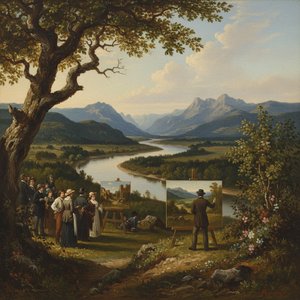
The enduring allure of the Hudson River School lies heavily in its technical brilliance, specifically in the mastery of light and atmosphere. Artists of this period were obsessed with luminosity—the ability to capture the precise moment when sunlight transforms a landscape from ordinary to extraordinary. This required an incredible command of color theory and oil application. Consider the serene beauty found in works like Daniel Huntington’s 'Late Afternoon on the Susquehanna', where the masterful realism of light and shadow creates a sense of profound peace and stillness. The artists employed meticulous layering techniques to build up a three-dimensional texture, allowing the canvas to reflect the actual movement of light across water or through clouds. This focus on atmospheric perspective—the way distance softens colors and blurs edges—created an illusion of immense space, drawing the viewer deep into the heart of the American wilderness and making the grandeur of the landscape feel tangibly real.
A Lasting Legacy: How the Hudson River School Shaped American Identity
The legacy of the Hudson River School extends far beyond the museum walls; it fundamentally shaped how Americans perceive their land and their place within it. The movement instilled a sense of stewardship and reverence for the natural world that continues to resonate in our modern environmental consciousness. These paintings did more than document scenery; they constructed a national mythology, turning the rugged terrain into a sacred heritage. Today, as we look back upon these masterpieces, we see the echoes of that original American vision—a vision of strength, beauty, and infinite possibility. At OriginalUniqueArt.com, we are honored to preserve this magnificent legacy, offering meticulously handcrafted oil reproductions that allow the spirit and tactile depth of these historical treasures to find a permanent home in the contemporary world, ensuring that the majesty of the American wilderness remains an eternal source of inspiration.