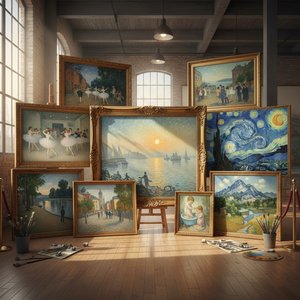
The Domestic Sanctuary: Reclaiming Nature Within the Home
There is a particular quietude found in the corner of a room where a single, well-tended plant rests against the morning light. It is a small, contained victory over the distance that often grows between our modern lives and the natural world. To bring greenery indoors is to invite a living pulse into our private spaces, creating a sanctuary that breathes alongside us. This impulse to cultivate life within walls is not a new desire, but one that has long anchored the human spirit.
Long before the Impressionists sought to capture the dappled light of Giverny, the very foundations of art were built upon this reverence for the domestic and the natural. In ancient Egyptian tomb paintings, food and botanical elements were depicted with a profound intention: they were believed to become real in the afterlife, providing eternal sustenance for the deceased. This early belief mirrors our own modern attempt to sustain life within our homes, bridging the gap between the physical room we inhabit and the enduring vitality of the earth. Today, when we tend to a Snake Plant or a Peace Lily, we are participating in an ancient ritual of preservation and connection.
Luminous Foliage: The Interative of Light and Leaf
Flowers in a Vase: An Impressionist Still Life Embodied Pierre-Auguste Renoir’s “Flowers in a Vase” stands as a testament to the enduring beauty of simplicity and the transformative power of light—a cornerstone of Impressionism that continues to reso...
The true magic of indoor greenery reveals itself not through the plant itself, but through the way it interacts with the light filtering through a window. An Impressionist painter understands that a leaf is never merely green; it is a surface for the dance of shadows and sunbeams. When light hits the waxy skin of a Rubber Plant or the translucent petal of a Begonia, it creates a spectrum of shifting tones—from deep, cool emeralds to pale, sun-bleached yellows.
This fascination with the movement of light finds its historical echo in the works of Pierre-Auguste Renoir. In his 1901 work, Flowers in a Vase, he does not simply document blossoms; he captures the way light dissolves form and creates an atmosphere of soft, shimmering emotion. He used short, broken dashes of pigment to mimic the effect of light filtering through foliage, much like how we observe the dappled patterns cast by a Fern in our own living rooms. To look at a plant in the afternoon sun is to see a living version of Renoir’s technique, where color changes with every passing hour, reminding us that even the most stationary object is in a state of constant, luminous flux.
Transient Beauty: From Vanitas Symbolism to Impressionist Joy
A Meditation on Mortality and Light In the quiet realm of William Merritt Chase’s Fish Still Life , time seems to suspend itself, inviting the viewer into a profound contemplation of existence. Painted around 1890, this oil on canvas is far more than...
There is a delicate tension in every potted plant—a beauty that is inseparable from its fragility. We tend to them because we know they are ephemeral; we water our succulents and prune our Geraniums with an awareness of the passing seasons. This awareness of transience has been a central theme in Western art for centuries, often expressed through the heavy, somber lens of the vanitas tradition.
In the 17th-century Dutch paintings of artists like Adriaen van der Kabel, still lifes often featured symbols of mortality, such as the skull or decaying fruit, to remind the viewer of the inevitability of death. While these works were heavy with moralizing messages, the Impressionists shifted this perspective toward a celebration of the present moment. In William Merritt Chase’s Fish Still Life, we see a similar theme of mortality through the presence of a fish, yet the execution is bathed in the light and vitality of American Impressionism. The focus moved from the dread of decay to the appreciation of life's fleeting, beautiful instances. We find this same balance today when we care for our indoor herbs; we acknowledge their seasonal cycles while finding joy in the immediate, fragrant reality of a Basil or Mint plant.
Tactile Greenery: Exploring Form through Brushstroke and Bloom
Subject and Composition This captivating still life masterfully captures a simple yet evocative scene filled with everyday objects that resonate with warmth and familiarity. At its center, a white dish holds plump, vibrant oranges and a lemon, their ...
To truly appreciate a plant, one must engage with its texture. There is a profound difference between the smooth, leathery surface of a Jade plant and the soft, feathery fronds of a fern. This tactile variety provides a sensory richness to an interior space, much like the varied textures found in a well-composed painting. The way an artist uses paint to mimic these surfaces is where the soul of the medium resides.
This mastery of texture is evident in the work of Paul Cézanne, particularly in Still Life with Milk Jug and Fruit. Created around 1900, this work demonstrates his ability to use impasto and expressive brushwork to give weight and substance to organic forms. He sought to explore the underlying geometric structures of nature, making the fruit feel tactile and real. We experience a similar tactile engagement when we choose our planters—the heavy, cool weight of a clay pot versus the light, smooth surface of plastic. Each choice adds a layer of physical depth to our environment, much like Cézanne’s layers of pigment add depth to his canvas.
Contained Wildness: The Art of the Potted Specimen
A Living Chronicle of Botanical Artistry Nestled within the historic heart of Cambridge, the Cambridge University Botanic Garden serves as much more than a mere horticultural display; it is a living, breathing masterpiece where scientific inquiry mee...
The act of potting a plant is an exercise in composition. There is a structural logic to a healthy planter, often described by gardeners as the balance of a "thriller, filler, and spiller." An upright, dramatic plant serves as the focal point, while smaller textures fill the gaps, and low-growing vines cascade over the edges. This intentional arrangement creates a sense of harmony and completeness within a single vessel.
This principle of structured beauty finds its parallel in the architectural precision of the Cambridge University Botanic Garden. While the garden is vast, its design relies on a systematic approach, grouping species by evolutionary relationships to create a rhythmic flow of texture and color. It is a large-scale version of the small-scale composition we perform on our windowsills. Whether it is a grand landscape or a single pot of California Fuchsia, the goal remains the same: to find order within the wildness of nature and to present it in a way that invites contemplation.
A Living Chronicle: The Evolution of Botanical Observation
Introduction To step into the world of Marianne North is to embark on a voyage through time and geography, guided by a hand that refused to be tethered by the domestic expectations of the Victorian era. Her work does not merely depict plants; it brea...
Our relationship with botanical subjects has evolved from scientific documentation to emotional expression. In the Victorian era, artists like Marianne North traveled the globe to create meticulous records of biodiversity. Her paintings, found in the Marianne North Gallery at Kew Gardens, are vibrant chronicles of plants in their natural habitats, capturing the humidity of rainforests and the sun-drenched warmth of the Australian bush.
While North’s work was rooted in a mission to record, the Impressionists moved toward a mission to feel. They were less concerned with the exact botanical classification and more interested in the sensory experience of the plant. This evolution reflects our own changing relationship with nature; we no longer look at plants merely as specimens to be studied, but as essential companions in our domestic lives. As we tend to our indoor gardens, we are part of this ongoing history—a living, breathing lineage of observers who find meaning in the simple, enduring beauty of a leaf.
At OriginalUniqueArt.com, we celebrate this enduring connection between art and the natural world. Whether through our hand-painted oil reproductions that capture the light of Renoir or custom commissions that bring your own botanical memories to life, we invite you to continue this beautiful tradition of finding wonder in the everyday.
Embark on a global journey through the vibrant botanical landscapes of Marianne North. Explore 25 iconic Victorian masterpieces, from lush tropical flora to rare scientific illustrations. Find museum-quality art reproductions and decor inspiration. Discover all masterpieces on OriginalUniqueArt.com.
Explore the exquisite world of botanical realism. From scientific precision to Impressionist light, discover how master artists capture nature's true essence through timeless, hand-painted oil reproductions and historical insights for the discerning art lover.
Discover how to harmonize your home with the luminous beauty of Impressionist art. Our expert guide explores color theory, light, and texture to help you curate a sophisticated, tranquil interior using timeless masterpieces and custom oil reproductions.
Journey through Impressionism's golden age! Explore 10 masterpieces by Monet, Renoir & Degas that redefined art. Discover the stories behind these iconic paintings and find museum-quality reproductions to elevate your home decor on OriginalUniqueArt.com.

 Flowers in a Vase
 Fish Still Life (also known as Still LIfe - Fish and Big Bowl, Still LIfe - Striped Bass)
 Still Life with Milk Jug and Fruit
 Cambridge University Botanic Garden
 Nature Unbound: The Top 25 Masterpieces by Victorian Explorer Marianne North